At least 46 people have been confirmed dead following a Uganda highway collision involving two long-distance passenger buses that crashed head-on along the Kampala-Gulu Highway overnight.
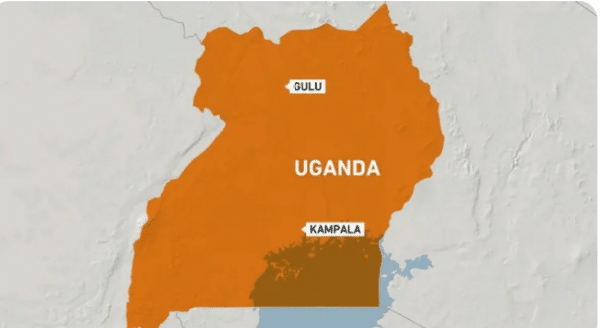
The tragic crash occurred shortly after midnight near the central-northern district of Kiryandongo, about 263 kilometres from Kampala, when both buses attempted to overtake at high speed.
Police reports indicate that each bus was trying to pass a slower vehicle — one a truck and the other a small car — when the collision happened.
“In the process, both buses met head-on during the overtaking manoeuvres,” the Uganda Police Force said in an official statement posted on X, formerly known as Twitter.
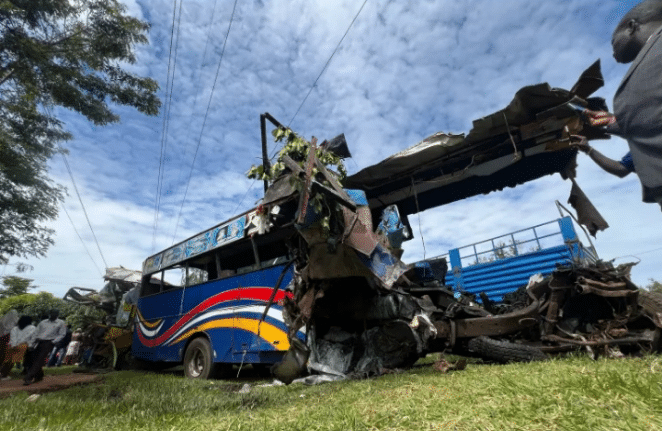
Authorities initially feared 63 people were dead, but the number was later revised down to 46 after rescuers found several victims alive but unconscious.
Police said the Uganda highway collision remains under investigation, adding that poor visibility, driver recklessness, and fatigue may have contributed to the deadly impact that destroyed both vehicles.
Fred Enanga, police spokesperson, warned that “careless overtaking is a leading killer on our roads. Drivers must value lives over speed and impatience.”
The crash site, near the town of Kiryandongo, was littered with twisted metal, shattered glass, and luggage scattered across the tarmac — a haunting scene of destruction.
Eyewitness James Owor, who arrived minutes after the Kampala-Gulu Highway accident, said, “The noise was deafening. People were trapped and screaming. It was chaos everywhere.”
Emergency responders from the Red Cross and local police rushed to rescue survivors, pulling bodies from the wreckage through the night and into early morning.
“The magnitude of this incident is so big,” said Irene Nakasiita, a spokesperson for the Uganda Red Cross. “Our teams worked under extreme pressure to save lives.”
Nakasiita described the tragedy as one of the most horrific she had seen, adding that “many victims had broken limbs, head injuries, and severe bleeding.”
The Uganda highway collision has reignited concerns over road safety enforcement in a country struggling with rising traffic deaths and poorly maintained transport infrastructure.
According to police data, Uganda traffic fatalities have steadily increased in recent years, with 5,144 deaths recorded in 2024, up from 4,806 in 2023 and 4,534 in 2022.
Experts say most of these Uganda road accidents involve commercial buses, motorcyclists, and poorly regulated heavy trucks that often operate with minimal safety checks or trained drivers.
Transport Minister Katumba Wamala described the Uganda highway collision as “a national tragedy” and promised stronger enforcement of traffic rules and stricter penalties for reckless drivers.
“This should never happen again,” he said. “We are reviewing night travel policies and considering limits on long-distance bus operations after dark.”
The Kampala-Gulu Highway accident occurred on one of Uganda’s busiest roads, connecting the capital to the country’s northern regions and serving as a vital trade and commuter route.
Many of those killed were travelling from Kampala to Gulu for family events and work commitments. Rescue workers said most victims were adults, though children were among the dead.
Kiryandongo General Hospital confirmed receiving 39 injured passengers, with eight in critical condition. “Some have severe fractures and internal injuries,” said Dr. Sam Opio, the hospital’s director.
The Kiryandongo bus crash shocked residents in the area, where large crowds gathered to assist rescuers and donate blood for survivors. “Everyone wanted to help,” said a local volunteer.
Police noted that both buses were registered under licensed companies, though investigators are examining whether vehicle inspections and driver rest schedules were properly followed.
The Uganda Police Force emphasized that initial evidence suggests both drivers were speeding in violation of highway regulations that limit overtaking in poorly lit stretches.
Uganda’s Transport Ministry has now ordered a full mechanical inspection of all long-distance buses, especially those operating on the Kampala-Gulu Highway, following the collision.
Ministry spokesperson Allan Ssempebwa said, “This tragedy underscores the urgent need for accountability in public transport. Safety must be prioritized over profit margins and speed.”
The Uganda highway collision has sparked nationwide mourning, with condolences pouring in from government officials, opposition leaders, and citizens horrified by the scale of the disaster.
Opposition figure Bobi Wine posted on X, “Our hearts are with the families affected by this terrible loss. Uganda must take serious steps to end such preventable deaths.”
Church leaders held prayer vigils across the country, urging the government to improve road lighting, signage, and driver education to reduce Uganda road accidents.
Father Paul Mwesigwa from Kiryandongo parish said, “This is not fate — it’s failure. Every life lost on our roads is a result of negligence we can correct.”
The Red Cross said the recovery process took several hours due to darkness and the remote nature of the crash site. Bulldozers were later brought in to clear debris.
“The images are too graphic to share publicly,” Nakasiita said. “We will focus now on helping survivors and supporting bereaved families through counselling and relief efforts.”
The Kiryandongo bus crash is not the first major tragedy in the region. In 2018, another bus accident in the same district killed 23 people under similar circumstances.
Authorities say such incidents continue because enforcement remains weak and many drivers ignore speed limits and road safety campaigns launched by the government.
Transport analyst David Ochieng said, “Without consistent penalties, road users won’t change behaviour. Uganda needs automated enforcement like speed cameras on major highways.”
The Uganda highway collision has renewed calls for stronger collaboration between police, transport unions, and the private sector to improve safety awareness among bus operators.
Meanwhile, grieving families have gathered in hospitals and mortuaries to identify loved ones. “I lost my sister and her two children,” said one relative tearfully. “They were returning home.”
Police have urged next of kin to report missing passengers to designated centres in Kiryandongo and Masindi, where recovered bodies are being documented for burial arrangements.
Uganda’s National Road Safety Council has described the disaster as “a wake-up call,” saying over 90 percent of crashes in Uganda stem from human error and poor discipline.
In a televised statement, the Council urged “drivers to remember that speed thrills but kills,” adding that every road user must play a role in preventing Uganda traffic fatalities.
Experts argue that government investment in safer road designs, enforcement technology, and public awareness is crucial to curbing the deadly trend of Uganda road accidents.
The Uganda highway collision also exposes gaps in emergency response systems, with critics noting delays in deploying ambulances and medical teams to crash sites.
Humanitarian organisations are now pressing for better coordination among first responders, calling the current system “under-resourced and reactive rather than proactive.”
International road safety groups have expressed condolences, with the African Transport Forum urging Uganda to adopt modern monitoring systems that automatically flag driver fatigue and speeding.
Police said investigations into the Kampala-Gulu Highway accident are ongoing, including examination of black box data from both buses and forensic analysis of brake systems.
As darkness falls on Kiryandongo, families continue to search for closure, lighting candles at the crash site where dozens lost their lives in the Uganda highway collision.
For many Ugandans, the tragedy has become a grim symbol of how everyday travel can suddenly turn fatal — and how urgently reform is needed to save lives.
About The Author