Trump’s Greenland Obsession – Donald Trump’s renewed focus on Greenland has sent ripples through the world of international football, raising concerns about the potential impact on the Trump Greenland World Cup 2026.
Senior officials at Fifa and Uefa are reportedly watching the situation closely, aware that any significant geopolitical developments could have direct consequences for the tournament.
While the 2026 World Cup is set to be the most lucrative in history, the looming tensions over Greenland have created a situation in which football and international politics are intersecting in unprecedented ways.
The scenario has placed Fifa president Gianni Infantino in an unusual position, as his relationship with Trump now appears central to navigating this complex situation.
No official statements have been issued by Fifa, and no formal meetings are publicly documented. Observers and football insiders are closely monitoring Gianni Infantino Trump relationship, recognizing that Infantino’s perceived closeness to the former US president may compromise Fifa’s long-standing reputation for political neutrality.
Traditionally, Fifa has maintained a distance from geopolitical matters to prevent conflicts from spilling over into the sport. However, the current circumstances are different.
The prospect of a United States intervention in Greenland, a territory under the Kingdom of Denmark, has raised concerns among European football federations, which now view the World Cup as a potential leverage point.
Several European officials have reportedly discussed the possibility of a Fifa World Cup boycott should the Greenland situation escalate. Political discussions in Germany and petitions in the Netherlands indicate that public opinion is beginning to influence national football associations.
While the idea of boycotting a global sporting event may have once seemed unthinkable, these developments demonstrate how the European football federation response could become a decisive factor in the weeks leading up to the tournament.
The prospect of a boycott reflects broader concerns about the ethical responsibilities of sporting organizations and their capacity to respond to international crises.
The 2026 World Cup, which will be hosted across the United States, Canada, and Mexico, represents a massive commercial and cultural investment.
Organizers anticipate record-breaking attendance, unprecedented sponsorship revenue, and global broadcasting deals. A boycott, however, could disrupt these plans, causing financial losses and diplomatic headaches for Fifa and the host nations.
Football authorities have emphasized that every scenario is being considered, from partial boycotts to full withdrawals by specific national teams.
The timing is particularly sensitive because the tournament is less than a year away, leaving little room for contingency planning.
Infantino has often highlighted football’s role as a unifying force, suggesting that the World Cup has the capacity to bring people together regardless of political divisions.
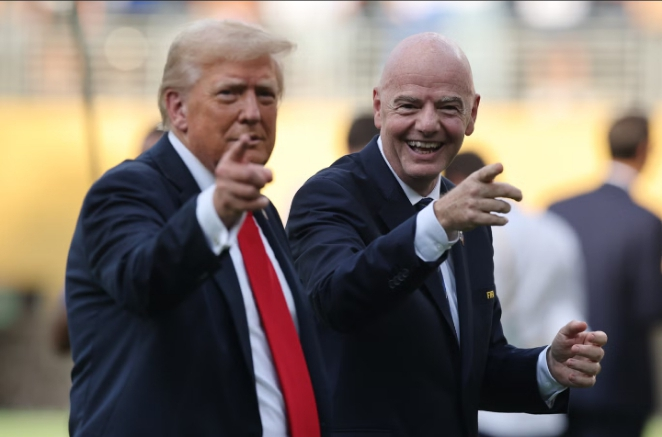
Yet critics argue that the current situation exposes the limitations of this approach. Sources within Fifa suggest that Infantino’s influence over political leaders, including Trump, is highly debatable. “Events, dear boy, events,” one official remarked, referencing the unpredictable nature of global politics and its influence on international sport.
The Trump Greenland World Cup 2026 scenario exemplifies how even well-intentioned sporting diplomacy can quickly become entangled in broader political disputes.
The potential fallout extends beyond the field. The relationship between Greenland and Denmark adds an additional layer of complexity.
Greenland has a unique status as an autonomous territory within the Kingdom of Denmark, and any actions by the United States in the region could trigger strong international responses.
European football federations, conscious of their ethical and political obligations, may feel compelled to act in solidarity with Denmark, reinforcing the notion that sport cannot be entirely insulated from global events.
This dynamic underscores the relevance of the Greenland Denmark political tension in shaping the decisions of football authorities.
While Fifa traditionally avoids taking explicit political stances, the influence of prominent figures such as Infantino cannot be ignored. By engaging directly with Trump, Infantino has become a key figure in navigating what is now a highly charged intersection of sports and politics.
Some within the organization argue that Infantino’s role is crucial, as he may be uniquely positioned to communicate concerns directly to the US administration, potentially preventing escalation.
However, others suggest that his proximity to political leaders might compromise Fifa’s neutrality and inadvertently align the organization with a particular geopolitical agenda.
Financial considerations also play a critical role. The 2026 World Cup is projected to be the most lucrative in history, with billions of dollars in revenue expected from ticket sales, merchandising, sponsorships, and broadcasting rights.
A boycott could severely undermine these financial projections, affecting not only Fifa but also host cities, investors, and sponsors.
In addition, the uncertainty surrounding Greenland has reportedly caused some US investment in Danish football clubs to be paused, highlighting how even indirect effects of the geopolitical tension can influence the broader football ecosystem.
European football federations are particularly sensitive to public perception. Any decision to boycott, or even threaten a boycott, would likely be scrutinized in the media and could spark political debates within member countries.
The European football federation response is therefore not just a logistical or sporting question but a moral and diplomatic one.
Federations must weigh their allegiance to Fifa, their solidarity with Denmark, and the expectations of their governments and fans. In this context, football is no longer just a game; it has become a stage for demonstrating national values and geopolitical positions.
The current situation has parallels with past sporting boycotts and sanctions, such as the banning of Russia from international competitions. Those precedents show that global football authorities can be forced to respond swiftly to geopolitical crises, even when the timing is inconvenient.
The Fifa World Cup boycott discussions over Greenland reflect a similar dynamic, where federations consider the ethical, political, and financial consequences of participation.
The uniqueness of the 2026 World Cup, with its North American hosts and global attention, amplifies these stakes.
For now, football authorities are focused on monitoring developments, preparing contingency plans, and maintaining communication channels with national federations.
The timing of these preparations is critical, as the tournament is fast approaching and logistical decisions must be finalized well in advance.
Observers note that Infantino’s handling of the situation will be closely scrutinized, both within the sport and by the broader public, as the balance between diplomacy, sport, and ethics is tested.
The situation demonstrates how international events, politics, and football are increasingly intertwined, making leadership decisions more complex than ever.
Ultimately, the Trump Greenland World Cup 2026 scenario highlights the unpredictable ways in which politics can intersect with sport.
While Fifa seeks to maintain neutrality and promote football as a unifying global force, the organization is now caught in a web of political, ethical, and financial pressures.
The decisions of European football federations, the actions of the US administration, and Infantino’s personal influence will collectively shape the outcome.
Fans, investors, and officials alike are waiting to see whether diplomacy, boycott threats, or unforeseen developments will determine the fate of the tournament.
Football, it seems, is now inseparable from the global political landscape, and the coming months will test the ability of sporting organizations to navigate these challenges.