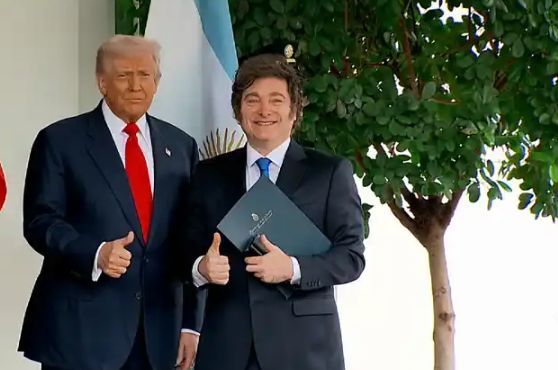
Donald Trump has issued a sharp warning to Buenos Aires, declaring that the United States will reconsider its aid package if Argentine President Javier Milei loses re-election.
The statement came during Milei’s visit to the White House, where both leaders publicly affirmed their ideological kinship and economic cooperation under what Trump called a “shared conservative vision.”
Trump said, “If he loses, we will not be generous with Argentina,” underscoring that Washington’s $20 billion aid pledge depends on Milei’s continued hold on power.
The remark immediately rattled markets, highlighting growing concerns that political instability could derail the fragile Argentine economy and jeopardize ongoing American financial assistance.
Trump threatens Argentina openly, linking U.S. foreign aid to domestic electoral outcomes, a move that critics describe as coercive interference in another nation’s democratic process.

For Trump, the relationship with Milei represents both a symbolic and strategic partnership — a union of nationalist economics and anti-globalist politics stretching from Washington to Buenos Aires.
Milei, who faces midterm elections this month, is seeking to strengthen his legislative position to advance sweeping cost-cutting reforms amid mounting public frustration over inflation and unemployment.
Argentina’s economic turmoil has eroded public trust in Milei’s leadership, while Trump’s endorsement aims to stabilize his right-wing ally’s standing before the crucial October 26 vote.
The Trump administration has already transferred emergency funds to stabilize Argentina’s currency and offset severe capital flight, signaling a rare direct intervention in Latin American financial markets.
Economists remain divided over the aid strategy. Supporters see it as vital to prevent Argentina’s collapse; opponents argue it compromises the independence of American foreign policy.
Trump threatens Argentina with economic consequences if Milei falters, insisting the partnership hinges on “philosophical alignment” rather than pure diplomacy or humanitarian objectives.
“This man’s philosophy is correct,” Trump said. “If he wins, we stay with him. If he loses, we’re gone. It’s that simple.”
The comment, broadcast widely across U.S. and Argentine media, sparked heated debate over Washington’s motives and its potential influence on South American electoral politics.
For Trump, the partnership with Milei provides another arena to advance his “America First” agenda — redefined as exporting conservative economic models rather than traditional foreign aid.
Still, questions persist about whether U.S. taxpayers benefit from underwriting Argentina’s reforms at a time when Trump’s domestic budget cuts have drawn criticism at home.
When asked what America gains, Trump replied: “We’re helping a great philosophy take over a great country. We want to see it succeed — for our mutual benefit.”
Analysts note that the Trump administration’s unprecedented $20 billion package mirrors Cold War–era tactics, using financial leverage to shape ideological outcomes in developing economies.
Milei’s aides described the White House meeting as “productive and visionary,” emphasizing that both sides share a belief in free markets and aggressive fiscal restructuring.
Still, opposition lawmakers in Argentina have condemned Trump’s remarks, calling them “blackmail diplomacy” that undermines national sovereignty and places democratic legitimacy at risk.
Trump threatens Argentina precisely as the country faces another debt crisis, with its central bank burning through reserves to defend a currency on the brink of collapse.
Over the past weeks, Argentina spent more than $1 billion protecting the peso, an approach economists warn is unsustainable without foreign support or structural reforms.
Washington’s Treasury Secretary, Scott Bessent, confirmed that Argentina’s “moment of acute illiquidity” required decisive action, announcing the $20 billion support plan to prevent systemic economic failure.
That announcement triggered a short-lived rally in Argentine stocks and bonds, offering brief relief before political uncertainty began eroding investor confidence again.
For Milei, Trump’s embrace serves as both lifeline and liability — ensuring financial backing while exposing him to accusations of overreliance on foreign political alliances.
Domestic critics accuse Milei of turning Argentina into a satellite of U.S. conservative politics, especially after he adopted Trump’s slogan, “Make Argentina Great Again.”
Trump, who praised Milei as a “great leader,” described their partnership as a “revolution against socialism,” reflecting ideological solidarity that transcends geographic distance.
Observers say Trump’s public threat marks an escalation in Washington’s pressure strategy, using economic leverage to secure ideological conformity among right-leaning Latin American partners.
The move also signals the Trump administration’s broader intent to reassert influence in South America amid China’s growing investments in the region’s energy and mining sectors.
Before Milei’s presidency, Argentina had deepened economic ties with Beijing, particularly in lithium production and infrastructure projects — areas now seen as strategic by Washington.
Trump threatens Argentina while quietly competing with China for economic dominance in Latin America, linking political allegiance to access to U.S. capital and market security.
The Argentine president’s office confirmed the leaders discussed “multiple strategic issues,” including currency stabilization, trade, and defense cooperation, but declined to release further details.
Analysts believe Trump’s transactional approach could destabilize future U.S.-Argentina relations if Milei fails to deliver electoral victory or economic recovery soon.
For Washington, the partnership carries risks: should Milei lose power, Argentina’s next government may pivot toward Europe or China, undoing Trump’s economic influence.
Meanwhile, the Trump administration has extended its confrontational posture to other allies, including Spain, threatening new tariffs over Madrid’s defense spending shortfall.
“I’m very unhappy with Spain,” Trump said, accusing the Spanish government of “disrespecting NATO” by refusing to meet the alliance’s 5 percent military spending target.
His threat to impose trade penalties reignited fears of a broader transatlantic rift, echoing his first-term trade wars and unpredictable foreign policy maneuvers.
NATO leaders agreed earlier this year to raise defense spending, but Spain secured an exemption, citing troop deployments as compensation for its lower budget ratio.
Madrid currently allocates 2.1 percent of GDP to defense, arguing its extensive overseas missions in Eastern Europe fulfill its NATO commitments beyond financial metrics.
Despite those arguments, Trump has intensified criticism of European partners, insisting full compliance is non-negotiable if the alliance wants continued U.S. protection.
Trump threatens Argentina and pressures Spain in the same breath — signaling a renewed era of conditional alliances shaped by transactional diplomacy and personal loyalty.
His approach marks a departure from traditional statecraft, replacing multilateralism with bilateral coercion as the preferred mechanism of international influence.
Political analysts argue this “deal-based diplomacy” reflects Trump’s background as a negotiator who prioritizes leverage over consensus, extending business instincts into geopolitics.
For Latin America, that shift means aid will increasingly depend on ideological alignment, not humanitarian need, cementing a U.S. foreign policy defined by partisan affinity.
Critics within Congress warn that Trump’s overt threats could violate the spirit of democratic neutrality, potentially alienating future administrations in friendly nations.
Still, among Trump’s conservative base, such rhetoric strengthens his image as a leader who uses America’s wealth strategically, rewarding loyalty and punishing dissent abroad.
The outcome of Argentina’s election will test that doctrine, determining whether Washington’s $20 billion gamble yields influence or becomes another costly misadventure.
Trump threatens Argentina to secure his ideological foothold, but in doing so, he risks destabilizing a nation already fragile under the weight of debt and inflation.
For Milei, success could transform Argentina into a model of right-wing reform; failure could expose the limits of Washington’s transactional diplomacy.
As the election nears, markets, allies, and adversaries alike watch closely, gauging whether Trump’s gamble in Argentina reshapes regional politics or merely deepens the crisis.
About The Author