President Donald Trump opened his Asia tour in Malaysia by celebrating the Trump Thailand Cambodia ceasefire, a rare diplomatic breakthrough ending months of bloodshed along their shared border.
The Trump Thailand Cambodia ceasefire was formalized at the Kuala Lumpur Convention Center, where Trump presided over the signing of the Kuala Lumpur Peace Accords.
This agreement marked the official end of a conflict that left dozens dead and thousands displaced, drawing praise from regional leaders who credited Trump’s mediation skills.
The Trump Thailand Cambodia ceasefire was the culmination of months of tense negotiations coordinated by Malaysia and supported by ASEAN, bringing long-awaited peace to Southeast Asia’s frontier.
Standing before a massive “Delivering Peace” backdrop, Trump said the Trump Thailand Cambodia ceasefire reflected “America’s commitment to resolving conflicts through strength, not surrender.”
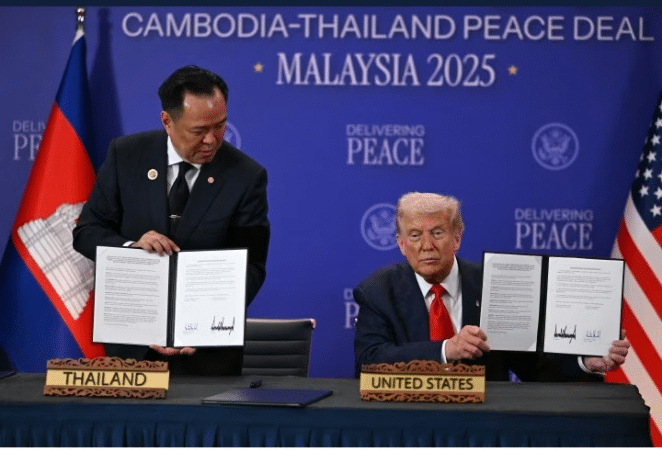
He added, “We have brought eight wars to an end since I took office. Peace is not a coincidence; it is a choice and a duty.”
The conflict began in July when Thai and Cambodian troops clashed near a disputed temple zone, sparking cross-border shelling and civilian evacuations.
Humanitarian groups warned the skirmish could spiral into a prolonged war before the Trump Thailand Cambodia ceasefire initiative intervened, halting hostilities after five violent days.
Cambodian Prime Minister Hun Manet praised the U.S. president, saying, “The Trump Thailand Cambodia ceasefire saved thousands of lives and proved diplomacy still matters in our region.”
Thai Prime Minister Anutin Charnvirakul echoed the sentiment, calling the Trump Thailand Cambodia ceasefire “a turning point for peace and prosperity in Southeast Asia.”
Under the accord, Thailand agreed to release 18 detained Cambodian soldiers while both sides committed to border demilitarization under ASEAN observer supervision.
Trump personally thanked Malaysia’s Prime Minister Anwar Ibrahim for facilitating the peace process, crediting him with ensuring the Trump Thailand Cambodia ceasefire stayed on track.
Anwar, chairing ASEAN this year, said, “President Trump showed boldness by prioritizing peace above politics, demonstrating leadership few have shown in recent decades.”
During the ceremony, Trump recalled how discussions for the Trump Thailand Cambodia ceasefire began over phone calls from his Scottish golf course at Turnberry.
He said, “Turnberry is beautiful, but I told them peace was far more important than playing a round. So, I stayed on those calls all day.”
Trump also took a moment to honor Thailand’s late Queen Mother Sirikit, describing her as “a timeless symbol of dignity and grace for the Thai people.”
After signing the Trump Thailand Cambodia ceasefire, Trump announced a series of trade agreements linking peace to prosperity among Southeast Asian partners.
He signed reciprocal trade pacts with Cambodia and Thailand, framing them as extensions of the Trump Thailand Cambodia ceasefire and rewards for stability and cooperation.
Thailand removed tariffs on 99 percent of U.S. goods, while Cambodia abolished all trade barriers on American imports under the new agreements.
Trump stated, “When nations stop fighting, they start trading. The Trump Thailand Cambodia ceasefire shows peace builds wealth, and wealth sustains peace.”
The U.S., however, maintained a 19 percent tariff on imports from both countries, underscoring a balanced yet assertive trade approach toward regional economies.
In addition to peace and trade, Trump signed critical minerals agreements with Malaysia and Thailand to diversify U.S. supply chains away from Chinese control.
U.S. Trade Representative Jamieson Greer described the move as “a matter of strategic urgency,” tying it to the Trump Thailand Cambodia ceasefire as part of regional stabilization.
Greer said Malaysia’s new trade framework would eliminate non-tariff barriers and strengthen cooperation on rare earth materials vital for electronics and defense production.
Trump’s emphasis on strategic resources reflected his broader Southeast Asia diplomacy doctrine—peace, trade, and resilience in the face of China’s economic aggression.
Analysts said the Trump Thailand Cambodia ceasefire marked a significant shift in U.S. engagement, reestablishing American influence across ASEAN’s expanding political landscape.
Trump’s presence at the ASEAN Summit, following the ceasefire signing, reinforced his administration’s message that the U.S. had returned as Asia’s key stabilizing power.
During his first presidency, Trump attended ASEAN meetings infrequently. This return, coupled with the Trump Thailand Cambodia ceasefire, was widely interpreted as re-engagement.
Foreign affairs analyst Collins Chong Yew Keat said, “Trump’s active diplomacy through the Trump Thailand Cambodia ceasefire sends a clear deterrent signal to Beijing.”
ASEAN, which formally admitted East Timor as its eleventh member, now positions itself as a stronger regional bloc with renewed confidence in U.S. partnership.
Hun Manet said Cambodia would nominate Trump for the Nobel Peace Prize, citing the Trump Thailand Cambodia ceasefire as proof of his “relentless pursuit of peace.”
The accords also established a humanitarian corridor for displaced villagers and launched reconstruction initiatives along previously shelled areas.
Thai and Cambodian forces agreed to participate in cross-border education and cultural programs under the broader ASEAN peace-building mandate.
Trump described the Trump Thailand Cambodia ceasefire as “the model of modern diplomacy,” combining “economic logic, moral resolve, and the will to act.”
He told reporters, “Every conflict can end. The only question is whether leaders have the courage to stop the fighting. These men did.”
The Trump Thailand Cambodia ceasefire not only prevented regional instability but also strengthened ASEAN unity amid escalating U.S.-China rivalry.
Observers noted that by mediating the ceasefire, Trump positioned the U.S. as a guarantor of both security and prosperity in Southeast Asia.
Greer added that “the peace dividend from the Trump Thailand Cambodia ceasefire will translate into stable supply chains and renewed investor confidence.”
Malaysia’s Anwar said the ceasefire and trade deals together “create a foundation for ASEAN-led stability with American support rather than dominance.”
Regional markets reacted positively, with analysts linking rising investor optimism to the Trump Thailand Cambodia ceasefire and U.S. diplomatic engagement.
Trump’s Malaysia visit is the first leg of his Asia tour, which will include stops in Japan and South Korea for further trade and security discussions.
White House officials described the Trump Thailand Cambodia ceasefire as “the signature diplomatic victory” of Trump’s second term, boosting his global statesman image.
They said it also advances his “Peace through Power” doctrine, intertwining diplomacy with strategic economic leverage to deliver enduring results.
Critics argued the Trump Thailand Cambodia ceasefire may depend too heavily on economic carrots, warning that renewed disputes could resurface if trade falters.
Supporters countered that the ceasefire proves Trump’s approach—tough pressure balanced with practical rewards—remains effective in volatile regions.
As the ceremony concluded, Trump declared, “The world has enough conflict. The Trump Thailand Cambodia ceasefire shows that peace is still achievable when leaders act boldly.”
Applause erupted as Trump signed the final page of the agreement, sealing a deal many thought impossible just months earlier.
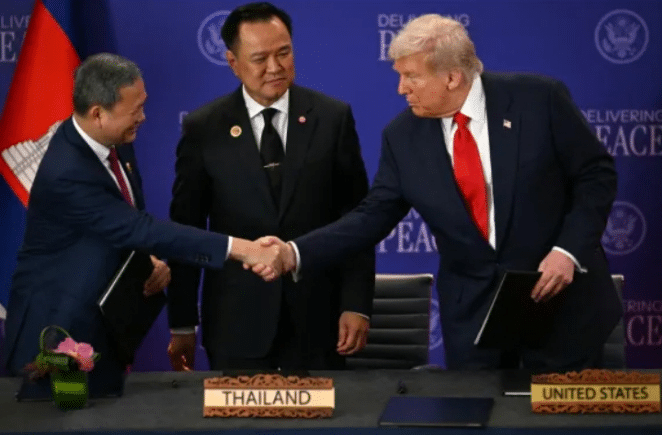
The Trump Thailand Cambodia ceasefire now stands as both a peace milestone and a strategic statement of renewed American engagement in Southeast Asia.
For Cambodia and Thailand, the accord promises stability, trade growth, and international legitimacy after years of simmering distrust.
For the United States, the Trump Thailand Cambodia ceasefire affirms a restored image of global leadership—assertive, results-driven, and unapologetically interventionist in pursuit of peace.
About The Author