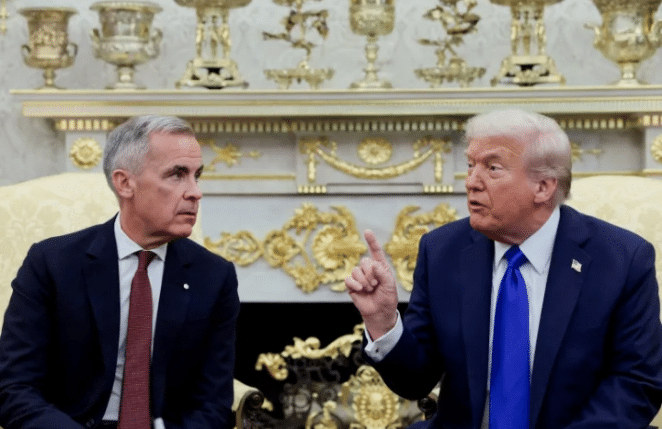
United States President Donald Trump terminates trade talks with Canada abruptly citing a fraudulent Ronald Reagan advertisement that allegedly misrepresented American policy on tariffs.
In a late-night post on his Truth Social platform, Trump declared that the advertisement, produced in Ontario, used a manipulated video of the late US president Ronald Reagan.
“The Ronald Reagan Foundation has just announced that Canada has fraudulently used an advertisement, which is FAKE,” Trump wrote, claiming Reagan appeared to criticise American tariffs unfairly.
He added, “Based on their egregious behaviour, ALL TRADE NEGOTIATIONS WITH CANADA ARE HEREBY TERMINATED.” The decision has immediately reignited tensions in already fragile Canada trade relations.
The controversy emerged after Ontario’s government aired a commercial that featured archival footage of Reagan warning against trade barriers and job losses caused by protectionist policies.
The Ronald Reagan Presidential Foundation & Institute condemned the advertisement, saying it distorted a “1987 Presidential Radio Address on Free and Fair Trade” without permission or historical accuracy.
In a social media statement, the foundation said, “Ontario has not received our consent to use and edit President Reagan’s remarks. We are reviewing legal options in this matter.”
The organisation also invited the public to view the unaltered address, in which Reagan spoke about the importance of balanced global trade and fair negotiations between allied nations.
Trump’s decision to terminate talks came as a shock to many in Washington and Ottawa, particularly as both sides had been pursuing dialogue to reduce US tariffs on Canadian goods.
The two nations had recently resumed discussions after months of strained diplomacy over duties on steel, aluminium, and automotive exports — all central to Canada’s manufacturing economy.
Observers said the latest development may mark one of the most abrupt interruptions in North American trade diplomacy since the 2018 renegotiation of the North American Free Trade Agreement.
Canadian Prime Minister Mark Carney, who met Trump in Washington earlier this month, had expressed cautious optimism about resolving disputes over cross-border trade restrictions.
But following Trump’s announcement, Carney’s office did not immediately issue an official response. Canadian media reported that senior trade officials were “caught off guard” by the president’s post.
The advertisement in question reportedly cost $75,000 and aired across major US networks, highlighting Canada’s opposition to tariffs that it claims are damaging bilateral industries.
Ontario Premier Doug Ford acknowledged producing the video, saying it was meant to “remind Americans that free trade works both ways” and that protectionism “hurts workers on both sides.”
“I heard that the president saw our ad. I’m sure he wasn’t too happy,” Ford told reporters earlier in the week, adding that Canada “will never stop making the case against unfair tariffs.”
In a social media post, Ford wrote, “Using every tool we have, we’ll never stop defending Canada. The way to prosperity is by working together, not by building barriers.”
However, Trump characterised the ad as an attempt to “interfere with the decision of the US Supreme Court and other courts,” though he did not clarify what case he was referring to.
Analysts say the president’s decision could have deep economic implications. More than three-quarters of Canada’s exports flow to the United States, making Washington its largest trading partner.
Each day, nearly 3.6 billion Canadian dollars worth of goods and services cross the border — an interdependence that underpins both countries’ supply chains, from automobiles to agricultural products.
Economists warn that if Trump terminates trade talks with Canada permanently, both economies could suffer significant disruptions, particularly in industries already affected by recent US tariffs.
“The Canadian economy is tightly integrated with the US market. Any interruption in trade discussions sends immediate shockwaves through manufacturing and energy sectors,” said economist Lisa Durant.
The White House did not provide additional details on whether the termination would affect ongoing negotiations over steel and auto tariffs or future bilateral trade frameworks.
According to reports from US media, some White House advisers had cautioned Trump against overreacting to the advertisement, warning that halting talks could backfire politically and economically.
But sources close to Trump said he viewed the Reagan issue as a matter of “principle” — arguing that the legacy of a former Republican president had been “defamed” for political purposes.
The Reagan Foundation’s statement added to the controversy by stressing that the original 1987 address supported fair trade principles, not unrestricted free trade or unreciprocated market access.
Reagan’s archived message had called on allies to “engage in honest and balanced trade that strengthens our economies rather than creating artificial advantages.”
Ontario’s adaptation reportedly spliced parts of that speech to make it appear that Reagan was criticising American tariffs directly — a claim the foundation says is entirely misleading.
Legal experts said the case raises serious copyright and ethical questions about using a deceased president’s likeness and words in contemporary political advertisements.
“It’s a grey area, but altering presidential recordings for foreign government messaging without consent risks diplomatic and legal fallout,” said US law professor Dana McAllister.
Canadian officials, however, defended their actions, arguing that the advertisement was “within fair use boundaries” and primarily intended for domestic audiences to promote free trade.
Still, Trump terminates trade talks with Canada has quickly become a defining headline across North American media, overshadowing other White House announcements.
Business groups in both countries voiced concern, urging leaders to de-escalate tensions and resume dialogue. The US Chamber of Commerce called for “immediate clarity” on the future of trade discussions.
Canadian auto manufacturers warned that prolonged uncertainty could lead to job losses and investment slowdowns, particularly in Ontario’s industrial corridor, which heavily depends on cross-border exports.
Trump’s tariffs earlier this year had already prompted Canadian retaliatory duties on American goods, including dairy, lumber, and agricultural machinery — escalating a tit-for-tat trade dispute.
“The president is playing a dangerous game with our most important trading partner,” said Democratic senator Patty Murray. “We’re looking at potential long-term damage to US industries.”
Former US trade officials described Trump’s move as politically motivated, suggesting it aligns with his broader “America First” economic stance and his 2025 re-election campaign strategy.
“Trump sees confrontation as leverage,” said former negotiator Tom Reynolds. “Terminating talks allows him to dictate terms later, but it risks alienating key allies like Canada.”
Meanwhile, Canadian Prime Minister Mark Carney announced plans to double his country’s exports to markets outside the United States, signalling a shift toward trade diversification.
Carney said Canada “will not allow unfair access to our markets” and will instead pursue new trade partnerships in Europe, Asia, and Latin America.
Political analysts said the fallout could reshape North American trade architecture if diplomatic repair efforts fail, potentially pushing Canada closer to the European Union and Pacific economies.
If Trump terminates trade talks with Canada permanently, experts predict new tensions in energy cooperation, border logistics, and regulatory frameworks that underpin continental commerce.
Ottawa officials indicated that Canada might seek arbitration through international trade bodies, including the World Trade Organization, if US policies continue to disrupt existing agreements.

The Ronald Reagan advertisement controversy underscores how symbolic disputes can derail high-stakes diplomacy in a climate already defined by political sensitivity and economic nationalism.
As legal reviews begin in both countries, observers warn that the issue could linger for months, further testing the resilience of Canada trade relations with Washington.
For now, the message from Trump remains unequivocal: “All trade talks with Canada are terminated.” Whether this marks a temporary halt or a permanent rupture remains to be seen.