Trump says US will not use force to take Greenland, insisting any American interest in the Arctic territory will be pursued without military aggression or coercion against allies.
Speaking during remarks that also targeted Nato and European partners, Trump said the United States had little to gain from global security commitments despite enormous financial contributions.
Trump says US will not use force to take Greenland even though he reiterated his belief that the territory holds strategic value for American national security interests.
He argued that Washington continues to shoulder disproportionate defence responsibilities while receiving minimal appreciation or tangible returns from longstanding alliances across Europe.
Addressing Nato directly, Trump claimed the United States “gives so much and gets so little in return” from the military alliance it has supported for decades.
He said American involvement in Nato has delivered “death, disruption, and massive amounts of cash” sent to countries he believes fail to value US sacrifices.
Trump made the comments while referencing Nato’s role in Europe’s security architecture, asserting that America’s primary outcome has been protecting Europe from Russia.
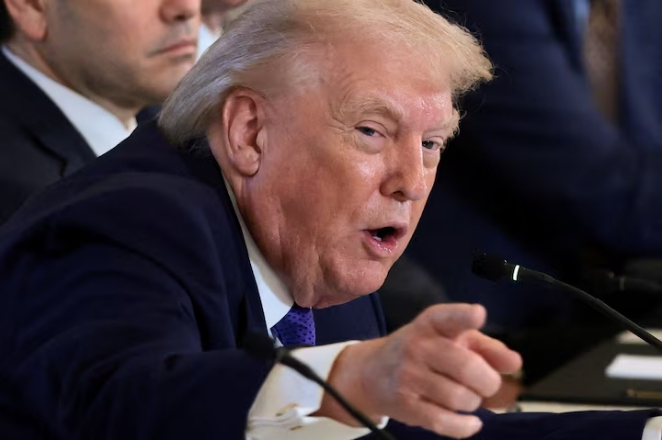
Trump says US will not use force to take Greenland, but added that the country would be “unstoppable” if it chose to apply overwhelming military power.
He quickly followed that assertion by stressing restraint, stating clearly that he would not deploy force to obtain the territory despite its geopolitical importance.
Trump’s remarks came as Nato Secretary-General Mark Rutte sat in the audience, having earlier praised Trump’s pressure on allies to increase defence spending.
Rutte has credited Trump with pushing Nato members toward higher military budgets, a long-standing demand aimed at reducing US financial dominance within the alliance.
Despite that acknowledgment, Trump maintained that Nato has provided the United States with little strategic benefit beyond continental European security.
Trump says US will not use force to take Greenland, yet repeated that America has received “nothing out of Nato” aside from shielding Europe from external threats.
That claim contrasts with Nato’s collective defence principle, which binds all members to mutual protection under Article 5 of the alliance treaty.
Article 5 has been invoked only once, following the September 11 attacks, when Nato allies rallied in defence of the United States.
Critics argue that this historical response undermines Trump’s assertion that Nato has failed to deliver reciprocal security benefits to Washington.
Nevertheless, Trump continued to frame American global engagement as costly and unbalanced, particularly in Europe where US troops remain heavily deployed.
He suggested that US taxpayers fund European security while domestic priorities struggle to receive equivalent attention and investment.
Trump says US will not use force to take Greenland, but his renewed interest has revived debate over Arctic security and emerging global competition.
Greenland’s strategic location and mineral potential have drawn increased attention as climate change opens new shipping routes and resource access.
Trump has previously argued that Greenland’s acquisition would strengthen US defence posture against rival powers expanding influence in the Arctic region.
Danish officials, who govern Greenland as an autonomous territory, have repeatedly rejected any suggestion of a sale or transfer of sovereignty.
Trump’s renewed comments signal that the idea remains politically alive, even as he insists that military coercion is not under consideration.
Trump says US will not use force to take Greenland, framing his position as firm yet peaceful amid broader criticism of global alliances.
The remarks reflect a continued scepticism toward multilateral institutions and a preference for transactional diplomacy based on perceived national benefit.
Trump’s stance on Nato mirrors previous arguments that allies must contribute more or risk diminished American support.
European leaders have responded by increasing defence spending, though tensions persist over burden-sharing and strategic autonomy.
Trump says US will not use force to take Greenland, but his rhetoric continues to challenge traditional assumptions about US leadership roles.
The comments also highlight an enduring divide between America’s security commitments and domestic political debates over international responsibility.
Supporters argue Trump’s approach prioritises national interest and fiscal responsibility over symbolic alliance loyalty.
Opponents counter that such rhetoric weakens trust among allies and emboldens adversaries seeking to exploit transatlantic divisions.
Trump says US will not use force to take Greenland, yet his continued emphasis on acquisition underscores the territory’s symbolic and strategic weight.
As global power competition intensifies, Arctic regions like Greenland are increasingly viewed as pivotal to future security calculations.
Trump’s comments ensure that Greenland, Nato, and America’s role in Europe remain central issues in ongoing geopolitical discourse.