

US President Donald Trump declared that no US officials will attend the South Africa G20 summit, citing what he claims is a white “genocide.”
Trump says US to boycott South Africa G20 summit over white ‘genocide’ is his latest political maneuver, repeating debunked allegations about Afrikaners being targeted in South Africa.
“This is a disgrace,” Trump tweeted, accusing South Africa of killing white farmers and illegally seizing farmland, asserting that the G20 should not convene under such conditions.
In the Oval Office, Trump presented South African President Cyril Ramaphosa with purported evidence of killings, a move Ramaphosa and experts have rejected as factually false.
White House sources confirmed that Vice President JD Vance will also skip the summit, despite previously being expected to attend in Trump’s stead.
Trump’s administration has framed the resettlement of white South Africans to the US as a humanitarian effort, granting asylum to 59 Afrikaners in May.
South Africa’s Expropriation Act, designed to address historical land inequalities, has been labeled by Trump as confiscatory and discriminatory against white farmers.
“The United States won’t stand for it,” Trump said. “We will act. Human rights violations cannot be ignored. The G20 should not reward South Africa.”
Trump’s rhetoric reflects longstanding grievances, including his claim that Afrikaners are being persecuted—a claim rejected by South African authorities and Afrikaner community leaders.
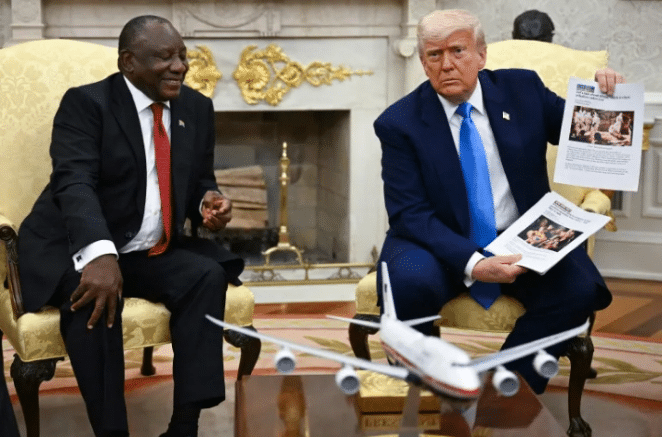
Ramaphosa dismissed Trump’s allegations during their May meeting, pointing to three white South Africans present as evidence there is no systemic “genocide” occurring.
Professor Saul Dubow of Cambridge University described Trump’s claims as a “fantasy,” suggesting geopolitical frustrations, including South Africa’s genocide case against Israel, may fuel the rhetoric.
The White House indicated that the US refugee cap would drop to 7,500 people annually, prioritizing white South Africans under Executive Order 14204.
Trump says US to boycott South Africa G20 summit over white ‘genocide’ has been repeated across Truth Social and other platforms, reinforcing a narrative dismissed by experts.
Trump’s hardline stance risks straining US-South Africa relations, raising questions about the future of G20 diplomacy and engagement with African economies.
The US president has called for Miami, Florida, to host the 2026 G20 summit, framing it as a rebuke to Johannesburg and South Africa’s policies.
“This is about human rights and justice,” Trump said. “We cannot tolerate the systematic targeting of any community, including Afrikaners in South Africa.”
Critics argue Trump is exploiting racial tensions, while supporters insist he is defending a community allegedly under attack, despite lack of evidence for a mass “genocide.”
South Africa has emphasized that land reforms aim to correct historical inequalities and do not constitute racial persecution or seizure without compensation.
Analysts warn Trump’s statements could inflame anti-US sentiment in Africa, while emboldening far-right supporters domestically who see the claims as justification for intervention.
Trump’s decision not to attend the G20 summit underscores his confrontational approach, signaling to allies and rivals alike that US engagement will reflect ideological priorities.
“This is not merely policy—it is political theater,” said one foreign policy expert, noting that Trump’s messaging focuses on symbolism as much as substance.
The US’s boycott could have economic repercussions, given South Africa’s role in trade, mining, and financial systems within the G20 framework.
Trump says US to boycott South Africa G20 summit over white ‘genocide’ continues to dominate international headlines, forcing world leaders to respond to allegations lacking factual basis.
Diplomatic observers stress that Trump’s hardline stance may overshadow substantive G20 discussions on climate, trade, and global security.
As the summit approaches, Washington has clarified it will maintain communication channels but will abstain from official attendance until human rights concerns are addressed.
The US’s absence is unprecedented, illustrating Trump’s willingness to confront perceived injustices with unilateral decisions rather than traditional multilateral engagement.
Trump’s framing of white South African persecution reflects his broader strategy of appealing to nationalist and conservative constituencies ahead of the 2026 political cycle.
Human rights organizations have criticized Trump’s selective focus, arguing that broader socio-economic challenges in South Africa, including crime and poverty, require more nuanced engagement.
Trump says US to boycott South Africa G20 summit over white ‘genocide’ is emblematic of his aggressive foreign policy style, intertwining domestic political messaging with international diplomacy.
Observers note that South Africa will proceed with hosting the summit, emphasizing the inclusivity of the G20 agenda despite the absence of US officials.
Trump’s claims have prompted media debates about misinformation, the role of social media in policy, and the impact of personal beliefs on international relations.
The White House stated refugee allocations will continue to prioritize Afrikaners while reducing overall US intake, a decision linked to Trump’s stated human rights concerns.
South African officials maintain that historical injustices require careful reform, but reject any characterization of systematic targeting or “genocide” of white citizens.
Trump’s insistence on Miami for the 2026 G20 summit illustrates his preference for symbolic victories, highlighting domestic political optics over multilateral diplomacy.
International legal experts have dismissed the “white genocide” allegations, reaffirming that there is no evidence of systematic killings or state-sanctioned persecution in South Africa.
Trump says US to boycott South Africa G20 summit over white ‘genocide’ has drawn both applause and criticism, reflecting the polarized domestic and global reception to his policies.
Political analysts anticipate that Trump will continue leveraging claims of persecution to justify unilateral US foreign policy decisions in Africa and beyond.
The US absence has sparked debate among G20 members, with several nations emphasizing that engagement should be based on facts rather than political narratives.
Trump’s aggressive posture may influence other countries’ participation, but South Africa remains committed to hosting a successful summit focused on economic recovery and climate change initiatives.
“This is a serious allegation without evidence,” said an African diplomat. “Boycotting the summit on such claims risks undermining the credibility of the G20.”
Trump says US to boycott South Africa G20 summit over white ‘genocide’ remains a focal point of discussion in international media, reflecting the administration’s hardline approach.
US domestic audiences have been divided, with conservative media lauding Trump’s decisive stance and critics warning it jeopardizes global cooperation and credibility.
The G20 summit is poised to proceed without US participation, signaling a rare public rift between the world’s largest economy and a key African partner.
Trump’s approach exemplifies a transactional view of foreign policy, where perceived injustices dictate engagement rather than traditional diplomatic protocols.
Trump says US to boycott South Africa G20 summit over white ‘genocide’ continues to shape the narrative ahead of the summit, demonstrating the influence of social media on foreign policy decisions.
South African leaders insist that reforms, including land redistribution, are legal, equitable, and intended to rectify historic imbalances rather than target specific racial groups.

As the global community watches, Trump’s decision highlights the tension between domestic political considerations and international obligations within multilateral institutions like the G20.
Trump’s rhetoric, refugee policy adjustments, and public denunciations exemplify a confrontational, high-stakes foreign policy approach that blurs lines between politics and diplomacy.
Trump says US to boycott South Africa G20 summit over white ‘genocide’ has become a central element in discussions of race, policy, and global leadership.
About The Author


