

The long-running controversy surrounding the naming of one of America’s most celebrated cultural institutions reached a dramatic turning point on Saturday as the Trump Name Removed From Kennedy Center order was finally carried out.
In the early hours of the morning, workers began removing Donald Trump‘s name from the facade of the John F. Kennedy Center for the Performing Arts in Washington, DC, following a series of court rulings that rejected last-minute attempts to halt the process.
The operation marked the culmination of weeks of legal battles, political tension and public debate over whether the former president’s name should remain attached to a venue established by Congress as a memorial to President John F. Kennedy.
The overnight removal immediately attracted national attention, drawing crowds outside the building and reigniting discussions about politics, public institutions and presidential legacies.
Supporters of the court decision celebrated what they viewed as the restoration of the Kennedy Center’s original identity, while critics argued the dispute reflected growing political divisions in the United States.
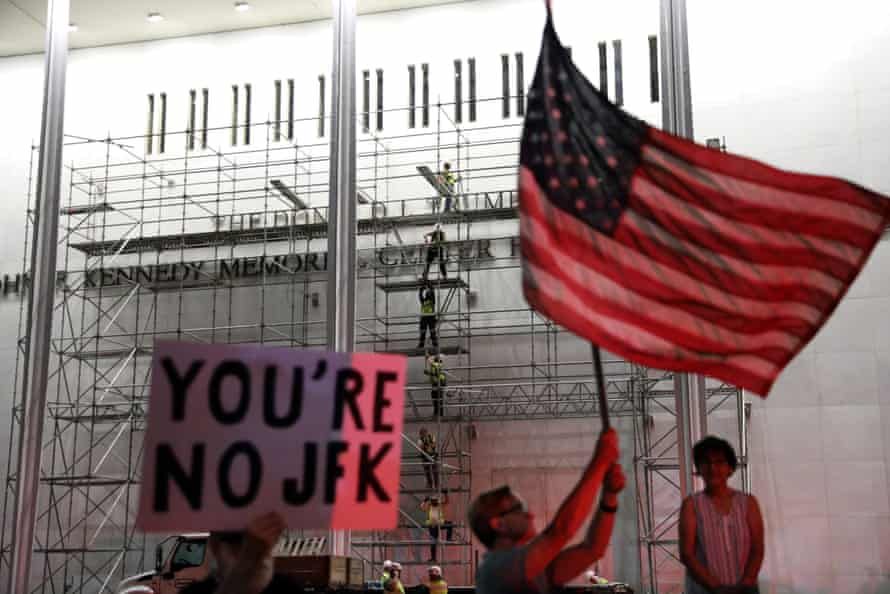
Trump Name Removed From Kennedy Center Following Court Order
The removal operation began shortly after federal courts rejected emergency appeals filed by lawyers representing the Kennedy Center and the Department of Justice.
The appeals sought to delay compliance with an earlier ruling issued by US District Judge Christopher Cooper, who determined that Trump’s name had been added to the institution in violation of federal law.
According to court records, the dispute stemmed from a decision by the Kennedy Center’s board of trustees to modify the venue’s name and add a reference to Donald Trump. The move sparked immediate criticism from lawmakers, legal experts and arts advocates who argued that the institution’s name was established by Congress and could not be changed through board action alone.
Judge Cooper agreed with that argument.
In a ruling that became central to the case, he wrote:
“Congress gave the Kennedy Center its name, and only Congress can change it.”
The decision ordered the restoration of the venue’s original title and required officials to remove references to Trump from the building’s facade.
How the Kennedy Center Controversy Began
The Trump Kennedy Center controversy began after sweeping leadership changes at the institution earlier this year.
Trump moved to reshape the organization by replacing several trustees and appointing allies to key positions. The restructured board later voted to rename parts of the institution in a move that supporters described as recognition of Trump’s role in American politics.
Opponents, however, argued that the board had exceeded its authority.
The Kennedy Center occupies a unique position in American public life. Established as a living memorial to President John F. Kennedy, it serves as the nation’s premier performing arts venue and hosts thousands of cultural events every year.
Because of its congressional origins and symbolic significance, critics argued that altering its name required approval from lawmakers rather than a simple vote by trustees.
The disagreement quickly evolved into a major legal battle, drawing national media attention and prompting intervention from members of Congress.
Legal Challenge Gains Momentum
The lawsuit that ultimately led to the removal of Trump’s name was brought by Representative Joyce Beatty of Ohio, an ex-officio member of the Kennedy Center board.
Beatty argued that the renaming violated federal statutes governing the institution and undermined congressional authority.
Read also: Trump Kinetic strike kills Tren de Aragua leader Niño Guerrero in SOUTHCOM operation
The legal challenge gained momentum when Judge Cooper issued a lengthy opinion concluding that the board lacked the legal power to alter the center’s official name.
The ruling represented a significant setback for those seeking to maintain the revised title and set the stage for the final confrontation over the building’s signage.
Workers Remove Trump Name Under Cover of Darkness
The actual removal process unfolded during the night and early morning hours.
Workers first erected scaffolding around the section of the building where Trump’s name appeared. Tarpaulins were then installed to shield the operation from public view.
Despite efforts to conceal the work, observers reported seeing crews removing letters through gaps in the covering.
The scene attracted considerable public interest.
Dozens of people gathered outside the venue, many hoping to witness a historic moment in the institution’s history. Some spectators applauded as workers continued the operation, while others voiced frustration over the controversy that had engulfed the arts center.
Witnesses reported chants of:
“Take it down.”
and
“Shame!”
echoing across the plaza as the removal proceeded.
For many attendees, the event represented more than a dispute over signage. It symbolized a broader debate about political influence over public institutions and cultural landmarks.
Emergency Appeals Rejected by Federal Courts
The removal only proceeded after multiple attempts to secure emergency relief failed.
Lawyers representing the Kennedy Center argued that removing the signage before the appeals process concluded could create confusion and unnecessary expense if future rulings ultimately favored their position.
The Department of Justice echoed similar concerns and sought a temporary pause.
However, federal judges were unconvinced.
The courts determined that the appellants had failed to demonstrate a likelihood of success on appeal or show that irreparable harm would occur if the name was removed immediately.
Those rulings effectively cleared the path for the overnight operation.
Request for Extension Sparks Criticism
Even after losing their appeals, officials requested additional time to comply with the court order.
Lawyers cited severe weather forecasts and concerns about worker safety, arguing that thunderstorms could complicate the removal process.
The request sought a brief extension beyond the court-imposed deadline.
Critics quickly condemned the move.
Supporters of the lawsuit accused officials of attempting to delay compliance and prolong the dispute.
Although the extension request generated fresh controversy, workers ultimately began removing the signage only hours later.
What the Kennedy Center Facade Means Symbolically
The Kennedy Center facade has long served as one of the most recognizable features of the Washington landmark.
Located along the Potomac River, the building stands as a tribute to President Kennedy’s vision for arts and culture in American society.
Because of that symbolism, the dispute over the signage carried significance far beyond architecture.
Supporters of the court ruling argued that restoring the original name preserved the institution’s historic mission and protected congressional authority over a federally designated memorial.
Others viewed the conflict through a political lens, seeing it as part of broader battles surrounding Trump’s influence and legacy.
Either way, the removal attracted nationwide attention and transformed a legal dispute into a major public event.
Political Fallout Expected to Continue
Although the signage is now being removed, the legal and political ramifications may continue for months.
Lawyers representing supporters of the renaming effort are expected to pursue further appeals.
Questions also remain regarding the future governance of the Kennedy Center and the extent of board authority over institutional branding and management decisions.
Political analysts believe the dispute could become another flashpoint in debates surrounding executive influence, cultural institutions and the limits of administrative power.
The controversy has already generated extensive discussion among lawmakers, arts organizations and constitutional scholars.
Many experts believe the case could influence future disputes involving federally chartered institutions and congressionally established memorials.
Public Reactions Remain Divided
Public reaction to the Donald Trump name removal remains deeply divided.
Supporters of the court ruling argue that the decision reinforces the principle that public memorials should be governed according to law rather than political preference.
Critics contend that the dispute unfairly targeted Trump and reflected broader political hostility toward the former president.
Social media platforms quickly filled with reactions from both sides, highlighting the emotional and political significance of the issue.
Despite those disagreements, many observers agree that the event marks an important moment in the ongoing debate over politics and public institutions in America.
A Historic Moment for the Kennedy Center
The removal of Trump’s name from the building’s exterior represents one of the most consequential chapters in the recent history of the Kennedy Center.
What began as a boardroom decision evolved into a high-profile legal battle involving federal courts, lawmakers, political activists and members of the public.

Now, with workers removing the lettering from the building, the institution is returning to the name established by Congress decades ago.
Whether future appeals alter the outcome remains uncertain, but for now, the Trump Name Removed From Kennedy Center decision stands as a significant legal and symbolic victory for those who argued that the venue’s identity should remain unchanged.
As scaffolding surrounds the building and crews continue their work, the Kennedy Center once again finds itself at the center of a national conversation about history, politics, culture and the rule of law.
About The Author


