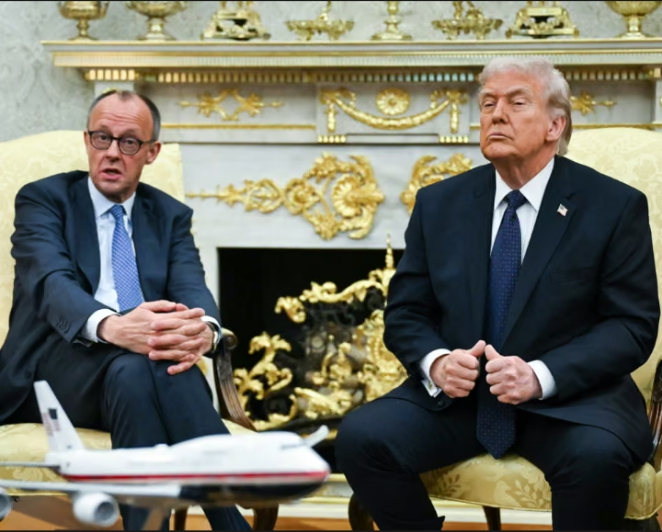
President Donald Trump met German chancellor Friedrich Merz at the White House on Tuesday, with Iran strikes dominating talks between the two leaders.
It marked Trump’s first in-person meeting with a key European ally since the conflict escalated into open military confrontation involving Washington, Jerusalem and Tehran.
Speaking to reporters before their closed-door discussions, Trump said the Iran strikes would be central to the bilateral meeting.
“We’ll obviously be talking a little bit about Iran today, and he’s been helping us out,” the president said, standing alongside Merz in the Oval Office. He praised what he described as close coordination with Berlin during the rapidly evolving crisis in the Middle East.
The Iran strikes have reshaped diplomatic calculations across Europe, with Germany emerging as one of Washington’s most vocal backers among major EU powers.
While Berlin has historically supported diplomatic engagement with Tehran, Merz’s government has signalled strong alignment with US and Israeli security objectives since hostilities intensified.
Trump used the appearance to tout what he described as sweeping military success against Iran’s armed forces. “They have no navy — it’s been knocked out. They have no air force — it has been knocked out.
They have no air detection that’s been knocked out. Their radar has been knocked out, and just about everything’s been knocked out,” he said of the Iranian regime. “We’re doing very well.”
The president framed the Iran strikes as a decisive operation aimed at degrading Tehran’s military capabilities and deterring further regional escalation.
According to Trump, coordinated actions have significantly weakened Iran’s defensive infrastructure, including maritime assets and air surveillance systems.
German officials have not publicly detailed the extent of Berlin’s involvement, but Merz acknowledged ongoing consultations with Washington. In brief remarks, he emphasised the importance of transatlantic unity and said Germany remained committed to stability in the Middle East, while also urging efforts to prevent a wider regional war.
The Iran strikes have sent shockwaves through global markets and diplomatic circles. European governments have been balancing support for Israel’s security concerns with fears that prolonged fighting could destabilise energy supplies and trigger broader confrontation involving regional actors.
During the meeting, Trump and Merz were also expected to discuss NATO coordination, intelligence-sharing and contingency planning should the conflict expand. Germany hosts key US military installations, making its strategic position critical to Washington’s operational posture in Europe and beyond.
Merz’s visit to Washington comes amid heightened political pressure at home. While Germany has expressed solidarity with Israel following Iranian missile activity, segments of the German public have raised concerns about escalation and the humanitarian toll of sustained military action.
The White House meeting underscores how the Iran strikes have become a defining test of Western unity. For Trump, showcasing support from a leading European power strengthens his administration’s claim that its strategy enjoys broad international backing.
At the same time, analysts note that Europe’s approach remains more cautious than Washington’s rhetoric suggests.
Several EU member states continue to call for de-escalation channels to remain open, even as they stop short of directly criticising US or Israeli military actions.
Read also: Civilian deaths in Iran pass 700 as US-Israel war intensifies and regime tightens grip
Trump dismissed suggestions that the conflict could drag on unpredictably, insisting that Iranian capabilities had been severely degraded. “We’re doing very well,” he repeated, arguing that the strikes had achieved their primary objectives.
Analysts say the Iran strikes could have long-term implications for regional stability and international diplomacy. Beyond immediate military objectives, the operations signal a new phase of US-Israel coordination in the Middle East, one that European allies must navigate carefully.
Observers also note that Iran’s leadership may seek asymmetric responses, including cyberattacks or proxy engagements, meaning that Western governments must remain vigilant and adaptable as the situation evolves.