In a move that has drawn global attention, US President Donald Trump confirmed that he recently spoke with Venezuelan President Nicolás Maduro. Trump offered no details about the discussion.
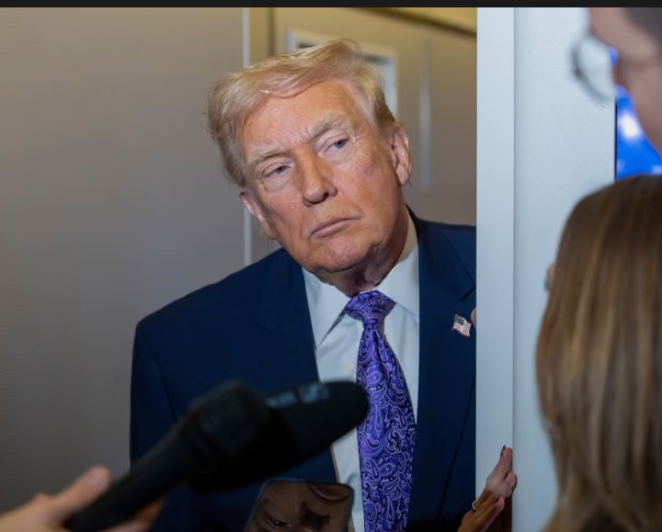
“I don’t want to comment on it. The answer is yes,” Trump said while speaking to reporters onboard Air Force One, leaving analysts speculating about the purpose of the call.
The conversation reportedly took place earlier this month, as first reported by The New York Times. The discussion may have included the possibility of a meeting between Trump and Maduro in the United States.

Trump characterized the conversation as neutral. “I wouldn’t say it went well or badly. It was a phone call,” he said, avoiding any explicit assessment of the diplomatic engagement.
The confirmation comes at a time when Trump has maintained a tough stance toward Venezuela, blending bellicose rhetoric with hints at potential diplomacy, leaving observers uncertain about Washington’s intentions.
Earlier, Trump declared that the airspace above and surrounding Venezuela should be “closed in its entirety,” raising concerns in Caracas about the potential for military action or further US escalation.
When asked if his airspace comments indicated imminent strikes, Trump replied, “Don’t read anything into it,” offering little clarity while maintaining a public posture of unpredictability.
The US administration has long scrutinized Venezuela over alleged involvement in illegal drug trafficking, which Washington claims has contributed to deaths in the United States, accusations Maduro consistently denies.
Sources indicate the Trump administration is weighing a range of options, including potential regime change, following a significant military buildup in the Caribbean and several months of strikes on suspected drug-smuggling operations.
Human rights groups have condemned US military strikes off the Venezuelan coast as illegal extrajudicial killings, with critics warning that Washington may be violating international law and risking regional stability.
Trump said he would investigate whether a second strike in the Caribbean during September had killed survivors, stating he would not have authorized such an action, signaling concern over unintended civilian casualties.
US Defense Secretary Pete Hegseth defended the operations as lawful, emphasizing that the strikes are intended to be “lethal,” reflecting ongoing US pressure to combat drug trafficking from Venezuela.
Trump’s recent remarks also included promises of imminent land operations against suspected Venezuelan drug traffickers, underscoring the administration’s willingness to escalate military measures if necessary.
Venezuelan officials have remained largely silent on the reported call. Jorge Rodríguez, head of Venezuela’s national assembly, focused his press conference on investigating US boat strikes rather than commenting on the conversation itself.
The conversation’s secrecy has fueled speculation about potential diplomatic openings or negotiations, even as tensions rise between the United States and Venezuela over both security and political concerns.
While the US emphasizes counter-narcotics objectives, critics argue that Trump’s approach may exacerbate tensions and destabilize the region, highlighting the delicate balance between enforcement and diplomacy.
Trump’s handling of Venezuela reflects a broader pattern of mixing military assertiveness with selective engagement, leaving both allies and adversaries unsure how the US may act in future scenarios.
Observers note that US-Venezuela relations have historically oscillated between confrontation and cautious dialogue, and the recent call could signal a nuanced shift or merely be a temporary communication channel.
The impact of the phone call remains uncertain, but it underscores the volatile nature of international relations, particularly when high-stakes security and geopolitical issues intersect with personal diplomacy.
Experts caution that any misinterpretation of US intentions could escalate tensions, emphasizing the importance of transparency and careful messaging in sensitive diplomatic exchanges between Washington and Caracas.
Trump’s ambiguous statements and the lack of Venezuelan response highlight the strategic ambiguity often employed in US foreign policy, a tactic designed to maintain leverage while avoiding immediate commitments.
The confirmation of the call also coincides with ongoing debates in Washington regarding appropriate measures against Maduro’s government, weighing military action against diplomatic engagement and international law considerations.
Regional leaders and international organizations continue to monitor the situation closely, as any escalation or misstep could have wide-ranging consequences for stability, trade, and humanitarian conditions in Latin America.
For now, the conversation between Trump and Maduro remains largely opaque, with both leaders choosing discretion, leaving analysts to interpret potential signals, motives, and implications for the coming months.
As the situation develops, attention will focus on whether this communication represents a breakthrough in US-Venezuela relations, or if it is simply a tactical maneuver amid an ongoing high-stakes geopolitical standoff.
The coming weeks may reveal whether dialogue can coexist with the US’s enforcement strategy, and whether the call signifies a potential recalibration in Washington’s approach to Maduro’s government.
Ultimately, the Trump-Maduro call illustrates the complex interplay of diplomacy, military posture, and international scrutiny, demonstrating the precarious nature of modern geopolitical engagement in volatile regions.