

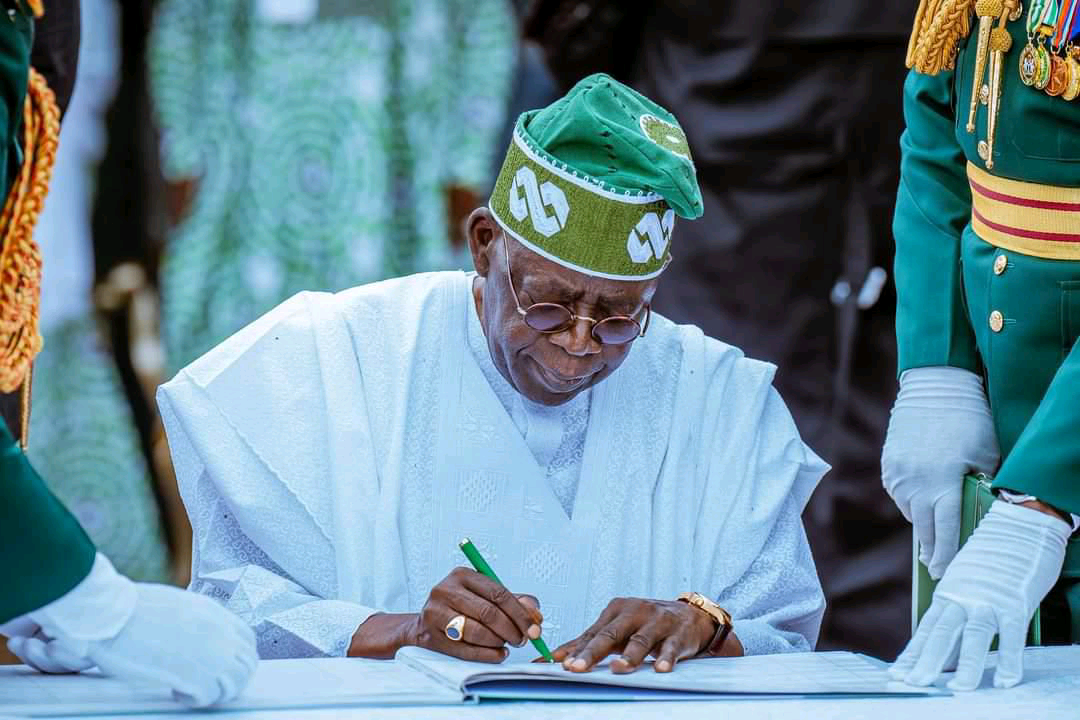
President Bola Ahmed Tinubu has formally approached the Senate with a major fiscal proposal seeking approval for a significant upward revision described as the 2026 Appropriation Bill adjustment.
The request, valued at about N9 trillion, is aimed at resolving inherited capital obligations while supporting strategic national investments across key sectors of the economy.
The proposal was presented on the floor of the Senate by Senate President Godswill Akpabio, who explained that the 2026 Appropriation Bill adjustment is intended to harmonise outstanding financial commitments accumulated between 2023 and 2025.
According to him, this step is necessary to prevent repeated budget distortions caused by unresolved obligations carried forward from earlier fiscal cycles.
Akpabio noted that one of the central objectives of the 2026 Appropriation Bill adjustment is to “regularise identified legacy capital commitments,” ensuring that all pending debts are consolidated into a unified framework.
He stressed that this would improve budget transparency and reduce the burden of managing overlapping expenditure plans that have stretched across multiple years.

Under the proposal, approximately N5.7 trillion is allocated for unfunded capital obligations from the 2025 fiscal period.
These obligations, according to lawmakers, are unlikely to be fully implemented before the expiration of the current budget cycle.
The 2026 Appropriation Bill adjustment therefore becomes a mechanism for preventing project abandonment and funding gaps.
In addition, about N2 trillion is earmarked for new strategic capital projects not originally captured in the initial 2026 budget.
These additions are designed to reinforce national development priorities in infrastructure, healthcare delivery, and institutional capacity building.
A key component of the 2026 Appropriation Bill adjustment includes funding for major transportation projects.
About N478.6 billion is proposed as equity financing through the Ministry of Finance Incorporated to support presidential legacy rail projects across Lagos, Kano, Kaduna, and Ogun States.
The plan also includes feasibility studies for proposed rail expansions in Enugu and Maiduguri.
Further allocations under the 2026 Appropriation Bill adjustment include N8.6 billion for feasibility studies on major national corridors such as the Calabar–Maiduguri route and the proposed Maiduguri–Sokoto superhighway.
These studies are expected to guide long-term infrastructure planning and improve national connectivity.
In the health sector, the proposal introduces approximately $344.8 million (about N482 billion) for priority interventions linked to bilateral agreements and existing implementation commitments.
Officials explained that this portion of the 2026 Appropriation Bill adjustment is intended to strengthen healthcare systems and ensure continuity of ongoing projects that require sustained funding.
The judiciary also receives substantial attention in the plan. The 2026 Appropriation Bill adjustment allocates N98.5 billion to the Court of Appeal and N36.7 billion to the Supreme Court.
These allocations are expected to improve judicial efficiency, support administrative operations, and enhance readiness ahead of the 2027 general elections.
An additional N268.5 billion is proposed to reinstate and expand the judiciary’s budget ceiling, taking into account the anticipated appointment of additional justices and judges.
This is aimed at strengthening institutional capacity within the justice system as part of broader governance reforms.
Overall, the total value of the 2026 Appropriation Bill adjustment stands at about N9 trillion.
Of this amount, N7.7 trillion is dedicated to legacy capital regularisation, while N1.3 trillion is reserved for new strategic projects across priority sectors of the economy.
To finance the expanded spending plan, the Federal Government proposes a funding structure heavily anchored on external borrowing.
According to Senate leadership, this approach is considered more sustainable under current macroeconomic conditions.
It is expected to reduce pressure on domestic lending markets while ensuring sufficient liquidity for capital-intensive projects.
Senate President Akpabio explained that the financing structure tied to the 2026 Appropriation Bill adjustment will help preserve private sector access to credit and stabilise interest rate pressures in the domestic economy.
He added that aligning external funding with infrastructure-heavy projects is a more efficient fiscal strategy.
He further emphasised that the 2026 Appropriation Bill adjustment reflects the administration’s commitment to restoring fiscal discipline.
Rather than allowing old obligations to repeatedly distort new budgets, the government aims to clean up legacy debts and create a more predictable financial planning system.
Following the presentation, the Senate referred the proposal to the Committee on Appropriations for detailed legislative review.
Chairman Solomon Adeola assured lawmakers that the committee would conduct a thorough examination and present a detailed report.
Adeola also noted that preliminary assessments of the 2026 Appropriation Bill adjustment had already begun, adding that full technical explanations would be provided when the committee formally presents its findings to the Senate.
The debate around the 2026 Appropriation Bill adjustment is expected to continue as lawmakers scrutinise its fiscal implications, borrowing structure, and long-term impact on Nigeria’s debt profile and development priorities.
About The Author
