

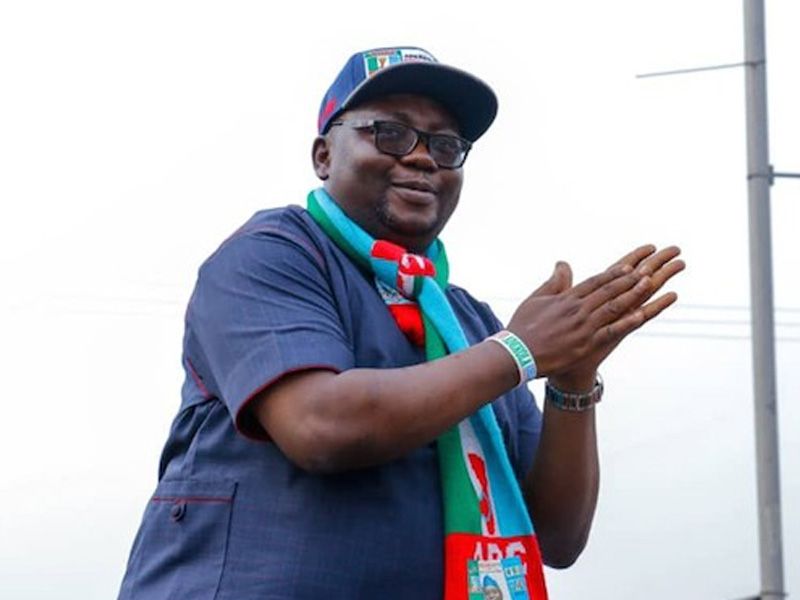
Nigeria’s political landscape has begun to shift as Adebayo Adelabu formally exits his role as Minister of Power to concentrate on his ambition of governing Oyo State.
The Adelabu resignation marks a significant moment in the early buildup to the 2027 general elections, where key figures are already positioning themselves for competitive contests across the country.
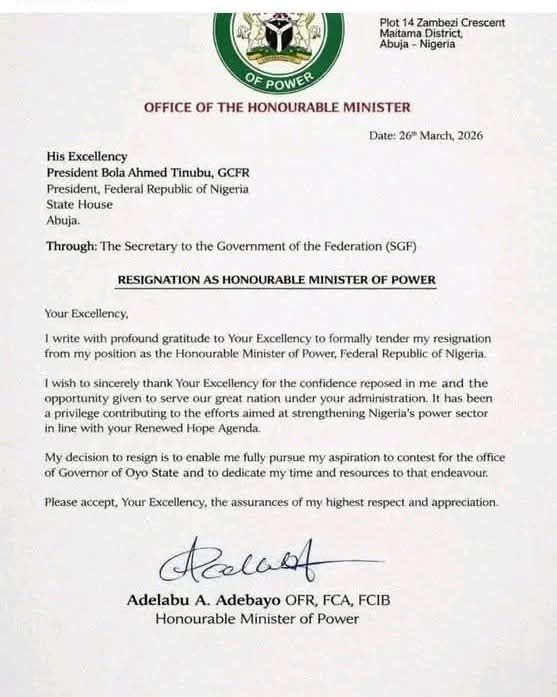
In a letter dated March 26 and submitted to President Bola Tinubu, the former minister explained that stepping aside was a strategic move.
According to him, the decision would allow full dedication to his political aspiration without the distractions and responsibilities tied to federal office.
For Adelabu, the transition is not just procedural but also a necessary step toward strengthening his grassroots connections and campaign structure.
The Adelabu decision follows a broader directive requiring political appointees with electoral ambitions to resign on or before March 31.
This policy is consistent with the Electoral Act, which aims to promote transparency and prevent the misuse of public office for campaign advantages.
By complying, Adelabu aligns himself with regulatory expectations while signaling readiness for the political contest ahead.
This is not the first time Adelabu has pursued the governorship of Oyo State.
His earlier attempts in 2019 under the All Progressives Congress and in 2023 under the Accord Party demonstrate a sustained interest in leading the state.
Those experiences are expected to play a crucial role in shaping his current strategy, as he is likely to leverage lessons learned from past campaigns to strengthen his chances.
Beyond politics, Adelabu brings a strong background in financial management and public administration.
Before joining the federal cabinet, he served as a deputy governor at the Central Bank of Nigeria, where he handled key operational responsibilities.
That experience contributed to his profile as a technocrat, a reputation he carried into his tenure in the power ministry.
While serving as minister, he oversaw a sector that continues to face persistent structural challenges.
Electricity supply fluctuations remained a major concern for households and businesses, despite ongoing reforms and interventions.
Under his leadership, efforts were made to improve generation capacity, enhance distribution systems, and engage stakeholders in addressing systemic inefficiencies.
However, like many before him, Adelabu faced the complexity of transforming a sector deeply affected by infrastructure gaps and funding limitations.
His resignation is part of a broader trend, as more government officials are expected to step down in the coming months to pursue elective offices.
Political alignments are already evolving, with parties and stakeholders recalibrating strategies ahead of 2027.
The Adelabu move, therefore, is not happening in isolation but reflects a wider shift in Nigeria’s political dynamics.
As attention gradually turns toward Oyo State, the governorship race is expected to attract significant interest from both established politicians and emerging contenders.
For observers, Adelabu’s re-entry into the race introduces a familiar face with both experience and determination, factors that could influence the overall competitiveness of the election.
At the time of this report, no official replacement has been announced for the Ministry of Power.
This leaves a temporary gap in leadership, even as the federal government continues efforts to stabilize the energy sector.
Meanwhile, Adelabu begins a new phase of his political journey, one that will test his resilience, strategy, and connection with the people of Oyo State.
Ireport247news
About The Author
