The Supreme Court has upheld presidential emergency powers, ruling that elected officials may be temporarily suspended to prevent chaos, subject to constitutional limits.
The Supreme Court has delivered a landmark judgment clarifying the scope of presidential emergency powers under Nigeria’s Constitution, affirming that the President has the authority to declare a state of emergency in any part of the country when public order, security, or governance is under serious threat.
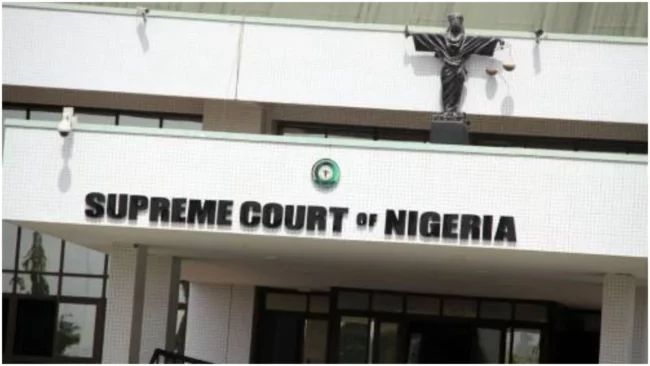
In a majority decision of six justices against one, the apex court ruled that the President may adopt extraordinary measures, including the temporary suspension of elected state officials, to prevent a complete breakdown of law and order.
However, the court emphasized that such actions must be time-bound and cannot be indefinite.
The judgment was delivered against the backdrop of a constitutional dispute arising from the declaration of a state of emergency in Rivers State by President Bola Ahmed Tinubu.
Following the declaration, key elected officials in the state were suspended for a period of six months, a move that sparked intense political and legal controversy across the country.
The case was initiated by Adamawa State alongside 10 other states governed by the Peoples Democratic Party (PDP).
The plaintiffs approached the Supreme Court to challenge the legality and constitutionality of the President’s actions, arguing that suspending elected officials violated democratic principles and exceeded executive authority.
In his lead judgment, Justice Mohammed Idris anchored the court’s reasoning on Section 305 of the 1999 Constitution.
He explained that the provision clearly empowers the President to declare a state of emergency when circumstances threaten national stability, public safety, or constitutional order.
Justice Idris noted that the Constitution does not explicitly list the specific measures that may be taken once emergency rule is proclaimed.
According to him, this deliberate silence grants the President discretion to determine the most effective steps required to restore normalcy, provided such measures are proportionate and temporary.
Addressing the procedural aspect of the case, the Supreme Court first considered preliminary objections raised by the defendants—the Attorney General of the Federation and the National Assembly.
The defendants argued that the plaintiff states failed to establish a valid constitutional dispute capable of invoking the court’s original jurisdiction.
The apex court agreed with this position. Justice Idris held that the plaintiffs did not demonstrate a direct conflict between the federation and the states as required under the Constitution.
As a result, the suit was struck out for want of jurisdiction.
Despite striking out the case on jurisdictional grounds, the court proceeded to examine the substantive issues raised.
This approach, the court explained, was necessary to provide clarity on the constitutional questions surrounding presidential emergency powers, given their national importance.
On the merits, the majority of the justices concluded that the President acted within the boundaries of the Constitution in declaring emergency rule in Rivers State.
The court stressed that emergency powers are designed as a safeguard mechanism to prevent governance failure, widespread violence, or institutional collapse.
The judgment further clarified that while democratic governance remains sacrosanct, it cannot be allowed to operate in a vacuum where institutions are unable to function or where public safety is gravely threatened.
In such situations, extraordinary executive intervention may be justified to protect the larger constitutional order.
However, the ruling was not unanimous. Justice Obande Ogbuinya delivered a strongly worded dissenting opinion, agreeing only in part with the majority.
He acknowledged that the President has the authority to declare a state of emergency but firmly disagreed with the suspension of elected officials.
Justice Ogbuinya argued that emergency powers should not be interpreted as a tool for dismantling democratic structures at the state level.
In his view, governors, deputy governors, and members of state legislatures derive their mandate directly from the electorate and cannot be removed or suspended through executive fiat, even during emergency rule.
He warned that allowing such suspensions could set a dangerous precedent capable of weakening federalism and undermining the autonomy of states within the Nigerian federation.
Despite the dissent, the majority decision now stands as binding authority.
Legal experts say the ruling has significantly expanded judicial interpretation of presidential emergency powers, while also reinforcing the requirement that such powers must be exercised with restraint and within a clearly defined timeframe.
The judgment is expected to influence future debates on executive authority, federalism, and constitutional checks and balances in Nigeria.
It also places renewed responsibility on the National Assembly to provide effective oversight whenever emergency powers are invoked.
As Nigeria continues to grapple with security challenges and governance pressures, the Supreme Court’s decision underscores the delicate balance between preserving democratic institutions and ensuring national stability.
Ireport247news
About The Author