Flash floods in Safi have plunged Morocco into mourning after torrential rain overwhelmed the historic coastal city, killing dozens and exposing deep vulnerabilities in urban infrastructure.
Flash floods in Safi struck with terrifying speed on Sunday, turning narrow streets into rivers and trapping residents inside homes, shops, and vehicles across the old city.
Authorities confirmed at least 37 people died, while hospitals treated dozens more, including critically injured victims struggling for survival after the sudden deluge.
State broadcaster SNRT News quoted officials describing “an exceptional and violent weather episode” that unfolded within just one hour of relentless rainfall.
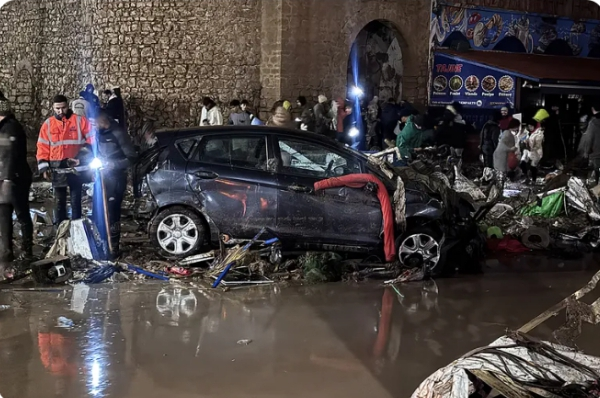
Images shared online showed muddy torrents sweeping away cars, rubbish bins, and market stalls, leaving devastation etched across Safi’s centuries-old neighborhoods.
Flash floods in Safi inundated at least 70 homes and businesses, particularly in low-lying historic districts where drainage systems proved disastrously inadequate.
A Safi governorate statement said search-and-rescue operations continued overnight, adding that security forces were deployed to stabilize damaged zones.
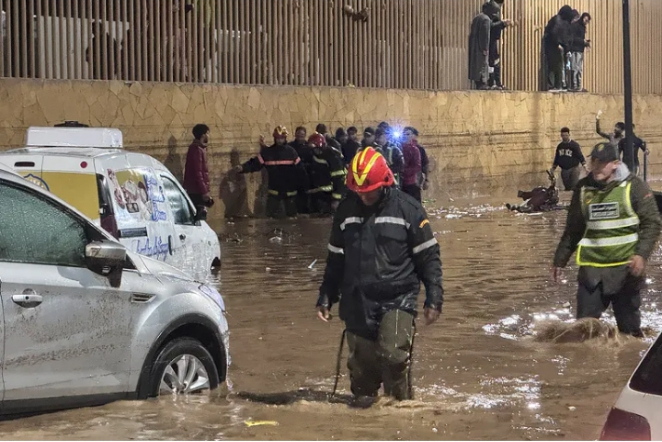
“We are still looking for missing people,” a local official said, stressing that emergency teams faced debris-filled streets and collapsed road sections.
Resident Marouane Tamer told AFP, “The water rose too fast. We kept asking why pumping trucks didn’t arrive sooner to clear the streets.”
Flash floods in Safi also crippled transportation, cutting off key access routes to the Atlantic port city and disrupting commercial supply lines.
Casablanca-based newspaper Le Matin reported severe damage along provincial road 2300 linking Safi with Hrara, isolating nearby communities.
Education authorities suspended school activities across Safi province, citing safety risks and damaged facilities following the unprecedented flooding.
By Sunday evening, floodwaters receded, revealing mud-choked streets where residents searched desperately for salvageable belongings.
Flash floods in Safi left families staring at ruined furniture, destroyed merchandise, and collapsed walls, compounding grief with sudden economic hardship.
Local shopkeeper Amina El Idrissi said, “Everything I worked for is gone. One hour changed my entire life.”
Emergency responders distributed blankets, food, and drinking water, while temporary shelters opened for families whose homes became uninhabitable.
Flash floods in Safi occurred as Morocco braces for further heavy rainfall, with meteorologists warning of additional storms across several regions.
The General Directorate of Meteorology forecast renewed downpours on Tuesday, raising fears of fresh flooding and landslides nationwide.
Morocco is also experiencing snowfall in the Atlas Mountains, a stark contrast after seven years of punishing drought.
Climate scientists say flash floods in Safi reflect a dangerous pattern of extreme weather intensified by rising global temperatures.
“Warmer air holds more moisture,” a Rabat-based climatologist explained. “When rain falls, it comes suddenly and violently.”
Official data show 2024 was Morocco’s hottest year on record, amplifying evaporation and destabilizing long-established rainfall cycles.
Flash floods in Safi revived painful memories of earlier disasters, including deadly floods in Tangier in 2021 that killed 24 workers.
That tragedy involved an illegal underground textile workshop, exposing regulatory failures alongside natural hazards.
In 2014 and 2015, torrential rains also caused widespread flooding across Morocco, damaging infrastructure and displacing thousands.
Flash floods in Safi arrived just days after another catastrophe, when two buildings collapsed in Fes, killing 19 people.
That incident intensified public anger over safety enforcement, urban planning, and accountability at local government levels.
Residents increasingly question whether aging infrastructure can withstand intensifying climate-driven disasters.
“We keep rebuilding the same way,” said urban planner Youssef Benali. “But the risks are growing faster than our solutions.”
Flash floods in Safi highlighted drainage failures in historic districts never designed for modern population density.
Experts argue that urban expansion, sealed surfaces, and inadequate maintenance worsen runoff during heavy storms.
Environmental groups urge Moroccan authorities to integrate climate adaptation into city planning before disasters multiply.
“Floods are no longer rare events,” warned a spokesperson for a local NGO. “They are becoming the new normal.”
Flash floods in Safi also exposed social inequalities, as poorer neighborhoods suffered disproportionate damage and slower recovery.
Many residents lack insurance, savings, or alternative housing, making recovery painfully uncertain.
Humanitarian volunteers described scenes of exhaustion, grief, and solidarity as neighbors helped neighbors clear debris.
Flash floods in Safi prompted messages of condolence from across Morocco, with national leaders pledging support and investigations.
The interior ministry promised assessments of infrastructure resilience and emergency response coordination.
However, critics say promises often fade once floodwaters recede and headlines shift elsewhere.
“Accountability disappears with the mud,” said activist Khadija Rami. “We need action, not sympathy.”
Flash floods in Safi underscore the urgent intersection between climate change, governance, and human safety.
As Morocco confronts intensifying extremes, Safi’s tragedy may become a turning point—or a warning unheeded.
For grieving families, the focus remains painfully immediate: burying loved ones and rebuilding shattered lives.
Read also:Bondi beach shooting gun law debate intensifies after Sydney terror attack
Flash floods in Safi will be remembered not just for their death toll, but for the urgent questions they leave behind.
About The Author