

The Bondi Beach shooting gun law debate has engulfed Australia after a devastating attack left fifteen people dead, reigniting national grief, political resolve, and urgent questions about public safety.
What began as a festive gathering near Sydney’s iconic shoreline descended into terror as gunshots echoed across Bondi Beach, sending families, children, and tourists scrambling for cover.
Police said the attack unfolded rapidly, with witnesses describing panic, screams, and confusion as people fled toward the ocean and nearby streets under sustained gunfire.
Emergency responders arrived within minutes, transforming the beachfront into a triage zone as paramedics treated the wounded amid scattered belongings and overturned festival stalls.
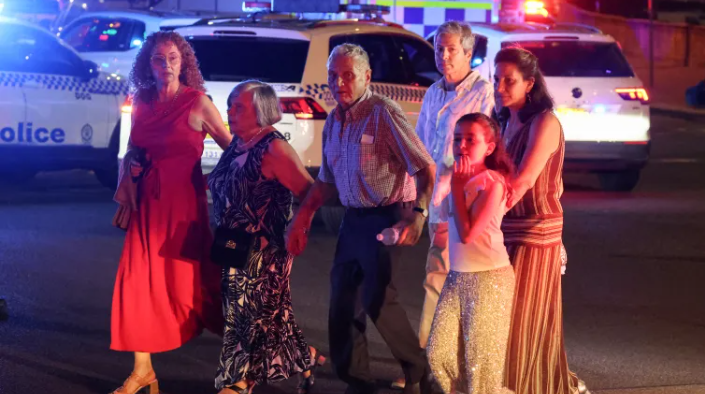
Authorities later confirmed at least forty people were injured, several critically, overwhelming nearby hospitals and prompting blood donation appeals across New South Wales.
The victims, aged between ten and eighty-seven, reflected the indiscriminate nature of the violence, intensifying public sorrow and anger across Australia’s normally peaceful communities.
Prime Minister Anthony Albanese addressed the nation in sombre tones, calling the massacre “an attack on everything we stand for as Australians.”
“This violence has no place here,” Albanese said. “We must confront hatred, extremism, and the tools that enable such devastation.”
The Bondi Beach shooting gun law debate sharpened after police disclosed that one attacker legally owned the firearms used in the assault.
According to investigators, the primary suspect, a fifty-year-old man, held a valid weapons licence and died at the scene during the police response.
His twenty-four-year-old son, identified as the second suspect, was critically injured and remains under heavy guard in hospital, authorities said.
Counterterrorism officials classified the incident as a terrorist attack, stating it deliberately targeted Sydney’s Jewish community during Hanukkah celebrations.
“This was a targeted act of hate,” a senior police official told reporters. “The symbolism and timing were clearly chosen.”
Jewish leaders across Australia expressed heartbreak and fear, with many calling for increased security at religious and cultural events nationwide.
“This has shaken us deeply,” said one community organiser. “People came to celebrate faith and family, not to face bullets.”
Flowers, candles, and handwritten notes quickly filled the Bondi promenade, as mourners gathered silently overlooking the sea.
Among the tragedy emerged an act of courage that briefly cut through the darkness of the day.
Video footage showed a bystander tackling and disarming one attacker, an intervention police believe saved numerous lives.
“That man is a hero,” Albanese said. “His bravery reminds us of humanity even in moments of horror.”
Social media users echoed the sentiment, praising the bystander’s instinctive courage while mourning lives that could not be saved.
As shock turned to reflection, attention shifted swiftly toward the Bondi Beach shooting gun law debate unfolding in parliament.
Albanese confirmed the national cabinet would urgently review firearm regulations, including licence limits and periodic reassessments of gun ownership.
“The government is prepared to take whatever action is necessary,” Albanese said, “including tougher gun laws if required.”
He pointed to Australia’s landmark reforms following the 1996 Port Arthur massacre, describing them as “a proud bipartisan achievement.”
“Those laws made an enormous difference,” he said. “If gaps exist today, we must close them.”
Opposition leaders cautiously signalled support for discussions, though some warned against rushed legislation amid national grief.
Gun control advocates argued the tragedy proved existing safeguards were insufficient, particularly regarding multiple-weapon ownership and licence renewals.
“This is a systemic failure,” said one campaigner. “Legal access does not always mean safe access.”
Others urged authorities to examine warning signs, noting the younger suspect had previous contact with officials without triggering intervention.
Security analysts highlighted rising global antisemitism, warning Australia is not immune to extremist ideologies circulating online.
“The threat environment has changed,” said one terrorism expert. “Lone actors and family units can radicalise quietly.”
International leaders condemned the attack, with messages of solidarity arriving from Europe, the Middle East, and neighbouring New Zealand.
Israel’s prime minister described the shooting as “a vile act of antisemitic terror” and urged global vigilance.
Back at Bondi, residents struggled to reconcile the violence with a place synonymous with leisure, surf, and sunshine.
“I walk this beach every morning,” one local said. “I never imagined something like this could happen here.”
Psychologists warned of long-term trauma for survivors, first responders, and children who witnessed the violence.
“This kind of event leaves invisible scars,” a trauma specialist explained. “Support must extend far beyond the headlines.”
As investigations continue, police increased patrols at religious sites and public events across major Australian cities.
For many, the Bondi Beach shooting gun law debate now represents a defining national moment.
It raises uncomfortable questions about balancing freedoms, security, and the evolving nature of extremist threats.
Families of victims have called for accountability, reform, and remembrance rather than political division.
“We don’t want excuses,” said one grieving relative. “We want change, so no one else suffers like this.”
Australia now stands at a crossroads, confronting grief with resolve and deciding whether tragedy will again reshape its laws.
The coming weeks may determine whether the Bondi Beach massacre becomes another painful memory or a catalyst for lasting reform.
Read more: Hero bystander stops gunman during Australia Jewish festival shooting
About The Author


