The status quo collapsed at Al-Aqsa Mosque after Israeli police actions and arrests disrupted long-standing prayer arrangements in Jerusalem, sparking widespread concern as Ramadan began.
Tensions escalated sharply in Jerusalem as Muslim worshippers faced new restrictions at the sacred compound during Ramadan, a period traditionally marked by increased religious attendance.
The crisis centres on Al-Aqsa Mosque, a focal point of religious sensitivity whose governance has historically required careful political and security balance.

For more than six decades, a fragile agreement regulated worship at the compound, permitting Muslim prayer while restricting Jewish religious rituals within the site.
That arrangement has now fractured following repeated police raids, arrests of Islamic caretakers, and growing incursions by Jewish activists supported by powerful political figures.
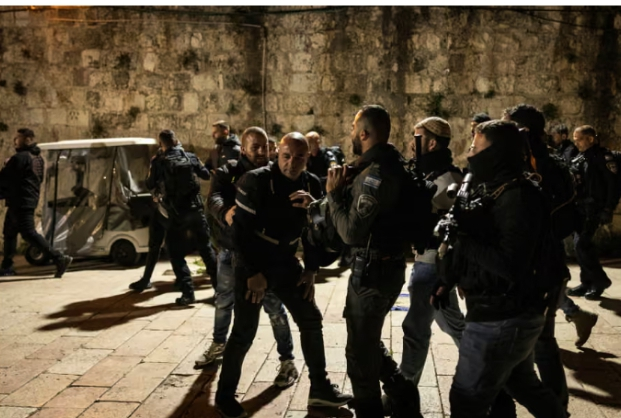
Israeli police arrested mosque staff and briefly detained the imam during evening prayers, actions described by observers as unprecedented during the opening of Ramadan.
Security forces also barred hundreds of Palestinian Muslims from entering the compound, forcing many to pray outside under heavy armed supervision.
The compound, known to Muslims as Haram al-Sharif, also includes the Dome of the Rock, further heightening its religious and political significance.
To Jews, the same site is revered as the Temple Mount, believed to house ancient temples destroyed in antiquity.
Legal expert Daniel Seidemann warned that any perceived threat to the site’s integrity risks triggering serious unrest.
“Al-Aqsa is a detonator,” he said, adding that tensions during Ramadan magnify existing political and religious sensitivities across the region.
Read also: Poland warns citizens to leave Iran as war risk escalates
He noted that previous provocations had already strained coexistence, but current actions represented an unprecedented shift in enforcement and intent.
The situation recalls past flashpoints, including a controversial 2000 visit by Ariel Sharon that ignited the second Palestinian uprising.
More recently, Hamas cited alleged violations at the mosque when naming its 2023 attack on Israel.
Israeli policy changes have coincided with the rise of far-right leadership within key security institutions governing Jerusalem.
National security minister Itamar Ben-Gvir has openly advocated expanding Jewish prayer at the compound.
Ben-Gvir has also called for symbolic actions at the site, including raising Israeli flags, alarming Palestinian leaders and regional observers.
His influence reportedly extends into policing decisions, following the appointment of ideological allies to senior Jerusalem security positions.
Prime minister Benjamin Netanyahu has faced criticism for allowing unilateral alterations to the long-standing agreement.
Printed Jewish prayer sheets were reportedly permitted inside the compound, a move widely described as violating established norms.
Israeli authorities have defended their actions as necessary for security, though they declined to comment directly on specific allegations.
The Islamic trust administering the mosque, the Jerusalem Waqf, reported extensive pressure on its staff ahead of Ramadan.
Officials said multiple employees were detained without charge, while dozens were banned from entering the compound entirely.
Offices were allegedly raided, repairs obstructed, and even basic supplies restricted, severely limiting operational capacity.
These measures, Waqf officials said, jeopardised preparations for tens of thousands of worshippers expected throughout Ramadan.
Separate figures released by Palestinian authorities indicated differing detention numbers, reflecting confusion and mistrust surrounding enforcement actions.
The Israeli internal security service, Shin Bet, did not respond to media requests regarding detentions.
Meanwhile, Israeli police extended visiting hours for Jewish visitors and tourists, another change criticised as unilateral.
Palestinian worshippers, blocked from entry, prayed on surrounding steps under armed surveillance, images that quickly spread across social media.
Analysts warn that these developments risk igniting broader unrest beyond Jerusalem itself.
The West Bank remains highly volatile, with recent violence increasing fears of wider escalation.
Regional dynamics have also shifted, reducing diplomatic constraints previously influencing Israeli decision-making.
According to International Crisis Group, this Ramadan carries heightened risk due to multiple converging pressures.
Senior analyst Amjad Iraqi warned that activists may exploit the moment to force irreversible changes.
“There are so many ingredients that make this Ramadan especially dangerous,” he said, pointing to political calculations on both sides.
He added that Israeli leaders appear increasingly unconcerned about regional or international reactions to actions at the site.
Past restraint, he argued, has been replaced by a sense of impunity shaped by recent regional conflicts.
As worship continues under heavy security, fears persist that further incidents could spark protests or violence.
Diplomats and religious leaders have urged restraint, warning that Al-Aqsa remains one of the most sensitive sites globally.
For many Palestinians, access to the mosque during Ramadan is both a religious obligation and a symbol of dignity.

For Israelis, internal political pressures continue to shape decisions affecting the compound’s future.
With Ramadan only beginning, observers fear the coming weeks will test an already fragile status quo.