Spanish police seize cocaine ship off the Canary Islands in what authorities describe as the largest maritime drug interception ever conducted by Spain’s national police force.
The operation uncovered nearly ten tonnes of cocaine concealed within a massive cargo of industrial salt aboard a merchant vessel crossing the Atlantic from Brazil toward Europe.
Spanish investigators say the seizure represents a major breakthrough in dismantling sophisticated maritime smuggling routes used by multinational criminal organisations supplying cocaine to European markets.
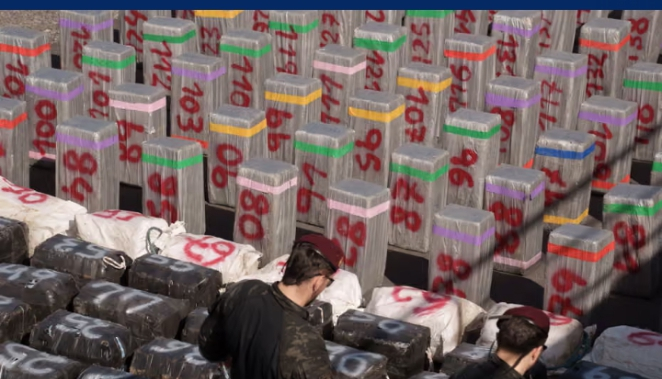
The vessel was intercepted approximately 332 miles from the Canary Islands after months of intelligence gathering and international surveillance cooperation involving multiple law enforcement agencies.
Spanish police elite maritime units boarded the ship after it became stranded at sea due to fuel shortages, preventing any attempt to divert or destroy evidence.
Once on board, officers discovered hundreds of tightly wrapped cocaine bundles buried deep beneath tonnes of salt in the ship’s vast cargo hold.
Video footage released by authorities shows officers shovelling through the salt cargo, carefully extracting bale after bale of cocaine hidden to evade detection.
In total, police recovered 9,994 kilograms of cocaine packed into 294 bundles, confirming the seizure as Spain’s largest ever drug haul at sea.
Thirteen individuals were arrested during the operation, all suspected of belonging to an organised criminal network operating across multiple continents.
Investigators also recovered a firearm onboard, believed to have been carried to protect the illicit shipment during its transatlantic journey.
Spanish police seized cocaine ship operations are increasingly viewed as critical in disrupting Europe’s growing reliance on maritime drug trafficking routes.
Authorities say the intercepted vessel had departed from Brazil, a major transit hub used by South American trafficking networks moving cocaine toward Europe.
The Canary Islands have become a strategic chokepoint for law enforcement due to their geographic position along Atlantic smuggling corridors.
Police officials described the mission, codenamed Operation White Tide, as a textbook example of successful international law enforcement coordination.
The operation involved cooperation between Spain’s Policía Nacional, Brazilian federal police, the US Drug Enforcement Administration, and British authorities.
French and Portuguese agencies also contributed intelligence and logistical support, highlighting the increasingly global nature of modern drug enforcement operations.
Spanish officials stated that maritime trafficking networks are becoming more complex, using legitimate commercial cargo to conceal massive drug consignments.
Salt, grain, and fruit shipments are frequently exploited by smugglers due to their bulk and difficulty to thoroughly inspect at sea.
The Canary Islands cocaine seizure underscores the scale at which criminal organisations are willing to operate to satisfy European cocaine demand.
Read also: Malaysia blocks Elon Musk’s Grok AI over global outrage on sexualised deepfake images
Spanish police emphasised that the operation dealt a “decisive blow” to international drug trafficking networks operating across the Atlantic.
Authorities say the interception prevented millions of doses of cocaine from reaching European streets, averting significant social and economic harm.
This seizure surpasses Spain’s previous maritime record of 7.5 tonnes of cocaine recovered from a fishing trawler in 1999.
While maritime seizures remain rare, they are often far larger than land interceptions due to the volume traffickers move via ocean routes.
Spain has emerged as one of Europe’s most critical frontline states in the fight against cocaine trafficking from Latin America.
The country’s extensive coastline and proximity to Atlantic shipping lanes make it a primary entry point for illicit narcotics.
In 2024 alone, Spanish authorities seized over 123 tonnes of cocaine nationwide, reflecting a sharp increase from previous years.
Law enforcement officials attribute the rise partly to stronger intelligence sharing and improved maritime surveillance technologies.
However, they also warn that criminal networks are expanding production and trafficking operations at unprecedented speed.
Spanish police seize cocaine ship cases demonstrate how traffickers increasingly rely on legitimate shipping infrastructure to mask criminal activity.
Authorities say drug syndicates are embedding themselves deeper into global trade systems, making detection more challenging.
Despite this, officials insist that international cooperation remains the most effective weapon against large-scale maritime trafficking.
The ship was towed to Santa Cruz de Tenerife, where forensic teams began a detailed inspection of the vessel and its documentation.
Prosecutors are now building cases against the arrested suspects, who may face lengthy prison sentences under Spanish and international law.
Investigations are also ongoing to identify the financial backers and logistical coordinators behind the shipment.

Spanish authorities believe the operation will lead to further arrests across Europe and South America as intelligence continues to be analysed.
Experts say such seizures send a powerful message to organised crime groups that maritime routes are no longer safe from detection.
The success of the Canary Islands cocaine seizure highlights the growing effectiveness of multinational law enforcement alliances.
Spanish police reaffirmed their commitment to intensifying operations against international drug trafficking networks operating on a global scale.
As Europe’s cocaine market continues to expand, authorities warn that sustained cooperation will be essential to counter increasingly aggressive criminal syndicates.
About The Author