

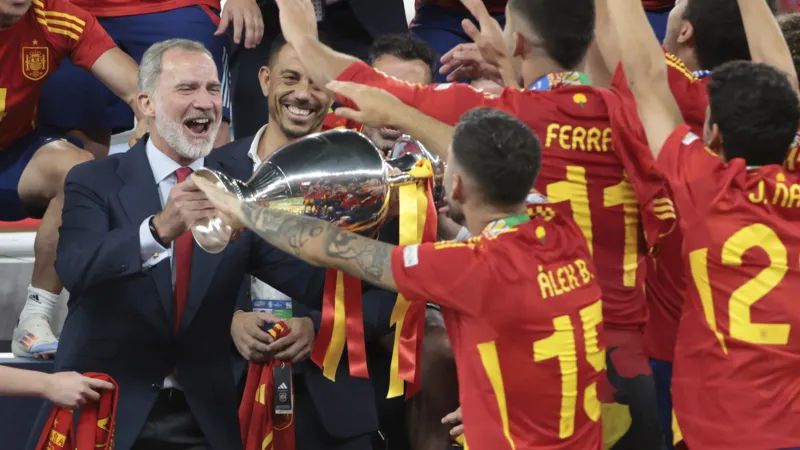
Spain’s King Felipe VI has welcomed an invitation from Mexico to attend the upcoming FIFA World Cup, in what is being widely interpreted as a significant step toward repairing strained relations between the two nations.
The invitation, extended by Mexican President Claudia Sheinbaum, comes shortly after the Spanish monarch publicly acknowledged that there had been “a lot of abuse” during Spain’s colonial conquest of the region that is now Mexico, marking a rare and symbolically important moment in the long-running debate over historical accountability.
According to Spain’s royal household, Sheinbaum’s message framed the joint hosting of the FIFA World Cup 2026 by Mexico, the United States and Canada as an opportunity to celebrate and reflect on the deep historical and cultural ties between Mexico and Spain.
She described the tournament as a “timely opportunity” to highlight a relationship shaped by shared language, heritage and collective memory, while also acknowledging the complexities that continue to define it.
The Spanish palace confirmed it had “welcomed” the invitation, though it has not yet stated whether King Felipe will attend the event, scheduled to take place between June and July 2026.
The diplomatic gesture is notable because relations between the two countries have been tense in recent years, largely due to disagreements over how Spain should address the legacy of its colonial rule in the Americas.

The issue gained renewed prominence in 2019 when former Mexican president Andrés Manuel López Obrador formally requested that Spain apologise for human rights abuses committed during the conquest of the Aztec Empire. That request went unanswered, contributing to a cooling of diplomatic ties and setting the stage for further friction.
Tensions escalated again in 2024 when Sheinbaum made the unusual decision not to invite King Felipe VI to her presidential inauguration, a move widely interpreted as a diplomatic snub. At the time, the absence of an apology from Spain remained a central sticking point.
However, the tone of the relationship began to shift following the king’s recent remarks during a visit to an exhibition in Madrid focusing on Indigenous Mexican women. In those comments, Felipe acknowledged that aspects of Spain’s past, when judged by modern values, were difficult to take pride in.
“There are things that, when we study them with present-day criteria, obviously cannot make us feel proud,” the monarch said, in what observers have described as the first time a Spanish king has publicly recognised abuses linked to the colonial era.
Although the statement stopped short of offering a formal apology, it was nonetheless seen as a meaningful acknowledgment of historical wrongdoing.
President Sheinbaum responded cautiously but positively, describing the remarks as a gesture of reconciliation, even if they did not fully meet Mexico’s expectations.
“One could say that it is not everything we would have wanted, but it is a gesture,” she noted, signalling a willingness to move forward diplomatically while keeping the broader issue of historical justice on the table.
It has since emerged that Sheinbaum had already initiated efforts to rebuild ties before the king’s comments became public, suggesting a coordinated attempt by both sides to ease tensions.
In her communication to the Spanish monarch, she emphasised the enduring bonds between the two nations, referring to a “historical brotherhood” reinforced by centuries of shared culture, language and migration. This framing indicates a deliberate effort to balance acknowledgement of past grievances with a forward-looking vision of cooperation.
The World Cup invitation itself carries both symbolic and practical significance. As one of the largest sporting events in the world, the tournament offers a high-profile platform for diplomacy, allowing countries to showcase unity and collaboration on a global stage.
For Mexico, hosting the event alongside its North American partners represents an opportunity to reinforce its international standing, while also addressing domestic challenges such as security concerns linked to organised crime.
Preparations for the tournament have included a major security push by Mexican authorities, particularly in response to recent violence involving drug cartels.
The killing of notorious cartel leader Nemesio Oseguera Cervantes earlier in 2026 triggered a wave of retaliatory violence in parts of the country, raising concerns about safety ahead of the influx of international visitors expected for the World Cup.
One of the host cities, Guadalajara, lies in the state of Jalisco, which has been a focal point of cartel activity.
Despite these concerns, President Sheinbaum has insisted that there is “no risk” to visiting fans, while FIFA president Gianni Infantino has expressed confidence in the security arrangements being put in place.
Mexican authorities are planning to deploy thousands of security personnel across host cities to ensure the safety of players, officials and supporters during the tournament.
For Spain, participation at a high level in the World Cup would also carry cultural resonance, given the country’s strong footballing tradition and the personal enthusiasm of King Felipe VI for the sport.
The monarch is known to be an avid supporter of Atlético de Madrid and has frequently attended major matches, including the UEFA European Championship final in 2024. His presence at the World Cup would therefore not only have diplomatic significance but also reflect his longstanding engagement with football.
Beyond the immediate context of the tournament, the evolving relationship between Spain and Mexico reflects broader global debates about how former colonial powers address historical injustices.
While some countries have taken formal steps to apologise or provide reparations, Spain has generally adopted a more cautious approach, emphasising historical interpretation and dialogue rather than explicit acknowledgment of wrongdoing.
However, recent statements by Spanish officials suggest a gradual shift in tone.
Spain’s foreign minister, José Manuel Albares, drew praise from Mexican leaders when he acknowledged that the shared history between the two countries included “pain and injustice.”
Such remarks, combined with the king’s comments, indicate a growing willingness within Spain’s leadership to engage with the more difficult aspects of its past, even if a formal apology remains unlikely in the near term.
The invitation to the World Cup can therefore be seen as part of a broader process of diplomatic recalibration, in which both nations are seeking to move beyond past disagreements while maintaining their respective positions on historical issues.
For Mexico, this involves pressing for greater recognition of colonial-era abuses, while also prioritising international partnerships and economic cooperation.
For Spain, it means balancing domestic political considerations with the need to maintain strong ties with one of its most important partners in Latin America.
As preparations for the 2026 tournament continue, the possibility of King Felipe VI attending the event will remain a focal point of attention.
His decision could serve as a powerful symbol of reconciliation, signalling that both countries are ready to turn a new page in their relationship. Even if he ultimately declines the invitation, the exchange itself has already helped to ease tensions and open the door to further dialogue.
In this sense, the World Cup is functioning not only as a sporting spectacle but also as a diplomatic मंच where historical narratives, national identities and international relationships intersect.
The evolving dynamic between Spain and Mexico underscores how global events can create opportunities for dialogue and understanding, even in the context of deeply rooted historical disputes.
Read also: Tottenham vs Atletico Madrid: Tottenham vs Atletico Madrid thriller ends in painful exit
Ultimately, while the legacy of colonialism continues to cast a long shadow over relations between the two nations, recent developments suggest a cautious but meaningful shift toward reconciliation.
The acknowledgment of past abuses by a Spanish monarch, combined with Mexico’s willingness to extend an olive branch through the World Cup invitation, represents a step forward in a complex and ongoing process.
About The Author
