

South Korean President Lee Beijing summit marks a critical diplomatic moment as Seoul and Beijing recalibrate relations amid regional tensions, economic interdependence, and intensifying strategic competition.
China’s invitation for President Lee Jae Myung signals Beijing’s intent to stabilise ties with South Korea during a period of evolving alliances and heightened geopolitical uncertainty.
Officials confirmed Lee will meet President Xi Jinping in Beijing before travelling to Shanghai, reflecting symbolic respect for shared history and forward-looking cooperation.
South Korea’s national security adviser Wi Sung-lac described the visit as focused on “practical cooperation” across economic, security, and cultural domains, according to media briefings.
Wi said both leaders aim to strengthen collaboration on supply chains, tourism recovery, and cross-border crime, areas increasingly affected by global instability and technological change.
Lee is also expected to encourage China’s “constructive role” in addressing stalled diplomacy on the Korean Peninsula, particularly concerning North Korea’s weapons programmes.
Analysts note the unusually short interval between Lee and Xi meetings underscores China’s urgency to engage Seoul before its next high-level summit with Japan.

Relations between Beijing and Tokyo remain strained following remarks by Japanese Prime Minister Sanae Takaichi regarding potential military responses to a Taiwan conflict.
A regional analyst observed, “China wants to emphasise South Korea’s importance slightly more than before,” highlighting shifting diplomatic priorities within Northeast Asia.
South Korea reaffirmed its adherence to the one China policy, maintaining formal recognition of Beijing’s sovereignty claims while sustaining informal ties with Taiwan.
Wi stressed Seoul’s position respects existing frameworks, balancing economic realities with alliance commitments, as tensions rise across the Taiwan Strait.
Under former president Yoon Suk Yeol, South Korea aligned more closely with Washington and Tokyo, drawing criticism from Beijing over regional security postures.
Lee has adopted what his administration calls “practical diplomacy,” seeking balanced relations without forcing binary choices between major global powers.
He has stated South Korea will not take sides in disputes between China and Japan, even as military drills near Taiwan intensify regional anxieties.
Security analysts say the summit may address modernisation of the South Korea United States alliance, often perceived by China as containment-oriented.
Approximately 28,500 US troops remain stationed in South Korea, primarily deterring North Korean threats while increasingly factoring broader regional contingencies.
US officials have suggested these forces may adopt flexible roles responding to challenges beyond the peninsula, including potential crises involving Taiwan.
General Xavier Brunson remarked, “Korea sits at the crossroads of broader regional dynamics,” reflecting Washington’s evolving strategic calculations.
China’s position as North Korea’s principal ally makes Beijing central to any renewed dialogue efforts between Seoul and Pyongyang.
Experts expect Lee to seek China’s assistance in reopening communication channels with North Korea, despite past hostility toward his outreach initiatives.
North Korea previously dismissed Lee as a “confrontational maniac,” language illustrating Pyongyang’s entrenched distrust of South Korean overtures.
Meanwhile, China and North Korea have strengthened coordination, with Kim Jong Un appearing alongside Xi at major state military events.
Trade considerations remain central to the South Korean President Lee Beijing summit, particularly regarding rare earth minerals and advanced manufacturing supply chains.
Nearly half of South Korea’s rare earth imports originate from China, underscoring economic interdependence despite strategic unease.
China also represents South Korea’s largest export market for semiconductors, accounting for roughly one-third of annual overseas chip shipments.
Last month, officials agreed to pursue stable rare earth supplies, easing industry concerns amid global competition for critical resources.
The summit may also explore collaboration in green industries, artificial intelligence, and next-generation technologies shaping future economic growth.
Huawei plans to introduce its Ascend 950 AI chips in South Korea, offering domestic firms alternatives beyond US-based technology suppliers.
Huawei’s South Korea chief said the launch reflects confidence in bilateral technology cooperation despite broader geopolitical pressures.
Cultural diplomacy could resurface during talks, particularly Beijing’s informal ban on K-pop content imposed after THAAD deployment in 2017.
Entertainment executives joining Lee’s delegation suggest Seoul hopes to revive cultural exports, leveraging popular demand among Chinese audiences.
A senior industry figure noted, “Cultural exchange is often the first casualty of political tension,” underscoring commercial stakes involved.
Observers say restoring cultural flows could signal broader stabilisation beyond purely economic or security-driven engagement.
Lee’s Shanghai visit includes a stop at the historic site of South Korea’s provisional government during Japanese colonial rule.
The gesture carries symbolic resonance, linking shared historical experiences with contemporary diplomatic outreach.
Regional scholars argue symbolism matters, particularly in East Asian diplomacy, where historical memory shapes present-day policy decisions.
China’s outreach reflects concern about deepening US-Japan-South Korea cooperation, increasingly framed as a unified strategic bloc.
Seoul, however, continues to emphasise autonomy, avoiding rigid alignment that could constrain economic or diplomatic flexibility.
A former South Korean defence official said, “Balancing alliances while managing China relations is Seoul’s central strategic challenge.”
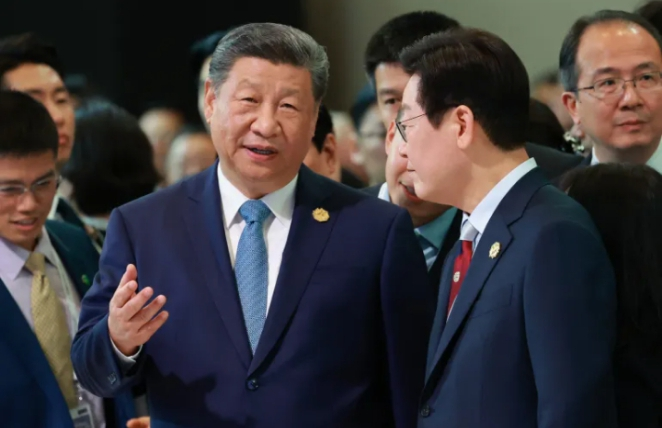
As regional power competition intensifies, Lee’s visit illustrates South Korea’s attempt to navigate complex pressures without sacrificing national interests.
The South Korean President Lee Beijing summit ultimately highlights diplomacy as risk management rather than ideological alignment in today’s Asia.
Read also: Kim Jong-un hails “invincible” Russia alliance as North Korean troops fight abroad
Whether practical cooperation yields lasting stability will depend on sustained engagement beyond ceremonial meetings and carefully worded communiqués.


