South Africa has strongly condemned the US decision to boycott the upcoming G20 summit in Johannesburg, describing the move as “coercion by absentia” aimed at undermining global cooperation.
The announcement follows confirmation from the Trump administration that none of its officials would attend the leaders’ summit scheduled for 22 to 23 November, marking the first G20 meeting hosted on African soil.
Washington has stated it will not recognize any final statement issued by G20 leaders in its absence, effectively challenging South Africa’s authority to issue a communique without US consent.
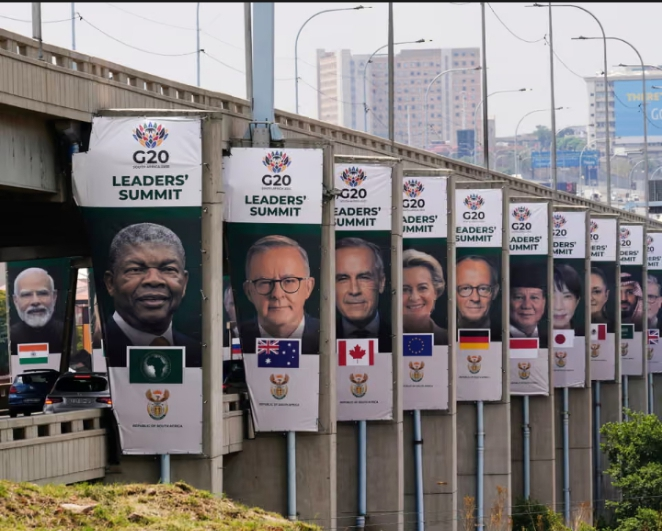
South African officials rejected claims that the boycott was justified, with government spokesperson Chrispin Phiri emphasizing that coercion tactics by absent parties risk institutional paralysis within multilateral forums.
“The absence of Washington does not negate the legitimacy of our leadership, but allowing coercion by absentia sets a dangerous precedent for international diplomacy,” Phiri said in a statement.
The US embassy in Pretoria sent a note stating that only a “chair’s statement” would be acceptable, rejecting the issuance of a formal G20 leaders’ declaration without Washington’s agreement.
South African priorities for the G20 presidency include addressing global debt sustainability for low-income countries and increasing financing for a “just energy transition” away from fossil fuels.
The summit organizers have also invited 22 additional countries beyond the standard G20 members, reflecting South Africa’s commitment to inclusivity and engagement with the Global South on key economic and environmental issues.
Donald Trump has accused South Africa of discriminating against the minority white Afrikaner community, a claim the government has vehemently denied, citing the country’s democratic and inclusive constitution.
In previous statements, Trump framed South Africa’s G20 priorities, including sustainability and equality initiatives, as “contrary to US policy views,” implying that Washington would withhold cooperation from the summit.
US Secretary of State Marco Rubio previously labelled South Africa’s focus on solidarity and sustainability as “anti-Americanism,” reinforcing the narrative that Washington perceives the summit as conflicting with its interests.
The boycott underscores broader US criticism of the G20’s evolution from its original focus on global finance and economic governance to a wider agenda that now includes environmental and social dimensions.
Treasury Secretary Scott Bessent noted that the US intends to streamline the forum during its presidency next year, returning to a smaller, more focused G20 that prioritizes economic fundamentals over expansive global agendas.
South African President Cyril Ramaphosa expressed determination to proceed with the summit despite the US absence, highlighting that the G20 continues to function as an institution irrespective of participation by individual members.
Ramaphosa suggested that symbolic gestures, such as handing over the presidency to an empty chair representing the US, would illustrate that the forum’s work continues even when one member abstains.
The G20 consists of 19 of the world’s largest economies plus the European Union and traditionally issues a communique at the conclusion of each leaders’ summit, summarizing consensus decisions and future commitments.
Recent criticism of the G20 process includes objections from Ukraine and its allies regarding the omission of Russia’s invasion in the final communiqué last year, highlighting the forum’s sensitivity to geopolitical disputes.
South Africa’s G20 presidency has sought to balance economic, environmental, and social priorities, promoting debt relief, climate finance, and equitable growth as central objectives of the summit’s agenda.
The US boycott could potentially undermine these efforts, but South African officials remain confident that multilateral cooperation will continue through active engagement with other participating nations and invited observers.
Observers note that the first African-hosted G20 summit carries symbolic significance, representing a shift toward a more inclusive global economic dialogue that incorporates perspectives from developing nations.
Phiri emphasized that attempts to coerce leadership decisions by absent powers threaten the very foundations of collective action, warning that such tactics could set a harmful precedent for future multilateral negotiations.
The South African government has underscored the importance of maintaining G20 credibility, insisting that the summit’s outcomes should reflect broad consensus rather than the approval of a single absent nation.
Critics argue that US objections reflect geopolitical positioning ahead of its own G20 presidency, seeking to assert influence over the forum’s priorities while limiting engagement with initiatives it does not fully endorse.
The expanded G20 agenda aligns with global challenges, including debt crises, climate change, and energy transition, demonstrating that issues beyond traditional economic policy now require urgent international collaboration.
Ramaphosa’s administration continues to emphasize dialogue and inclusion, aiming to showcase Africa’s role in global governance and to strengthen partnerships between emerging and developed economies at the Johannesburg summit.
Despite tensions with the US, South Africa maintains that the summit will proceed as planned, underlining that the absence of one member cannot invalidate the collaborative work of remaining participants and invited countries.
The G20 communique, even if issued in modified form without US endorsement, is expected to address pressing global issues, including sustainable development, climate finance, and equitable economic recovery strategies.
South Africa’s stance reinforces its commitment to multilateralism and consensus-building, sending a message that coercive tactics by major powers will not dictate the course of international dialogue or summit outcomes.
The summit’s proceedings will be closely watched by international media, policymakers, and financial markets, with expectations that South Africa will demonstrate leadership despite the diplomatic challenge posed by the US boycott.
About The Author