

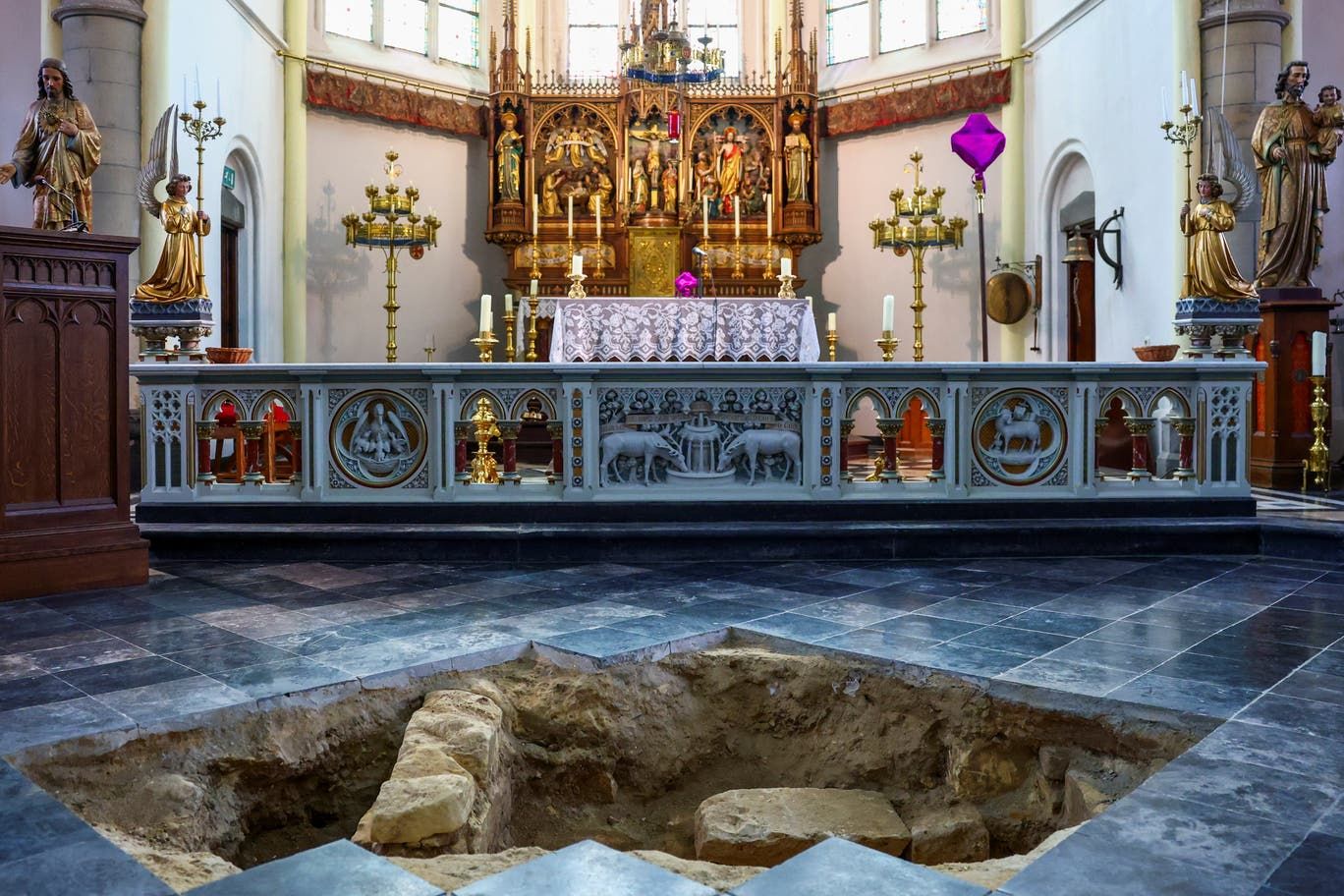
Archaeologists in Maastricht believe the skeleton of Three Musketeers hero d’Artagnan may have been found buried under church, potentially uncovering the remains of Charles de Batz de Castelmore, whose life inspired Alexandre Dumas’ novel.
The grave was revealed after part of the church floor subsided last month, prompting DNA testing to verify the identity. Workers carefully removed tiles, exposing human remains that could finally solve a centuries-old historical mystery, connecting literary legend with actual 17th-century events in the Netherlands, where the French army once camped near Maastricht during the Siege of 1673.
The remains are suspected to belong to the real-life d’Artagnan, a musketeer and spy serving King Louis XIV, who was fatally struck by a musket ball in Maastricht. Archaeologists hope DNA extracted from a jawbone will match descendants of the historical figure.

The discovery provides rare insight into France’s military history, while also bridging fiction and reality. Experts note that transporting the body to Paris in summer heat would have been difficult, making the church a likely final resting place and emphasizing the significance of the find for historical research and cultural heritage.
Investigators report that several clues were recovered alongside the bones, including a French coin dated 1660 and part of a lead bullet positioned at chest level, consistent with historical accounts. Deacon Jos Valke highlighted these artifacts as strong indicators, supporting the hypothesis that the skeleton belongs to d’Artagnan.
The burial took place under the church altar in consecrated ground, and archaeological evidence aligns with documented descriptions of the Siege of Maastricht, allowing historians to examine both literary sources and physical artifacts to reconstruct the final moments of the famed musketeer’s life.
DNA analysis now underway could provide conclusive identification of the skeleton, linking it definitively to Charles de Batz de Castelmore. Researchers emphasize that this investigation combines modern scientific techniques with meticulous historical study.
Wim Dijkman, an archaeologist involved in the dig, described the work as a top-level investigation. Confirmation of the identity would be a major breakthrough, validating centuries of speculation and bringing the legendary character of d’Artagnan from Dumas’ novels into real-world historical context. The site continues to be carefully excavated to preserve all remaining evidence for further study.
The fictional character d’Artagnan in The Three Musketeers was a young, ambitious hero who befriended the original three musketeers and eventually became the fourth. Dumas’ novel drew from the life and exploits of Charles de Batz de Castelmore, blending adventure, loyalty, and espionage into a literary masterpiece.
The possible discovery of his skeleton allows historians and literary scholars to study the historical figure behind the stories. Screen adaptations have portrayed d’Artagnan in multiple films, with actors including Douglas Fairbanks and Michael York, making the character an enduring icon whose real-life counterpart may now be confirmed through archaeology.
The church where the skeleton was found stands near the location where the French army camped during the Siege of Maastricht, making it a historically plausible burial site. Archaeologists have noted that the subsided floor tiles revealed not only the skeletal remains but also artifacts indicative of a 17th-century burial.

This discovery sheds light on burial practices of the time and provides tangible connections to military history. The combination of coins, bullets, and skeletal positioning offers multiple points of verification for identifying d’Artagnan, strengthening the likelihood that the skeleton is authentic.
Historians note that Charles de Batz de Castelmore’s death occurred during a critical moment in French military campaigns, reflecting both personal bravery and the high stakes of 17th-century warfare.
His legacy was immortalized in Dumas’ narrative, but verification of the physical remains adds an unprecedented dimension to our understanding. DNA testing remains the primary method to confirm the identity, allowing comparisons with living descendants.
The investigation balances literary heritage, historical scholarship, and scientific rigor, ensuring that the potential discovery of d’Artagnan’s skeleton is properly documented and authenticated.
Excavation teams have emphasized the careful handling of the remains to prevent any damage, while DNA samples are analyzed in specialized laboratories. The discovery also draws international attention to Maastricht, attracting historians, literary scholars, and enthusiasts alike.
Archaeologists have documented every step meticulously, including photography, mapping, and contextual analysis. This approach ensures that if confirmed, the skeleton of d’Artagnan can be studied for historical context, age, trauma, and other forensic evidence, further connecting the legendary hero with the reality of 17th-century European warfare.
Cultural historians highlight the significance of confirming d’Artagnan’s identity because it bridges fiction and history, demonstrating how literature can be grounded in reality.
The discovery of the skeleton allows for interdisciplinary study across archaeology, history, and literary scholarship. Experts are particularly interested in comparing historical records with physical evidence, understanding burial rituals, and evaluating artifacts recovered alongside the skeleton.
This multi-faceted approach ensures that any conclusions drawn will be thoroughly validated, enhancing both historical and literary narratives surrounding the legendary Musketeer hero.

The potential identification of the skeleton of Three Musketeers hero d’Artagnan also contributes to broader studies of European military history, battlefield archaeology, and 17th-century societal structures.
By analyzing coins, bullets, and skeletal remains, researchers gain insight into both the personal life of d’Artagnan and the broader historical context of French campaigns in the Netherlands.
If confirmed, the discovery may lead to renewed interest in Alexandre Dumas’ work, offering a tangible connection to the man who inspired one of literature’s most famous heroes, and enriching cultural understanding of how real-life events shape enduring stories.
Read also:Trump Xi China trip rescheduled as tensions reshape global diplomacy
Read more: Ireport247news
About The Author
