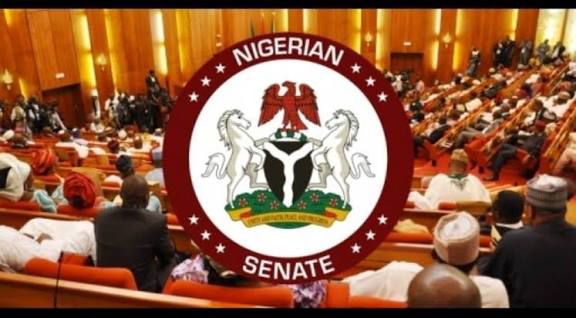
The Senate on Tuesday approved the 2026–2028 Medium-Term Expenditure Framework (MTEF) and Fiscal Strategy Paper (FSP), formally opening the door for President Bola Tinubu to present Nigeria’s proposed ₦54.4 trillion 2026 budget to the National Assembly.
The passage of the framework, which is a constitutional prerequisite for budget presentation, followed extensive deliberations on the report submitted by the Senate Committee on Finance, chaired by Senator Sani Musa (APC, Niger East).
With the approval secured, the executive arm is now expected to transmit the 2026 Appropriation Bill to lawmakers within days, setting the tone for fiscal planning ahead of the next budget cycle.
Senate President Godswill Akpabio, who presided over the plenary, emphasised that the approval of the MTEF should not be misconstrued as final endorsement of all fiscal assumptions contained in the document.
He explained that the framework merely provides a macroeconomic roadmap upon which the annual budget would be constructed.
According to Akpabio, the legislature retains the authority to review, adjust, or amend projections once the full budget details are submitted for scrutiny.
“What we have considered and passed today is a statutory requirement before the presentation of the budget. It is not a final position of the National Assembly,” Akpabio said.
“If circumstances change or new realities emerge, the framework can be revisited.”
Understanding the 2026–2028 MTEF and its fiscal assumptions
At the heart of the Senate’s decision lies the 2026–2028 MTEF, a three-year fiscal planning document designed to align government spending with projected revenues and macroeconomic realities.
The framework outlines key assumptions that will guide federal fiscal policy over the medium term, including oil production benchmarks, crude oil price projections, exchange rate expectations, and expenditure ceilings.
During the debate, lawmakers noted that the proposed parameters reflected cautious optimism amid lingering global and domestic economic uncertainties.
Senator Mohammed Monguno (APC, Borno North), who contributed to the discussion, described the assumptions as largely realistic, particularly the crude oil production benchmark of 1.84 million barrels per day.
He further commended the decision to peg the oil price benchmark at $60 per barrel, lower than earlier estimates, describing it as a prudent response to volatility in the global oil market.
Analysts believe the conservative oil price assumption could help insulate the budget from external shocks, especially given Nigeria’s heavy dependence on oil revenue to finance government operations.
Senate adopts MTEF report after debate
Following the debate, the Senate adopted the recommendations contained in the committee’s report through a voice vote, effectively endorsing the fiscal direction proposed in the 2026–2028 MTEF.
The approval marks the formal commencement of the 2026 budget cycle and places pressure on the executive to submit the appropriation bill promptly to maintain the January–December budget implementation timeline.
Lawmakers have repeatedly expressed concerns in past budget cycles over delays in budget presentation and implementation, which often result in capital projects being rolled over into subsequent fiscal years.
By passing the MTEF early, the Senate signalled its intention to avoid such disruptions and improve budget predictability.
Tinubu’s budget proposal expected within days
President Tinubu had earlier transmitted the 2026–2028 MTEF and Fiscal Strategy Paper to the National Assembly in line with statutory provisions.
The letter accompanying the submission was read on the Senate floor by the Deputy Senate President, Senator Barau Jibrin (APC, Kano North).
In the letter, the President outlined the macroeconomic assumptions underpinning the framework and urged lawmakers to give it expedited consideration to allow for timely preparation of the 2026 Appropriation Bill.
With the framework now approved, legislative sources indicate that the ₦54.4 trillion budget proposal could be presented before the end of the week, subject to final executive clearance.
The proposed budget is expected to prioritise infrastructure development, security, human capital investment, and economic reforms aligned with the administration’s Renewed Hope Agenda.
Renewed Hope Agenda and fiscal sustainability concerns
Supporters of the administration argue that the 2026–2028 MTEF reflects an attempt to balance ambitious development goals with fiscal sustainability.
However, concerns remain over Nigeria’s revenue generation capacity, rising debt service obligations, and the persistent gap between budget projections and actual revenue performance.
Although lawmakers expressed optimism that the framework’s assumptions were achievable, several senators cautioned that implementation would depend heavily on improved revenue mobilisation, particularly from non-oil sources.
In recent years, Nigeria has struggled to meet revenue targets, leading to increased borrowing to fund budget deficits.
Experts warn that without significant reforms to expand the tax base and boost non-oil exports, the sustainability of large budget outlays could be threatened.
What the passage means for Nigeria’s economy
The Senate’s approval of the 2026–2028 MTEF sends an important signal to investors, development partners, and international financial institutions about Nigeria’s fiscal direction.
A clearly defined medium-term framework is often viewed as a critical indicator of policy consistency and macroeconomic stability.
For businesses and households, the framework provides early insight into possible government priorities, including spending patterns, subsidy policies, and tax reforms that may emerge in the 2026 budget.
As attention now shifts to the details of the ₦54.4 trillion appropriation proposal, analysts will be watching closely to see how the government plans to fund its ambitions, manage debt, and stimulate economic growth amid ongoing structural challenges.
With the MTEF hurdle cleared, the coming days are expected to usher in a new phase of budget scrutiny that could shape Nigeria’s economic outlook for years to come.
About The Author