

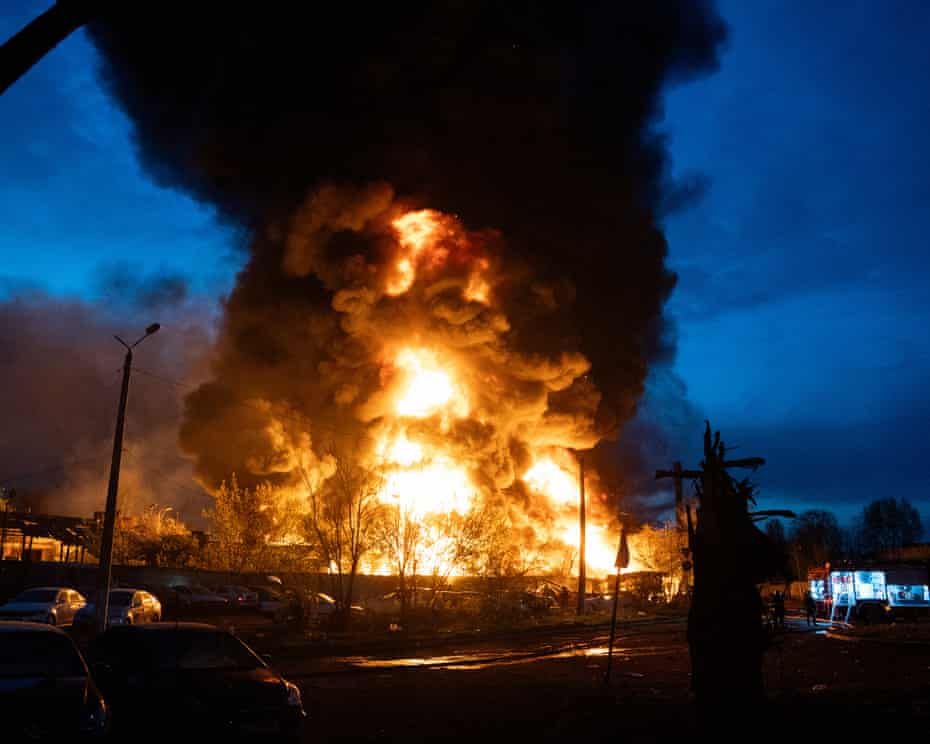
Russia missile and drone strikes in Ukraine killed at least 12 people overnight as coordinated attacks hit Kyiv, Odesa and Dnipro, according to regional authorities and emergency services reporting widespread destruction across multiple urban centres.
Officials confirmed that the assaults formed part of a renewed wave of long-range aerial attacks targeting both military and civilian infrastructure, with emergency alerts triggered across large parts of the country during sustained bombardments that stretched into the early morning hours.
Kyiv strike causes civilian casualties and widespread destruction
In Kyiv, at least four people were killed, including a child, after missile debris and drone impacts struck residential districts, causing fires and partial building collapses that left emergency teams searching through rubble for survivors.
Rescue operations continued for hours as firefighters and paramedics worked under unstable conditions, with officials confirming that multiple injuries were recorded as civilians were caught in collapsing structures and blast damage across several neighbourhoods.
Authorities said critical infrastructure damage has placed additional strain on emergency services, while air raid alerts remained active during ongoing aerial threats, forcing residents to remain in shelters throughout the night.
Odesa and Dnipro strikes expand war impact beyond the capital
In Odesa, missile strikes killed multiple civilians and caused significant damage to port infrastructure, further disrupting Ukraine’s key maritime logistics network and intensifying pressure on supply routes already affected by the ongoing conflict.
Dnipro also reported fatalities and injuries after drone strikes hit residential areas, with officials confirming that at least two people were killed and several others wounded in attacks that sparked fires and emergency evacuations.
The widening geographic spread of strikes reflects an escalation in operational reach, with both coastal and inland regions increasingly exposed to coordinated aerial assaults.
Rising drone warfare intensifies pressure on Ukrainian defence systems
The growing use of coordinated drone and missile attacks highlights a shift toward saturation-style warfare designed to overwhelm Ukrainian air defence systems across multiple regions simultaneously during overnight operations.
Military analysts say these combined assaults are increasingly difficult to fully intercept, forcing defensive units to prioritise high-value urban centres while attempting to manage rapidly evolving aerial threats across dispersed locations.
Despite ongoing interception efforts, officials acknowledge that sustained attack volume continues to challenge defensive coverage, particularly during periods of simultaneous multi-city strikes.
War escalation raises global concern over civilian impact
The escalation of attacks has triggered renewed international concern over rising civilian casualties, particularly as residential areas continue to bear the brunt of repeated strikes in densely populated cities.
Read also:Trump breaks with Orbán as Hungary election shock elevates Péter Magyar in political shift
Humanitarian organisations warn that continued bombardments are increasing displacement and stretching emergency response systems, with families forced to evacuate repeatedly as frontline dynamics shift and aerial threats persist.
The ongoing escalation underscores the continued volatility of the conflict and its widening impact on civilian life, infrastructure, and regional stability across Ukraine.
Strategic implications of Russia missile and drone strikes in Ukraine intensification
The latest wave of Russia missile and drone strikes in Ukraine reflects a broader shift in battlefield strategy, with increased reliance on long-range aerial attacks aimed at weakening infrastructure while avoiding sustained direct frontline confrontation. This pattern highlights a continued focus on pressure through distance warfare rather than territorial advances.
Military analysts suggest the growing scale of Russian drone attacks is intended to stretch Ukraine’s air defence systems across multiple regions simultaneously. By forcing rapid prioritisation between Kyiv, Odesa, Dnipro and other urban centres, the strategy increases the likelihood of successful strikes during saturation-style operations.
This escalation also reinforces a wider trend in the Ukraine war escalation, where infrastructure disruption is being used alongside military operations to degrade logistics, energy stability, and civilian resilience over time rather than through immediate battlefield breakthroughs.
Western response and evolving military support
Western governments have reacted to the renewed intensity of strikes by reassessing air defence assistance packages for Ukraine, with renewed emphasis on interceptor missiles, radar systems, and integrated early-warning capabilities.
NATO members and allied states have repeatedly stated that sustained missile and drone attacks demonstrate the need for deeper layered defence coverage, particularly in urban centres that continue to experience repeated targeting during overnight assaults.
While diplomatic engagement remains active, there is limited evidence of progress toward de-escalation, as both sides continue to prioritise operational advantage within the ongoing conflict environment.
Civilian infrastructure under increasing strain
The pattern of Russia missile and drone strikes in Ukraine shows an increasing focus on civilian infrastructure, including residential districts, transport corridors, and energy-related facilities that support daily life in major cities.
Humanitarian organisations report that repeated attacks are accelerating displacement trends, with many families forced into repeated cycles of evacuation and return as security conditions fluctuate across Kyiv, Odesa and Dnipro.
Emergency response systems remain under sustained pressure, with hospitals and rescue services operating beyond normal capacity due to the frequency, scale, and unpredictability of combined missile and drone assaults.
Geopolitical consequences and regional instability risks
The continued intensity of strikes carries wider geopolitical implications, particularly for European security stability and regional economic networks connected to Ukraine’s infrastructure.
Energy distribution routes, Black Sea maritime corridors, and grain export systems remain indirectly affected, contributing to broader economic uncertainty across global supply chains already sensitive to conflict disruptions.
Analysts warn that prolonged escalation could deepen geopolitical fragmentation and reduce the likelihood of near-term diplomatic breakthroughs, extending instability across Eastern Europe.
Outlook for the Russia-Ukraine war in the coming weeks
The trajectory of the Russia-Ukraine war suggests continued cycles of aerial escalation, with both sides adapting tactics in response to evolving defence technologies and interception capabilities.
Ukraine is expected to prioritise reinforcement of air defence systems in major population centres, while Russia is likely to maintain pressure through repeated long-range drone and missile operations targeting both infrastructure and urban zones.
In the near term, conditions remain highly volatile, with no clear indication of reduced intensity in aerial warfare across multiple regions of Ukraine.
About The Author

sildenafil cardiovascular disease
sildenafil cardiovascular disease
cenforce 200mg pills
cenforce 200mg pills
stendra generic
stendra generic
priligy pills uk
priligy pills uk
semaglutide waco texas
semaglutide waco texas
fincar 5mg uses
fincar 5mg uses
doxycycline hyclate 100mg dental
doxycycline hyclate 100mg dental
terbinafine for skin fungus
terbinafine for skin fungus
ketoconazole mechanism fundamentals
ketoconazole mechanism fundamentals
ivermectin long half‑life
ivermectin long half‑life
minoxidil foam vs liquid expert overview
minoxidil foam vs liquid expert overview
minoxidil onset vs results
minoxidil onset vs results
orlistat mechanism guide
orlistat mechanism guide
amoxicillin clinical facts
amoxicillin clinical facts
amoxicillin hormonal interactions
amoxicillin hormonal interactions
Independent Educational Resource
Independent Educational Resource
Alcohol and Sildenafil PD
Alcohol and Sildenafil PD
Metabolism Basics Resource
Metabolism Basics Resource
Peak Concentration Concepts
Peak Concentration Concepts
Compare Onset: Sildenafil vs Levitra
Compare Onset: Sildenafil vs Levitra