

EU foreign policy chief criticises fashionable euro-bashing by the US in a forceful intervention that sought to reassert Europe’s global relevance, defend the European Union’s democratic credentials, and push back against what was described as a growing tendency in Washington to portray Europe as weak, decadent, or in irreversible decline.
Speaking at the closing stages of the Munich Security Conference, Kaja Kallas, the EU’s high representative for foreign affairs, dismissed claims that Europe was facing civilisational erasure and argued that such rhetoric ignored both global realities and Europe’s continued appeal on the world stage.
Kallas framed her remarks as a direct response to comments emanating from senior figures in the United States, where criticism of Europe has increasingly become part of domestic political messaging.
She warned that what she described as “fashionable euro-bashing” risked undermining the foundations of the transatlantic alliance at a time when cooperation between Europe and the United States was more necessary than at any point since the end of the cold war.
According to Kallas, the idea that Europe is fading or morally exhausted is not only inaccurate but contradicted by international interest in European institutions, values, and standards.
At the heart of her argument was the assertion that Europe continues to be viewed globally as a beacon of stability, rights protection, and democratic governance.
Kallas told delegates that during her diplomatic travels she repeatedly encounters countries that see the European Union as a model rather than a cautionary tale.
Far from being shunned, she said, Europe remains attractive to states seeking closer political, economic, and regulatory ties with the EU, and even to populations beyond the continent who express interest in deeper integration.
The comments came at the end of a tense three-day Munich Security Conference dominated by debates over the future of the transatlantic alliance, the war in Ukraine, and Europe’s role within Nato.
The gathering exposed clear strains between Washington and its European partners, particularly over issues such as defence spending, migration policy, trade, and the balance of leadership within the western alliance.
While there was broad agreement on the need to counter Russian aggression and maintain support for Ukraine, disagreements over tone and priorities were difficult to ignore.
Kallas argued that recent US rhetoric underestimated Europe’s contributions to global security and overstated American capacity to act alone.
She pointed to the reality that any sustainable settlement to the war in Ukraine would require not only European participation but European consent.
In her view, Washington was gradually recognising that sidelining Europe was neither realistic nor effective, especially given Europe’s geographic proximity, economic exposure, and long-term security stake in the conflict.
Much of the immediate context for Kallas’s remarks lay in a speech delivered a day earlier by the US secretary of state, Marco Rubio, who combined conciliatory language with firm conditions for future cooperation.
Read also: Iran protest crackdown exposed by new photos, survivor testimonies
Rubio emphasised that the United States wanted to work with Europe but made clear that this partnership would depend on Europe aligning more closely with US priorities on migration control, free trade, and increased defence expenditure.
While couched in diplomatic language, the message was widely interpreted as an assertion of American leadership and a warning against European autonomy.
Kallas suggested that parts of Rubio’s speech were aimed primarily at a domestic US audience rather than European partners. She argued that portraying Europe as decadent or weak played well in certain political circles in Washington but bore little resemblance to reality.
In her words, euro-bashing had become “very fashionable,” even though Europe continued to deliver high standards of living, robust social protections, and strong democratic institutions for its citizens.
She directly challenged claims that Europe was suffering from a collapse of values or cultural confidence. Rejecting the notion of civilisational erasure, Kallas said the European project remained vibrant and aspirational.
She cited examples of countries beyond Europe expressing interest in closer ties or even eventual membership, highlighting Canada as a place where a significant share of the population reportedly viewed the EU positively and saw value in its model of governance.
Media freedom emerged as another point of contention between Europe and the United States. Kallas responded sharply to US criticism of press freedom in Europe by pointing to international rankings in which European states consistently outperform the United States.
Referring to her home country, Estonia, she noted that it ranked near the top globally for media freedom, while the US placed far lower. For Kallas, such comparisons underscored what she saw as the inconsistency of US accusations regarding European democratic standards.
Beyond values and rhetoric, the conference also exposed practical disagreements over security policy. The question of Europe’s role within Nato and the extent to which the continent should develop a stronger independent defence capability was debated extensively.
While the US has long urged European allies to spend more on defence, European leaders increasingly argue that greater investment must also translate into greater strategic autonomy rather than simple dependence on American leadership.
Kallas, known for her hawkish stance on Russia, reiterated her scepticism toward any premature concessions to Moscow. She has repeatedly warned against underestimating the Kremlin’s intentions and argued that sustained pressure and unity are essential to defending European security.
At the same time, she acknowledged political realities within the EU, stating that the bloc was not yet ready to offer Ukraine a definitive timetable for membership and that accession by 2027 was unrealistic.
Rubio, for his part, sought to strike a more emotional tone in parts of his address, describing the United States as a “child of Europe” and insisting that the destinies of the two continents remained intertwined.
He spoke of a desire to build a new world order together but made clear that Washington was prepared to act alone if necessary. For many European observers, this dual message reinforced concerns that partnership was increasingly being framed on American terms.
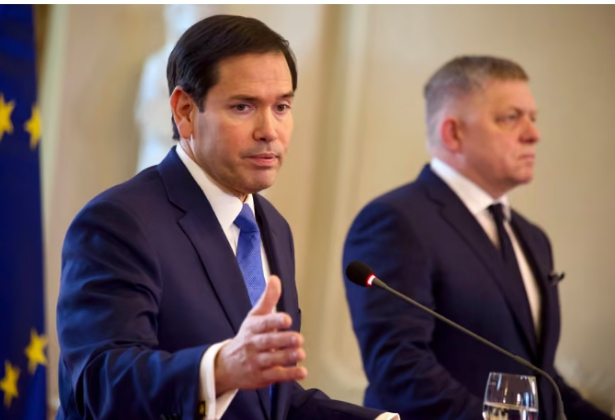
The aftermath of the conference saw Rubio travel to Slovakia, where he addressed questions about why US intelligence agencies had not formally joined a European assessment concluding that Russian opposition figure Alexei Navalny had been poisoned.
Rubio insisted that while the US did not dispute the findings, the investigation had been led by European agencies and was not an American initiative. His remarks highlighted ongoing sensitivities around intelligence sharing and trust within the alliance.
European leaders, including the UK prime minister Keir Starmer, sought to play down fears of a widening rift, emphasising that intelligence cooperation between the UK and the US remained close.
Nevertheless, the broader debate sparked by Kallas’s comments reflected a deeper unease about the future direction of US–Europe relations, particularly if public criticism continues to replace private diplomacy.
For Kallas, the stakes of this debate extend beyond immediate policy disagreements. She warned that persistent euro-bashing risks eroding mutual respect and weakening the shared narrative that has underpinned the transatlantic alliance for decades.
At a time when authoritarian powers are actively seeking to exploit divisions within the west, she argued, public denigration of allies serves no strategic purpose.

She concluded her intervention by reaffirming Europe’s confidence in its own values and role. The European Union, she said, remains committed to defending human rights, promoting prosperity, and contributing to global stability.
Rather than apologising for its model, Europe should assert it more clearly and demand recognition as an equal partner rather than a subordinate one.
As debates continue over defence, trade, and global leadership, Kallas’s remarks underscored a growing European determination to challenge narratives of decline and to insist that cooperation with the United States be based on mutual respect.
The clash over “fashionable euro-bashing” may therefore mark not just a rhetorical dispute, but a broader moment of recalibration in the transatlantic relationship.
About The Author


