

Police arrest Nnamdi Kanu’s lawyer, Aloy Ejimakor, during Nnamdi Kanu arrest protest in Abuja, sparking outrage over teargas and rights violations.
Tension gripped parts of Abuja on Monday as officers of the Nigeria Police Force reportedly arrested Mr. Aloy Ejimakor, lawyer to Nnamdi Kanu, the detained leader of the Indigenous People of Biafra (IPOB).
The incident occurred during a public demonstration tagged #FreeNnamdiKanuNow, organized to demand freedom for Kanu following his prolonged detention since the Nnamdi Kanu arrest in 2021.
The arrest of Ejimakor has drawn national attention and reignited debates over human rights abuses, excessive police force, and the shrinking space for civic engagement in Nigeria’s democracy.

Ejimakor, a leading member of Nnamdi Kanu’s legal team, confirmed his arrest through a post on his verified X (formerly Twitter) handle. He stated that he was detained along with several other protesters by officers of the FCT Police Command.
“We’ve just been arrested. Myself, Prince Emanuel and others. We are at FCT Command CID, No. 1 Zaria Street, Garki 2, Abuja,” Ejimakor wrote.
He also revealed that police officers fired teargas canisters to disperse peaceful demonstrators before the arrests were made. Ejimakor said the teargas caused him severe irritation in the eyes and throat, accusing the police of violating his rights and those of other protesters.
The protest, led by human rights activist and Sahara Reporters publisher, Omoyele Sowore, was intended to be a peaceful march calling for Nnamdi Kanu’s immediate and unconditional release.
Participants held placards with inscriptions such as “Free Nnamdi Kanu Now”, “Justice Delayed is Justice Denied”, and “Respect Court Orders.”
However, an eyewitness said that the demonstration quickly turned chaotic when security operatives began firing multiple rounds of teargas. Many commuters who were not part of the protest were caught in the crossfire.
A commuter, identified as Musa, said: “I was on my way to work when the police suddenly started shooting teargas. Everyone ran for cover. It was a terrible experience.”
The heavy deployment of police vehicles and barricades caused gridlock across the Central Business District, Wuse, and Garki, paralyzing traffic and leaving several commuters stranded for hours.
As of the time of filing this report, the Federal Capital Territory (FCT) Police Command had not issued an official statement regarding the arrests or the use of teargas. Attempts to contact the Command’s spokesperson were unsuccessful.
Legal experts and human rights advocates have criticized the silence, describing it as a failure of accountability and transparency.
They argue that the use of force against peaceful demonstrators undermines the constitutional right to freedom of expression and assembly.
The Nnamdi Kanu arrest saga has remained one of Nigeria’s most controversial legal and political issues. Kanu, leader of the Indigenous People of Biafra (IPOB), was first arrested in 2015 on charges of treasonable felony, incitement, and unlawful possession of arms.
He was granted bail in 2017 but fled Nigeria following a military operation in his hometown, Afara-Ukwu, Abia State.
In June 2021, Kanu was rearrested in Kenya and extradited to Nigeria in a process widely criticized as illegal and violating international law.
Since then, he has remained in the custody of the Department of State Services (DSS), despite several court orders granting him bail or calling for his release.
Ejimakor, alongside other members of Kanu’s legal team, has consistently pushed for his freedom. His arrest on Monday underscores the ongoing controversy surrounding the Nnamdi Kanu arrest and the government’s handling of dissenting voices.
Several civil society organizations, including the Coalition for Democracy and Justice (CDJ) and the Human Rights Advancement Forum, have condemned the arrest of Ejimakor.
In a statement, the CDJ said: “The arrest of Mr. Aloy Ejimakor, a lawyer who has the right to protest peacefully, is unconstitutional. We demand his immediate release and an end to police brutality against activists.”
Sowore also reacted, describing the arrests as evidence of government intolerance toward legitimate civic action. He vowed to continue mobilizing Nigerians until Kanu is released and justice is served.
“This government fears the truth. We will not be intimidated. Nnamdi Kanu deserves justice, and Nigeria deserves freedom,” Sowore declared.
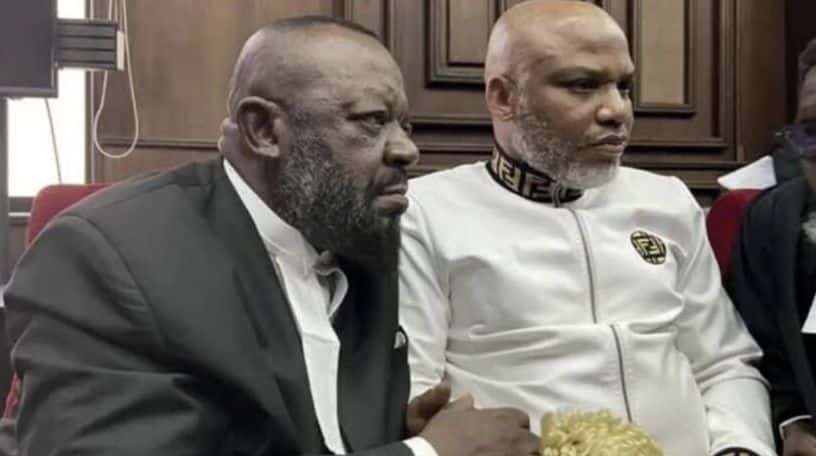
The arrest of Ejimakor has sparked widespread public outcry across social media, with hashtags such as #FreeEjimakor and #FreeNnamdiKanuNow trending nationwide. Critics accuse the authorities of weaponizing law enforcement to silence opposition and human rights defenders.
Several legal commentators have noted that the continued detention of Kanu and the harassment of his legal team could erode public trust in Nigeria’s justice system.
They argue that adherence to court orders and respect for the rule of law remain essential pillars of democracy.
Political analysts warn that incidents like this could deepen regional mistrust, particularly in the South-East, where Kanu’s movement still enjoys significant sympathy.
The arrest of Aloy Ejimakor during the Nnamdi Kanu arrest protest highlights ongoing tensions between the Nigerian government and citizens advocating for justice and accountability.
It also raises serious questions about police conduct, human rights protection, and the independence of the judiciary.
As Nigerians await an official police response, the demand for transparency, fairness, and respect for democratic rights continues to echo across the country.
The Nnamdi Kanu arrest remains not just a legal matter but a defining test of Nigeria’s commitment to justice and freedom under the rule of law.
More news at ireport247news
About The Author


