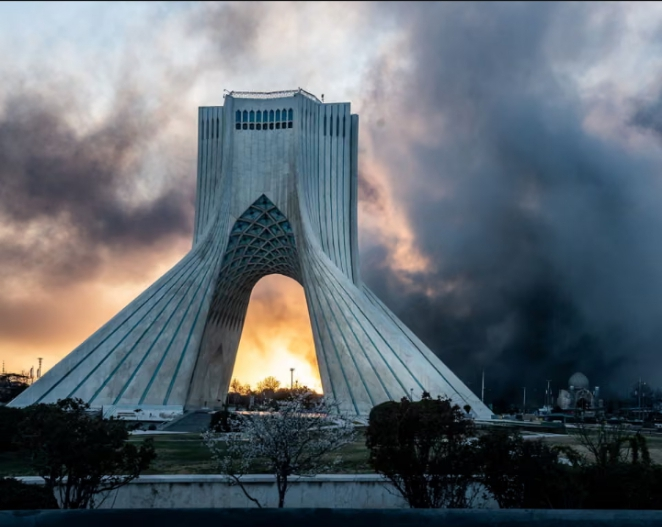
The United States and Israel will secure complete control of Iranian skies within a week, according to Defense Secretary Pete Hegseth, who outlined what he described as a sweeping and sustained aerial offensive strategy aimed at crippling Iran’s military capabilities and asserting dominance over its airspace.
Speaking about the joint campaign, Hegseth characterized US-Israel air power as representing “the two most powerful air forces in the world,” arguing that coordinated and concentrated strikes would rapidly neutralize Iran’s ability to contest control of its own skies.
He said coalition aircraft would operate over Tehran airspace “all day, all night,” maintaining relentless operational pressure on air defense systems, missile sites and strategic military positions.
The Pentagon chief’s remarks signal an intensification of operations designed to dismantle Iranian military infrastructure, particularly missile launch platforms, weapons depots and defense production facilities viewed as critical to Tehran’s strategic posture.
He also emphasized the importance of targeting IRGC leadership, describing the objective in blunt terms as “finding, fixing and finishing” those directing military activities across the country.
According to Hegseth, once aerial supremacy is achieved, coalition aircraft would be able to operate without meaningful resistance from Iranian air defenses.
The timeline he laid out suggests a rapid and concentrated effort to suppress radar networks, surface-to-air missile batteries and command-and-control nodes that underpin Tehran’s layered defensive architecture.
Military analysts note that establishing dominance in heavily defended airspace requires more than firepower alone. Suppressing integrated air defense systems depends on synchronized intelligence, surveillance and reconnaissance operations, coupled with electronic warfare capabilities capable of jamming communications and blinding early-warning detection platforms.
US-Israel air power reportedly includes advanced fighter aircraft, long-range bombers, drones and aerial refueling platforms that can extend combat missions deep into contested territory.

Tehran airspace, densely monitored and fortified over decades, presents complex operational challenges. Iran has invested heavily in radar coverage, hardened missile sites and dispersed command facilities designed to withstand initial waves of air assault. Sustained sorties, however, could gradually degrade these defenses, reducing the effectiveness of coordinated responses.
Hegseth framed the campaign as both a military and symbolic demonstration of dominance. He suggested that Iranian leaders would “look up and see our aircraft overhead,” underscoring what he described as the psychological dimension of persistent aerial presence.
Operations, he added, would continue “every minute of every day” until coalition objectives are fulfilled, signaling an open-ended commitment dependent on strategic assessments rather than a fixed withdrawal date.
Defense experts caution that achieving such rapid supremacy depends heavily on speed, coordination and uninterrupted logistical support. Establishing sustained aerial dominance requires not only neutralizing immediate threats but also preventing the reconstitution of defensive systems. Mobile missile launchers, in particular, pose challenges because of their ability to relocate quickly and blend into civilian environments.
US-Israel air power coordination relies on integrated targeting systems and real-time intelligence sharing designed to track and neutralize mobile units before they can be repositioned. Surveillance drones and satellite feeds are expected to play a central role in identifying emerging threats and guiding precision strikes.
Iranian military infrastructure losses could have cascading effects on command chains and the IRGC leadership’s capacity to coordinate retaliatory operations. By targeting communication hubs and logistics nodes, planners aim to disrupt decision-making cycles and slow the tempo of response.
Analysts say that weakening centralized command may reduce the effectiveness of counterstrikes, though it could also prompt decentralized tactics that are harder to predict.
The strategic calculus extends beyond battlefield considerations. Visible overflights of Tehran airspace carry diplomatic implications, potentially reshaping regional perceptions of military balance.
A sustained and uncontested coalition presence above Iranian territory would send a signal to neighboring states regarding the depth of US-Israel military integration and operational reach.
At the same time, observers warn that maintaining dominance demands careful calibration to avoid unintended escalation. Strikes that significantly degrade Iranian military infrastructure may invite asymmetric responses, including cyber operations or actions by allied non-state actors in the region.
Sustained aerial operations also require steady supply chains for munitions, maintenance and refueling, underscoring the logistical complexity of the campaign.
Hegseth insisted that Iran would be unable to counter prolonged aerial pressure, portraying the strategy as a decisive step toward broader campaign goals. He argued that overwhelming and continuous air operations would deny Tehran the ability to regroup or reestablish defensive coherence.
Analysts, however, stress that resilience and redundancy have long been central to Iran’s defensive planning.
Tehran airspace dominance would necessitate constant surveillance to detect and neutralize emerging threats swiftly.
Early successes in disabling fixed installations would need to be followed by persistent monitoring to ensure no restoration of radar coverage or missile deployment occurs. The tempo of operations, experts say, may prove as critical as the initial wave of strikes.
Damage assessments will likely guide subsequent targeting priorities. As Iranian military infrastructure sites are evaluated for operational capability, coalition planners could adjust strike packages to focus on remaining high-value assets. The degree to which IRGC leadership structures are disrupted may also influence the trajectory of the campaign.
Hegseth’s confidence reflects broader assessments of coalition technological superiority. Advanced avionics, stealth capabilities and precision-guided munitions provide significant advantages in contested environments.
Yet analysts caution that technological superiority alone does not eliminate risk, particularly in densely populated urban regions where collateral considerations complicate operational planning.
The broader regional context adds another layer of complexity. Control of Tehran airspace could influence diplomatic calculations among regional powers, potentially affecting ongoing negotiations or strategic alignments.
A visible shift in aerial balance may alter perceptions of deterrence and embolden or restrain various actors depending on their assessment of coalition resolve.
For now, preparations appear focused on achieving rapid suppression of defensive systems while sustaining high operational tempo. The success of the plan will hinge on maintaining pressure, preserving aircraft survivability and ensuring seamless coordination between American and Israeli command structures.
Read also:Russia, China voice opposition to US-Israeli attacks on Iran
As the campaign unfolds, military observers will closely monitor whether the ambitious timeline can be met and sustained. Establishing uncontested skies over one of the region’s most fortified environments would mark a significant strategic milestone.
Whether it proves transformative for the broader conflict will depend on how effectively aerial supremacy translates into long-term stability and negotiated outcomes.
With aircraft poised for extended missions and command centers synchronizing targeting data, US-Israel air power stands ready to test the feasibility of securing uncontested skies in a theater long considered heavily defended.
About The Author