Ondo deep seaport
The Ondo State Government has formally entered into strategic agreements with private investors for the development of a deep seaport and a petrochemical fertilizer plant, in what officials describe as a decisive shift toward large-scale industrialisation and export-driven growth.
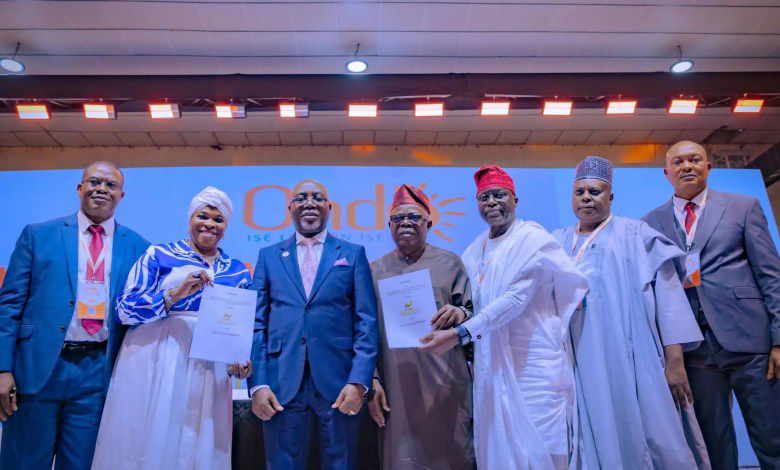
The Memoranda of Understanding were executed during the 2026 Ondo State Investment Summit held in Akure, signalling renewed momentum for the Ondo deep seaport project, which has lingered in regulatory and planning phases for years.
The seaport, proposed for Ilaje Local Government Area along the Atlantic coastline, is expected to serve as a maritime gateway for the state and neighbouring economic corridors.
Governor Lucky Aiyedatiwa said the agreements represent more than ceremonial endorsements, stressing that the state is prioritising structured partnerships anchored on policy clarity and regulatory stability.
According to him, the administration is repositioning the state from a predominantly civil service-driven economy to a private sector-led industrial hub.
He noted that investors are increasingly attracted to environments defined by legal certainty and predictable governance frameworks rather than mere resource potential.
In that context, the Ondo deep seaport is being presented as a bankable infrastructure asset designed to unlock trade, logistics, and manufacturing opportunities across the region.
Strategic coastline advantage
With approximately 75 kilometres of Atlantic coastline, Ondo is one of the few Nigerian coastal states yet to fully leverage maritime commerce.
The Ondo deep seaport is projected to complement existing ports in Lagos and other parts of the country by easing congestion and expanding cargo handling capacity in the South-West.
Industry analysts at the summit observed that a functional deep seaport in Ilaje could significantly reduce logistics costs for exporters of agricultural produce, solid minerals, and petroleum-based products.
The state hosts substantial deposits of bitumen, limestone, granite, and kaolin, alongside cocoa, oil palm, rubber, and timber plantations that depend on efficient evacuation channels.
The Federal Government had earlier approved the seaport licence during the administration of former President Muhammadu Buhari, with revalidation granted last year to revive investor confidence.
The latest MoU is therefore seen as a commercial acceleration step rather than a fresh regulatory application.
Fertilizer plant to drive agro-industrial value chain
Alongside the maritime project, the state also secured an MoU for a petrochemical fertilizer plant. Officials say the facility will support agricultural productivity by ensuring local availability of inputs while creating backward linkages to gas and petrochemical feedstock suppliers.
The integration of the fertilizer plant with the Ondo deep seaport is expected to create a logistics synergy: raw materials can be imported or sourced domestically through maritime routes, while finished products are distributed to domestic and export markets.
Economists describe such clustering as essential for achieving economies of scale and improving return on infrastructure investment.
Governor Aiyedatiwa argued that the projects align with a broader industrial policy aimed at deepening value addition rather than exporting raw commodities. He emphasised that the state is deliberately cultivating an ecosystem where infrastructure, policy reforms, and investor incentives operate in tandem.
Legislative and diaspora backing
At the summit, Senate President Godswill Akpabio, represented by Senator Jimoh Ibrahim, pledged legislative support for the seaport initiative, underscoring the need for long-term strategic planning to ensure sustainability beyond political tenures.
In parallel, the Chairman of the Nigerians in Diaspora Commission, Abike Dabiri-Erewa, encouraged Nigerians abroad to view the Ondo deep seaport and associated projects as structured investment platforms rather than symbolic gestures. She highlighted the role of diaspora capital in bridging funding gaps and transferring technical expertise.
Stakeholders noted that diaspora participation could be instrumental in mobilising blended finance models, combining equity, concessional funding, and commercial debt to de-risk early-stage infrastructure.
Addressing implementation risks
While optimism was evident, analysts cautioned that execution discipline will determine the success of the Ondo deep seaport. Large-scale infrastructure projects in Nigeria have historically faced challenges including funding shortfalls, land acquisition disputes, and regulatory bottlenecks.
To mitigate such risks, the state government reiterated its commitment to transparent frameworks and stakeholder engagement. Officials disclosed that feasibility studies, environmental impact assessments, and financial modelling would guide phased implementation.
The fertilizer plant, similarly, will require stable gas supply arrangements and competitive pricing structures to remain viable in a liberalised market environment. Experts at the summit stressed the importance of aligning the projects with federal industrial and maritime policies to avoid duplication and ensure interoperability with national logistics systems.
If successfully delivered, the Ondo deep seaport could catalyse job creation across construction, marine services, warehousing, haulage, and manufacturing. It may also enhance internally generated revenue through port-related levies and commercial activity.
Beyond direct fiscal gains, the project is positioned as a structural intervention capable of shifting the state’s economic base. By linking maritime trade with agro-processing and petrochemical production, the government aims to stimulate inclusive growth across coastal and hinterland communities.
For investors, the dual-track strategy—maritime infrastructure plus fertilizer manufacturing—signals an attempt to anchor long-term industrial clusters rather than isolated projects.
Market observers say that clarity on timelines, financing structure, and concession models will be critical in sustaining confidence.

As the agreements move from signing to implementation, attention will centre on how swiftly the Ondo deep seaport transitions from blueprint to groundbreaking.
The state’s leadership insists that measurable milestones, rather than declarations, will define the next phase of its industrial agenda.