North Korea nuclear deterrent efforts will accelerate following a recent joint military exercise between the United States and South Korea, with Pyongyang accusing the allies of rehearsing a nuclear attack against the country.
North Korea made the announcement on Monday through its state media, signalling that the military activities of Washington and Seoul would further strengthen its determination to expand its nuclear capabilities.
Kim Jong Sik, a deputy department director in North Korea’s ruling Workers’ Party, criticised the Iron Mace exercise, claiming it demonstrated that the United States remained committed to what he described as its ambition to suppress North Korea through nuclear threats.
He warned that the perceived danger was increasing, saying such threats were “escalating with each passing day.”
Kim argued that Iron Mace and other joint military activities involving Washington and Seoul showed why Pyongyang needed to strengthen its nuclear forces at a faster pace.
The exercise took place from September 29 to October 2. According to South Korean military authorities, it was designed to integrate US nuclear capabilities with South Korea’s conventional military forces.
Washington and Seoul view their military cooperation as an important part of deterring North Korean aggression. Pyongyang, however, has consistently condemned their joint exercises, describing them as hostile preparations against its government.
North Korea cites military drills as reason to expand nuclear forces
The latest warning reinforces North Korea’s longstanding argument that its nuclear arsenal is necessary to protect the country against external military threats.
Pyongyang has repeatedly used joint military exercises involving the United States and South Korea to justify expanding its weapons capabilities.
The government of North Korean leader Kim Jong Un maintains that a stronger nuclear force is essential to national security and deterrence.
The latest statement suggests that the Iron Mace exercise will provide further justification for the country to pursue that objective.
Although the allies describe their military cooperation as defensive, North Korea interprets the integration of American nuclear capabilities with South Korean conventional forces as a serious security threat.
The opposing positions have contributed to a prolonged cycle of military preparations, warnings and countermeasures on the Korean Peninsula.
Senior official’s role raises questions
Analysts have also highlighted the unusual decision to have Kim Jong Sik issue a statement outlining the country’s nuclear policy.
Kim is an important official involved in North Korea’s nuclear and missile development and production. Statements setting out broader nuclear policy are more commonly delivered by officials from the country’s defence or foreign ministries.
Yang Moo-jin, professor emeritus at the University of North Korean Studies, suggested that Kim’s responsibilities might be expanding beyond weapons development to include nuclear and missile policy.
Such a development could indicate that officials overseeing the country’s weapons programmes are taking on a greater role in explaining and shaping its wider security strategy.
North Korea’s nuclear and missile programmes have remained central to its confrontation with the United States and its allies, despite international sanctions and diplomatic efforts to limit their development.
Border tensions add to regional concerns
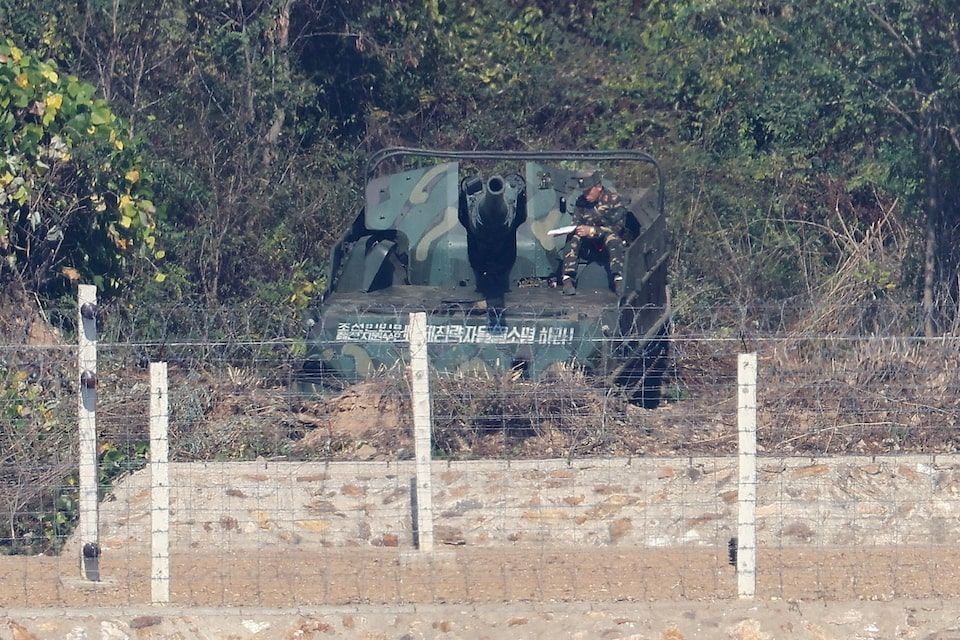
Relations between North Korea and South Korea have also deteriorated following a border mine explosion in September.
North Korea subsequently threatened to resume loudspeaker propaganda broadcasts towards the South by the end of October, raising concerns about another source of confrontation between the neighbouring countries.
Such broadcasts have historically heightened tensions along the heavily fortified border, with both sides using loudspeakers to transmit political messages and propaganda.
However, South Korea’s military said on Monday that it had not confirmed whether North Korea had acted on its threat.
The absence of confirmed broadcasts suggests that the latest warning had not yet resulted in a verified resumption of that activity.
Nevertheless, the situation remains sensitive as both countries continue to monitor each other’s military movements and public statements.
Nuclear deterrence remains a major obstacle to easing tensions
North Korea’s renewed commitment to strengthening its nuclear forces is likely to complicate efforts to reduce tensions across the region.
The United States and South Korea continue to coordinate their defence arrangements in response to Pyongyang’s nuclear and missile programmes. Their joint exercises are intended to improve military preparedness and cooperation in the event of a crisis.
North Korea, in contrast, argues that these activities threaten its security and require a stronger response.
The disagreement creates a difficult security environment in which measures presented by one side as defensive are interpreted by the other as evidence of hostile intentions.
Pyongyang’s latest declaration does not, by itself, confirm that a specific new weapons test or deployment is imminent. It does, however, make clear that the government intends to continue presenting its nuclear programme as a central element of national defence.
With tensions already elevated by military exercises and disputes along the border, further expansion of North Korea’s nuclear capabilities could deepen regional concerns.
About The Author