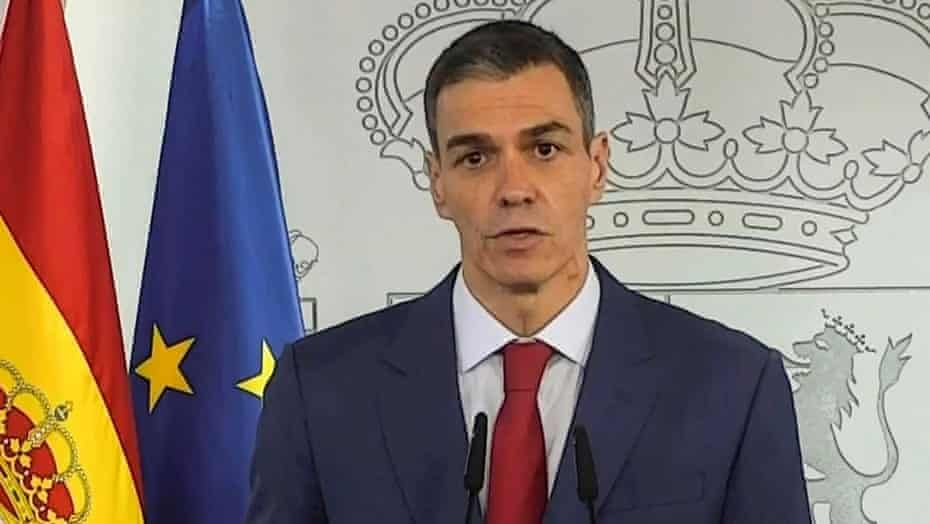
No to war– Spain’s prime minister, Pedro Sánchez, has said his government will not bow to pressure from Washington after Donald Trump threatened to sever trade ties with Madrid over its refusal to facilitate American military operations against Iran.
In a strongly worded address, Sánchez insisted Spain would stand by its opposition to the escalating conflict, declaring that his country would not become complicit in a widening war “simply out of fear of reprisals from someone”.
The remarks came after Trump criticised Spain for denying the US permission to use jointly operated bases in southern Spain to support ongoing strikes on Iran. The US president described Madrid’s stance as “terrible” and said he had instructed his treasury secretary to “cut off all dealings” with the European country, dramatically escalating tensions between the two NATO allies.
Sánchez framed the growing Middle East crisis as dangerously unpredictable, comparing the situation to “playing Russian roulette with the destiny of millions”.
Calling for restraint from the US, Israel and Iran alike, he warned that responding to one perceived illegality with another risked triggering far-reaching global instability. “You can’t respond to one illegality with another because that’s how humanity’s great disasters begin,” he said.
The Spanish leader has been among Europe’s most outspoken critics of Israel’s military conduct in Gaza and has consistently urged diplomatic solutions over military escalation. On Wednesday, he reiterated that Spain’s position could be summarised in three words: “No to war.”
He cautioned that even those who initiated the first strikes might not fully understand the long-term consequences, adding that the prospect of a prolonged conflict with mounting casualties and serious global economic fallout could not be ruled out.
Trump’s frustration with Spain also reflects broader tensions within NATO, particularly over defence spending. During a meeting with German chancellor Friedrich Merz, Trump again singled out Madrid for refusing to support a proposed increase in defence expenditure to 5% of GDP.
He suggested that, if necessary, the US could act unilaterally regarding base access, though he added that Washington did not “have to”.
The US president also took aim at the UK prime minister, Keir Starmer, over London’s refusal to authorise use of British bases for the strikes, contrasting him unfavourably with Winston Churchill. The comments underscored the widening rift between Washington and several European capitals over the handling of the Iran conflict.
In response, Merz publicly defended Spain, emphasising that trade negotiations between Brussels and Washington are conducted collectively. Spain, he said, could not be singled out for punitive measures because it is an integral member of the European Union.
“We negotiate about tariffs with the United States only together or not at all,” he stated, rejecting the idea of isolating Madrid.
The European Commission echoed that stance. Stéphane Séjourné, the EU’s internal market commissioner, warned that any threat directed at one member state amounted to a threat against all.
Read also:US General Hegseth declares Iran cannot outlast American Forces
About The Author