

Russian officials reiterated that there would be No compromise on territory, setting a firm tone after high-stakes discussions involving American envoys seeking progress on the long-delayed Ukraine peace talks.
The Kremlin confirmed the talks extended well past midnight, underlining the intensity of the Moscow negotiations and the strong emotions expressed by both delegations during their closed-door exchanges on the conflict.
Senior adviser Yury Ushakov described the dialogue as constructive yet uncompromising, repeatedly emphasizing the unyielding Kremlin stance that territorial concessions remain impossible under any diplomatic arrangement currently being discussed.
US special envoy Steve Witkoff and presidential adviser Jared Kushner led the US envoy mission, tasked with assessing potential pathways toward slowing hostilities through options previously circulated among international diplomatic circles.
Russian President Vladimir Putin signaled frustration with what he called shifting American expectations, claiming the visitors lacked clarity on essential matters relevant to long-term arrangements unsuited to rushed diplomatic calendars.
Putin delivered pointed remarks earlier in the day, accusing European governments of escalating the conflict and undermining ongoing Ukraine peace talks with public statements he considered provocative and strategically destabilizing.
He argued Western proposals were designed to pressure Moscow into compliance, insisting that Russia would withstand what he described as coercive tactics deployed to extract politically unacceptable concessions in wartime conditions.
Speaking bluntly, he stated, “Some of our partners pretend to push for peace while preparing for war,” reinforcing the hardened message shaping today’s evolving diplomatic conversation.
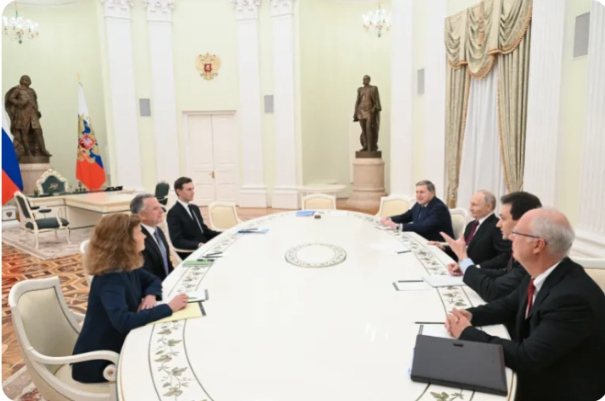
The Kremlin insisted US negotiators presented several new elements reflecting recent private consultations, yet Moscow interpreted these details as insufficient to convince Russian officials of Washington’s seriousness.
After the meeting, Ushakov declared, “Certain points from Washington appear workable, but major gaps persist,” underscoring the absence of any framework that could reliably halt battlefield escalation.
Ushakov explained that Russian delegates “still struggle to see evidence of strategic patience” from the United States, particularly regarding discussions concerning regions Moscow now considers integral.
Kremlin spokesperson Dmitry Peskov later reinforced the official line, stressing that Russia “will not accept foreign-imposed conditions,” a statement clearly previewing future expectations for public and private bargaining.
Ukrainian officials quickly responded. Foreign Minister Andrii Sybiha said the latest remarks demonstrated Moscow’s “clear refusal to end its assault,” claiming Russian leaders intend continued pressure on Ukrainian cities.
Sybiha added that Kyiv would “not allow intimidation,” describing Russia’s renewed emphasis on territorial dominance as “proof that negotiations alone cannot restrain expanding military aggression.”
President Volodymyr Zelenskyy, speaking in Ireland, called for a “dignified peace,” warning that Kyiv’s partners risk fatigue amid diplomatic stagnation and growing uncertainty surrounding the American political environment.
He noted that Russia “wants global attention to fade,” arguing that strategic distraction remains a central element of Moscow’s approach to weakening Ukraine’s international backing.
At a cabinet meeting, US President Donald Trump acknowledged the severe diplomatic hurdles, remarking, “Not an easy situation. What a mess,” referencing the persistent death toll across battlefronts.
Trump stated his team “is working nonstop,” while stressing the difficulty of reconciling competing narratives presented during the evolving Moscow negotiations, especially concerning territorial governance.
Officials indicated Witkoff and Kushner may meet Ukrainian representatives in Brussels soon, reflecting a coordinated attempt to establish continuity across multiple diplomatic tracks.
In Ukraine’s east, battlefield updates overshadowed diplomacy as Russia announced the capture of Pokrovsk, which it described as a city possessing “special operational value” for upcoming operations.
Kyiv denied these claims and accused Moscow of manufacturing narratives to heighten perceptions of Russian momentum during a period of intense international scrutiny surrounding the US envoy mission.
Russian state media highlighted comments from General Staff officials who claimed new territorial gains, asserting they provided “strong operational leverage” for upcoming winter maneuvers across contested regions.
Reuters cited analysts noting that Russian control now exceeds nineteen percent of Ukrainian territory, marking the most significant territorial shift since the mid-phase of the war.
Ukrainian sources warned that accepting any agreement requiring substantial withdrawal from key cities would amount to capitulation, further complicating ongoing Ukraine peace talks.
Zelenskyy reiterated that defending national sovereignty remains the “central objective,” emphasizing that no Ukrainian leader could accept arrangements undermining the country’s internationally recognized borders.
Observers said Ukraine’s stance directly conflicts with Russia’s approach, rendering tangible progress difficult despite diplomatic gestures made during today’s Moscow negotiations.
Experts argued that both sides appeared primarily interested in “mapping red lines,” rather than forming a unified roadmap, revealing how mutual distrust continues to limit breakthroughs.
American officials privately acknowledged that adjusting the peace plan may require months, considering feedback from allies uneasy about potential concessions to Moscow.
European governments remain concerned Trump’s approach could prioritize rapid de-escalation over long-term security, potentially leaving Ukraine vulnerable to renewed offensives after a temporary ceasefire.
Analysts said such fears surfaced throughout allied meetings, where diplomats stressed the importance of resisting proposals rewarding military aggression with territorial gains.
The earlier leaked US draft sought limitations on Ukraine’s military capacity, generating widespread backlash among regional partners who criticized Washington for adopting elements resembling the Kremlin stance.
Russia had insisted on legal recognition of its control over Donbas, Zaporizhia, and Kherson, terms Kyiv deemed entirely unacceptable from the outset of the Ukraine peace talks.
Ukrainian lawmakers warned such conditions would erase core constitutional commitments, noting that public opinion strongly opposes territorial concessions under threat of continued bombardment.
Moscow’s rhetoric has sharpened in recent weeks, coinciding with intensified strikes on ports, power stations, and oil facilities essential for sustaining Ukraine’s wartime economy.
Russian leaders defended these operations as “necessary countermeasures,” arguing that Ukrainian attacks on maritime assets forced Moscow to respond strategically across broader geographic corridors.
Ukraine condemned increased naval strikes, warning that the conflict’s expansion into maritime routes threatens wider regional security involving NATO members safeguarding essential transport channels.
International monitors observed heightened activity around energy hubs, documenting patterns aligning with Putin’s public declaration that Russia would intensify pressure until Washington softened its position.
American analysts said Russia hopes to secure leverage by shaping battlefield conditions before subsequent diplomatic cycles resume, likely early next year.
European ministers urged Washington to maintain unity with allies, fearing any separate American deal could fracture the broader coalition supporting ongoing Ukrainian defense.
Diplomats said tension emerged as European capitals doubted whether the US envoy mission could extract commitments compatible with NATO’s collective security interests.
Zelenskyy insisted Ukraine requires “long-term guarantees,” while arguing no settlement lacking reliable enforcement mechanisms can prevent Russia from resuming hostilities in the future.
Meanwhile, Moscow stated it would consider security guarantees only if Kyiv accepts irreversible territorial arrangements, again invoking the idea that there would be “No compromise on territory.”
Political strategists said Putin’s approach aims to force the United States into acknowledging the altered battlefield map, effectively institutionalizing Russia’s advances through diplomatic processes.
Washington, however, continues to emphasize principles of sovereignty, although officials admit privately that reconciling Ukrainian expectations with geopolitical realities remains extraordinarily challenging.
American experts described the current situation as a “conflict of timelines,” where Ukraine seeks durable security while major powers prioritize de-escalation ahead of global political transitions.
Regional analysts warn prolonged tension may escalate if diplomatic paralysis continues, potentially pushing Russia to accelerate offensive efforts during winter.
Ukrainian forces brace for renewed attacks, with commanders reporting increased Russian drone activity targeting ammunition depots and infrastructure in multiple regions.
Humanitarian groups sound alarms over worsening conditions, warning that further territorial loss would displace thousands, complicating relief operations already strained by extensive winter demands.
International organizations call for urgent humanitarian corridors, though both sides accuse each other of obstructing safe passage for civilians caught near active frontlines.
As the diplomatic impasse widens, experts doubt whether current Moscow negotiations can produce meaningful steps without significant concession shifts from both parties.
Yet Washington maintains that ongoing dialogue remains preferable to escalating conflict, reaffirming that its diplomats will continue engaging both sides in successive strategic consultations.
Regional observers forecast that upcoming talks may feature new proposals, though none expect Russia to dilute its rigid Kremlin stance anytime soon.
Ukraine’s government remains adamant that its military will continue defending key regions regardless of international political calculations arising from shifting diplomatic priorities.
Security analysts said both sides appear locked in a duel of attrition — militarily and diplomatically — with neither willing to adjust demands sufficiently to reach consensus.
Putin’s latest comments indicate the Kremlin seeks recognition of battlefield outcomes, effectively transforming military occupation into political legitimacy.
Kyiv rejects these intentions, arguing that accepting such terms would encourage future aggression not only against Ukraine but also other states near Russia’s sphere of influence.
The US envoy mission thus faces a delicate challenge: crafting proposals palatable to Ukraine while still compelling enough to prompt Russian engagement without heavy concessions.
Despite mounting concerns, diplomats stress the importance of maintaining dialogue, especially with winter fighting expected to intensify and reshape leverage on all sides.
With geopolitical stakes rising, Washington, Kyiv, and Moscow continue observing one another’s moves, each shaping strategy around expected shifts in international political landscapes.

For now, all indications suggest the conflict will remain deadlocked until stakeholders reevaluate core assumptions shaping the Ukraine peace talks.
And despite continuous appeals from global leaders, Moscow reiterated firmly that there can be No compromise on territory, ensuring diplomatic turbulence continues.


