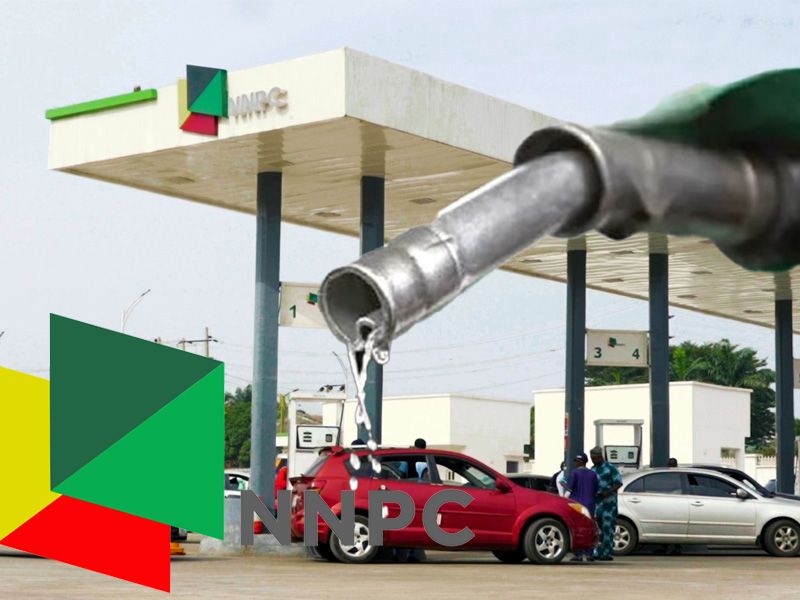
The Nigerian National Petroleum Company Limited (NNPC Ltd) has further reduced the pump price of Premium Motor Spirit (PMS), commonly referred to as petrol, at its retail outlets in Abuja.
The latest adjustment brings the price to N815 per litre, representing a N20 reduction from the previous N835 per litre rate.
According to a survey conducted by our correspondent, NNPC outlets across the Federal Capital Territory, including locations in Lugbe, Wuse Zones 4 and 6, the Kubwa Expressway, and along the Keffi–Abuja Road, have already implemented the revised pricing.
However, the price reduction has not fully aligned with the rates offered at other retail stations, with Dangote Refinery-backed MRS stations maintaining the lowest price at N739 per litre.
NNPC Cuts Petrol Price: Competitive Pressures and Market Response
The NNPC cuts petrol price move comes amid mounting competition in Nigeria’s downstream oil sector, following the entry of large-scale supply from the Dangote Petroleum Refinery.
Industry observers note that this is the latest in a series of competitive adjustments triggered by increasing domestic refining capacity.
In December 2025, the company first reduced its pump price by N80, from N915 to N835 per litre, reacting to Dangote Refinery’s reduction of its ex-gantry petrol price to N699 per litre.
That drop represented the lowest recorded price for refined petrol in two years.
The current NNPC reduction is part of a broader trend of market-driven pricing, reflecting the early effects of partial deregulation in the sector.
Analysts say that as local refining capacity expands, the Nigerian downstream market is experiencing heightened competition, compelling marketers to adjust pump prices to attract consumers.
Impact on Consumers and Retailers
While the NNPC cuts petrol price decision is intended to ease the cost of fuel for motorists, consumers continue to experience volatility across retail outlets.
Prices still vary significantly, with some independent stations charging as high as N840 per litre, while others, such as Sunlight outlets, sell at N825.
Optima Energy maintains a price of N835 per litre, further highlighting inconsistencies in the market.
Industry experts warn that while price reductions are welcome, disparities between operators underscore the need for coordinated pricing policies that reflect local refining output and cost structures.
Independent marketers have expressed concerns about shrinking profit margins and uneven access to competitively priced fuel, which could affect supply reliability and investment decisions.
NNPC Cuts Petrol Price: Strategic Implications
The reduction in pump price is seen as a strategic response to maintain market share in the face of rising competition from Dangote Refinery and other local producers.
The Dangote Refinery, which began large-scale operations in 2025, has altered the dynamics of fuel pricing in Nigeria by offering lower ex-gantry prices.
“The NNPC cuts petrol price adjustment is a clear indication that market forces are now shaping the downstream sector,” said a petroleum analyst.
“Marketers can no longer rely solely on historical pricing structures or government subsidies. Competition is real, and it benefits consumers.”
Despite the price cut, industry stakeholders caution that the wider adoption of domestic refining will require additional investments in distribution, storage, and logistics infrastructure to ensure consistent supply across the country.
The Role of Deregulation in Price Adjustments
The ongoing NNPC cuts petrol price is part of the Federal Government’s broader commitment to deregulation in the oil sector, allowing market forces to determine pricing.
This shift aims to encourage investment in local refining capacity, reduce import dependency, and enhance energy security.
As domestic refineries continue to scale operations, analysts predict further price adjustments in 2026, potentially narrowing the gap between NNPC, Dangote-backed stations, and other marketers.
Market Reactions and Outlook
Motorists welcomed the NNPC cuts petrol price decision, noting some relief in household budgets.
However, traders remain cautious, highlighting the need for stability in supply and pricing to prevent speculative spikes that could undermine the benefits of domestic refining.
“The reduction is positive, but sustained impact depends on ensuring that local refineries continue to operate efficiently and that distribution networks are fully functional,” said Joseph Obele, a retail fuel operator in Abuja.
With the Federal Government maintaining that petrol pricing will ultimately reflect market conditions, stakeholders anticipate that NNPC cuts petrol price measures will serve as a benchmark for competitive adjustments across other refining and marketing companies.
The latest NNPC cuts petrol price to N815 per litre represents a tactical response to intensifying competition in Nigeria’s downstream oil sector, particularly following the operationalisation of Dangote Petroleum Refinery.
While the move provides temporary relief for consumers, consistent supply, infrastructure development, and market-driven pricing will be crucial for sustaining lower costs.
As the sector adapts to deregulation and increasing local refining capacity, both consumers and marketers will closely monitor further price trends, which are likely to reflect a new era of competition and efficiency in Nigeria’s petroleum market.
About the Author