The Nnamdi Kanu protest disrupted Abuja traffic as Omoyele Sowore led demonstrators demanding the IPOB leader’s release, causing chaos along the Kugbo-Nyanya Expressway.
Massive traffic congestion gripped the Kugbo-Nyanya Expressway on Monday morning as the Nnamdi Kanu protest halted movement into the Federal Capital Territory (FCT), Abuja.
The demonstration, which began at dawn, caused a total gridlock that stranded thousands of commuters, including government workers, students, and traders trying to reach the city centre.
The Nnamdi Kanu protest, championed by human rights activist Omoyele Sowore, was organised under the banner #FreeNnamdiKanuNow.
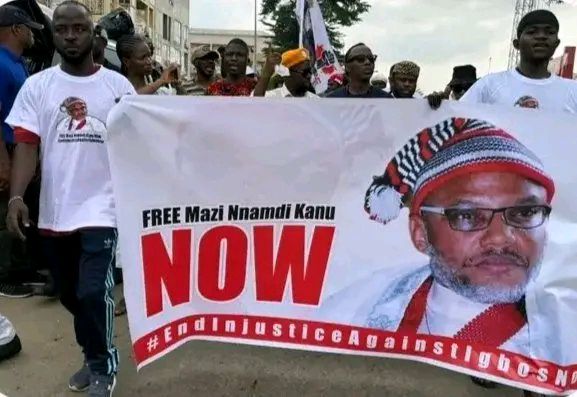
The protesters called for the unconditional release of the detained leader of the Indigenous People of Biafra (IPOB), Mazi Nnamdi Kanu, who has been in custody since 2021 on terrorism-related charges.
The protest reportedly began around 7:00 a.m. near the Transcorp Hilton Hotel, Maitama, before extending toward the Abuja-Keffi highway, one of the busiest routes linking the FCT with Nasarawa State.
Within minutes, the usually bustling highway was completely jammed as demonstrators, vehicles, and security personnel clogged multiple lanes.
Commuters described the experience as chaotic and exhausting. Many were forced to abandon their vehicles, while others trekked several kilometres from Mararaba, Nyanya, and Karu to get to work.
Long queues of cars stretched for miles as frustrated motorists honked in vain, unable to move forward or turn back.
A commercial driver, Sani Ibrahim, shared his ordeal: “I left Nyanya by 6:30 a.m., hoping to reach Area 3 before 8:00 a.m., but I’ve been stuck here since. The road is blocked because of the Nnamdi Kanu protest. Some people have started walking; there’s no movement at all.”
Similarly, Mrs. Blessing Okeke, a civil servant, said, “The government must act fast. We understand the protesters’ point, but blocking the roads is affecting ordinary Nigerians who have nothing to do with the issue.”
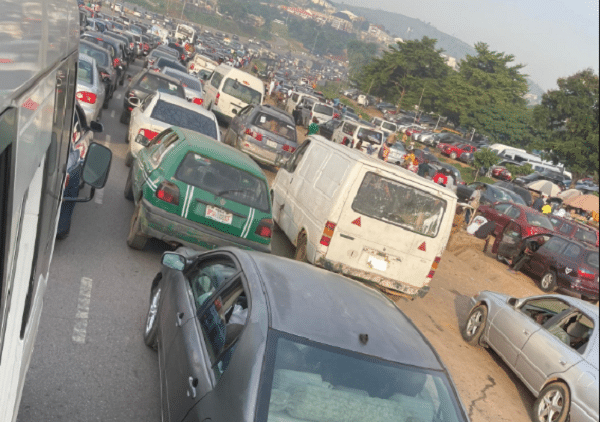
According to NTA News, the massive gridlock was caused by parked vehicles and large gatherings along the highway.
“Motorists heading into the FCT from the Kugbo and Nyanya axis experienced extremely slow movement, with several lanes completely blocked,” the station reported. It noted that the corridor has a history of traffic disruptions during demonstrations and security operations.
The congestion also affected businesses along the route, as delivery trucks, commercial buses, and private vehicles remained trapped for hours.
Shop owners lamented that customers were unable to access their stores, resulting in significant financial losses.
During the Nnamdi Kanu protest, Sowore addressed participants, calling on the Federal Government to respect court orders mandating Kanu’s release.
“Nnamdi Kanu’s continued detention is an assault on justice, freedom, and democracy,” he declared.
“We are here to demand his release because no one should be held unlawfully for exercising the right to self-determination.”
Sowore emphasized that the demonstration was peaceful and aimed at drawing international attention to Kanu’s plight.
Protesters chanted solidarity songs, waved Biafran flags, and carried placards bearing messages such as “Free Nnamdi Kanu Now”, “End Political Detention”, and “Justice Delayed is Justice Denied.”
A strong contingent of security personnel — including officers from the Nigeria Police Force, Civil Defence Corps, and Department of State Services (DSS) — was deployed to monitor the protest and prevent any breakdown of law and order.
While there were no reports of violence, the heavy presence of armed officers heightened tensions along the protest routes.
An officer who preferred anonymity said, “Our mission is to maintain peace and ensure the protesters do not block critical junctions leading into the capital. So far, the demonstration has remained peaceful.”
Despite this, traffic diversion and security checks worsened the gridlock, particularly at the Kugbo Checkpoint and Nyanya Bridge, where vehicles were forced to move slowly under police supervision.
Nnamdi Kanu, the leader of the banned IPOB, was first arrested in 2015 for allegedly committing treasonable felony. After being granted bail in 2017, he fled Nigeria following a military invasion of his home in Abia State.
He was later re-arrested in Kenya in 2021 and extradited to Nigeria, where he has remained in the custody of the Department of State Services (DSS).
Several Nigerian courts, including the Court of Appeal, have ruled in his favor, ordering his release. However, the Federal Government has appealed the decisions, arguing that his trial must continue due to the severity of the charges.
The prolonged detention has since fueled domestic and international criticism, prompting recurring protests across the country.
The Nnamdi Kanu protest also had ripple effects on the local economy. Transport fares doubled as drivers took advantage of the situation, while fuel consumption soared due to hours of idling in traffic.
Many civil servants, teachers, and business owners arrived late to work, with some returning home entirely.
Analysts described the protest as a reflection of Nigeria’s deepening civil rights tensions.
“This movement is not just about Kanu,” said political analyst Dr. Uche Okoro.
“It symbolizes a broader frustration among citizens over governance, justice, and inequality.”
Reactions to the Nnamdi Kanu protest have been mixed. While supporters hailed it as a legitimate form of civil resistance, critics condemned the blockage of highways as counterproductive.
“There should be dialogue, not disruption,” said Mr. Paul Olorunfemi, a public affairs commentator. “Both the government and IPOB supporters need to find common ground.”
Civic groups have urged the government to prioritize peaceful negotiation and adherence to the rule of law, warning that recurring protests could escalate into nationwide unrest if Kanu’s case remains unresolved.
Monday’s Nnamdi Kanu protest once again highlighted the friction between state power and citizens’ demand for justice in Nigeria. Though peaceful, the protest paralyzed movement and revealed the vulnerability of Abuja’s transport system to civil unrest.
As the debate over Nnamdi Kanu’s detention continues, citizens are calling on the Federal Government to address the root causes of agitation, uphold judicial rulings, and prevent future disruptions that affect ordinary Nigerians.
Until then, the Nnamdi Kanu protest remains a potent symbol of public defiance and the persistent demand for justice.
More news at ireport247news
About The Author