Nigeria elected into UN agency’s council
Nigeria has reclaimed a prominent seat in global maritime governance after being elected into Category C of the International Maritime Organisation (IMO) Council for the 2026–2027 term.
The diplomatic win, announced on Friday during the IMO General Assembly in London, marks Nigeria’s first return to the Council since 2011 and is widely regarded as a major boost to the nation’s maritime reform agenda.
The development positions Nigeria once again at the centre of international shipping policy shaping, strengthening its influence on decisions relating to safety, maritime security, environmental protection and sustainable shipping practices.
For Africa’s largest economy, the return signals not only renewed global confidence but also a validation of the far-reaching reforms underway within the maritime and blue economy sectors.
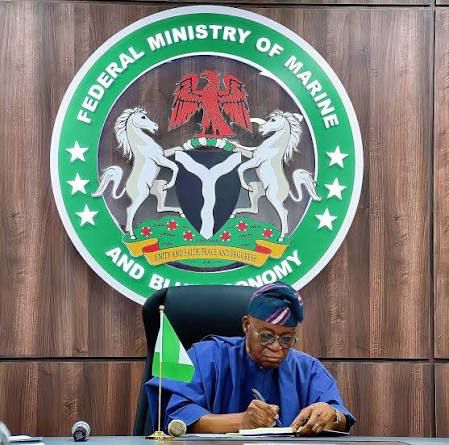
The Minister of Marine and Blue Economy, Adegboyega Oyetola, who led the country’s delegation and a year-long diplomatic engagement, described the victory as a milestone resulting from persistence, strategic foreign outreach and President Bola Tinubu’s support for Nigeria’s maritime repositioning.
In a statement issued by his Special Adviser, Bolaji Akinola, the minister said the election outcome reflects how significantly Nigeria’s credibility has improved across maritime blocs and global stakeholders.
Oyetola noted that Nigeria’s re-election was not an overnight achievement but the product of over twelve months of coordinated diplomacy involving high-level engagements, advocacy missions and international consultations across continents.
According to him, the election affirms that the world recognises Nigeria’s renewed commitment to maritime security, reforms in the Gulf of Guinea and the broader vision of unlocking the blue economy.
He stated,
“This is a landmark endorsement of the renewed confidence the world has in Nigeria under the leadership of President Bola Ahmed Tinubu.
It is a collective vote of confidence in our maritime reforms, our security architecture in the Gulf of Guinea and the ambitious drive of the administration to fully harness the opportunities of the blue economy.”
A Strategic Return to a Global Decision Table
Category C of the IMO Council is reserved for countries with special interests in international shipping, maritime transport and global navigation.
It also ensures geographical balance in the Council’s composition.
Nigeria now joins 19 other states—such as Singapore, Saudi Arabia, Malaysia, Egypt and South Africa—representing a diverse mix of maritime economies with significant regional influence.
For Nigeria, this return is expected to translate into expanded technical cooperation, enhanced investor confidence, and deeper access to global maritime innovations and capacity-building programmes.
Stakeholders also anticipate that the new mandate will help strengthen Nigeria’s regulatory framework and boost efforts to modernise its seaports, maritime surveillance systems, shipyard expansion and sustainable ocean governance.
Oyetola said Nigeria’s presence in the Council is an opportunity to contribute meaningfully to global maritime policies while amplifying the nation’s interests, particularly in the Gulf of Guinea—one of the world’s major shipping corridors.
According to him,
“Our return to the IMO Council after fourteen years signals that Nigeria is back—stronger, more strategic and more determined to shape the future of global shipping, maritime safety and sustainable ocean governance.
We worked tirelessly, travelling across continents, building bridges and demonstrating that Nigeria is ready to assume this responsibility.”
Presidential Backing and Technical Execution
A significant part of the success, the minister said, was the unwavering support of President Tinubu, whose approval of diplomatic resources and political backing created the foundation for a vigorous campaign.
Oyetola emphasised that the President’s commitment opened critical doors and fostered goodwill from partner nations.
The minister also acknowledged the work of the Technical Committee of Experts chaired by the Permanent Secretary of the Ministry, Olufemi Oloruntola.
The committee, he said, provided strategic coordination, meticulous campaign planning and continuous engagement that strengthened Nigeria’s visibility throughout the election process.
He extended appreciation to the global maritime community for its confidence in Nigeria’s reforms, assuring that the country would serve with integrity and a renewed sense of responsibility.
Global Council Structure and Nigeria’s Position
At the same General Assembly, other nations were elected into Categories A and B of the IMO Council, representing groups with the highest shipping volumes and the largest interests in maritime trade respectively.
Category A includes major shipping nations such as China, Greece, Japan, the United States, the United Kingdom, Norway, Italy and South Korea.
Category B elected countries with significant maritime trade influence including Germany, France, India, Canada, Australia, UAE and Brazil.
Nigeria’s selection into Category C is seen as a strategic alignment that reinforces Africa’s representation and strengthens the continent’s voice in global shipping matters.
What the Victory Means for Nigeria
Experts in the maritime industry say Nigeria’s return will accelerate momentum for ongoing national reforms, including:
• Modernisation of port infrastructure
• Strengthening of maritime domain awareness systems
• Enhanced collaboration on anti-piracy measures in the Gulf of Guinea
• Attraction of foreign investments into the blue economy
• Advancement of sustainable marine resource management
• Improved maritime training, capacity building and technical support
With the election secured, attention now shifts to execution.
The Ministry of Marine and Blue Economy is expected to deepen regulatory reforms, expand international partnerships and reposition Nigeria as a leading maritime nation on the continent.
Oyetola concluded that the victory is both an honour and a responsibility.
“We have earned the world’s confidence. Now we must deepen our reforms, strengthen our institutions and ensure that Nigeria takes its rightful place as a leading maritime nation.”
About the Author