


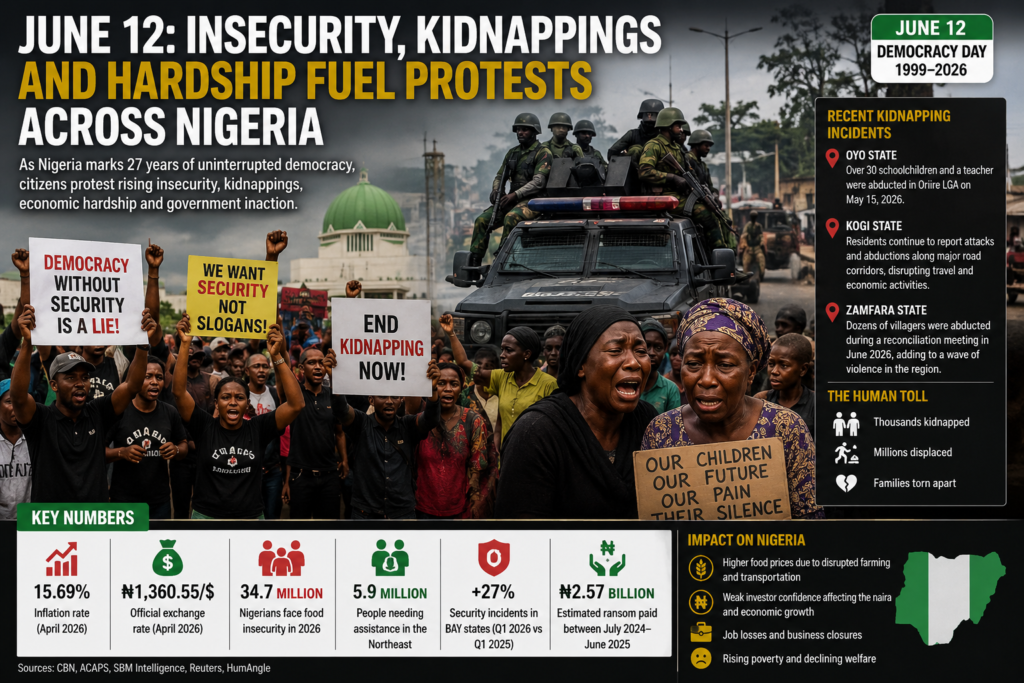
Twenty-seven years after Nigeria’s return to democratic rule, insecurity has emerged as one of the most significant threats to public confidence in governance, with recent kidnappings, bandit attacks and growing economic hardship fuelling fresh calls for accountability on Democracy Day.
As the country marks June 12, a date widely regarded as a symbol of democratic struggle and political freedom, many Nigerians say the conversation has shifted beyond elections and constitutional governance.
The concern increasingly dominating public discourse is whether democratic institutions have been able to guarantee one of the most basic responsibilities of government: protecting lives and property.
From Oyo to Kogi, from the northwest to parts of the Middle Belt, recent incidents involving kidnappings, violent attacks and criminal activity have renewed concerns about the country’s security architecture and the broader impact of insecurity on economic growth and social welfare.
The issue is expected to feature prominently in demonstrations planned by civil society groups and activists across parts of the country, where protesters are expected to highlight concerns ranging from insecurity and inflation to unemployment and the rising cost of living.
Democracy Day and the Growing Mood of Public Frustration
June 12 occupies a special place in Nigeria’s history.
The date commemorates the 1993 presidential election won by the late MKO Abiola, widely regarded as one of the fairest elections in the country’s history before its annulment by the military government.
Since its recognition as Democracy Day, June 12 has become a national symbol of resistance, political participation and democratic aspirations.
Yet for many citizens, the annual commemoration is increasingly becoming an opportunity to assess whether democracy is producing tangible improvements in daily life.

While successive governments have pointed to democratic stability and electoral progress, many Nigerians continue to judge governance through more immediate realities: safety, jobs, food prices, access to healthcare and economic opportunity.
These concerns have become especially pronounced amid worsening economic pressures and recurring security incidents.
Recent Kidnappings Renew National Concern
Recent incidents have reinforced public concerns about the spread of kidnapping across different parts of the country.
Recent events in Oyo State have become a symbol of growing public anxiety over insecurity in southern Nigeria. On May 15, armed attackers raided three schools in Oriire Local Government Area, abducting more than 30 pupils and a teacher.
The incident shocked many residents because the South-West had traditionally been viewed as safer than some northern regions that have experienced years of mass abductions.
Concerns have also persisted in Kogi and other North-Central states where travellers and rural communities continue to report attacks along major transport corridors.
Security experts say these routes have become attractive targets because they connect major commercial centres and allow criminal groups to exploit weak security coverage in remote areas.
While authorities have increased patrols in some locations, residents continue to call for stronger preventive measures and intelligence gathering.
Similar concerns have emerged in parts of the northwest, where kidnapping-for-ransom remains a persistent challenge despite repeated military offensives.
Security experts say the incidents demonstrate how criminal networks continue to adapt their operations, often targeting areas where security presence is limited.
What was once concentrated in a few regions now affects multiple parts of the country, creating widespread fear among families, businesses and travellers.
The psychological impact has been significant.
Parents and community leaders said the attacks disrupted education and forced some families to relocate. Security analysts warned that the incident suggested kidnapping networks may be expanding beyond their traditional strongholds, creating new security challenges for authorities
For many Nigerians, insecurity is no longer a distant headline but a daily reality influencing personal decisions and economic activities.
The Banditry and Terrorism Challenge
Beyond kidnappings, Nigeria continues to confront multiple security threats simultaneously.
In the northeast, security forces remain engaged in operations against insurgent groups and terrorist factions.
In parts of the northwest, bandit groups continue to carry out attacks on communities despite ongoing military offensives.
Security analysts note that Nigeria’s security challenges are no longer confined to a single region or threat category. The country is simultaneously confronting insurgency, banditry, organised kidnapping networks and communal violence, stretching security resources across multiple fronts.
According to security and policy researchers, this complexity has made coordination, intelligence sharing and rapid response increasingly important.
While military operations have recorded successes in several theatres, analysts argue that long-term stability will require stronger local intelligence systems, improved policing and greater economic opportunities in vulnerable communities.
The Middle Belt remains vulnerable to communal violence and resource-related conflicts, while separatist tensions continue to pose challenges in parts of the southeast.
Security analysts argue that the complexity of these threats places enormous pressure on security agencies.
Unlike conventional conflicts, many of the groups involved operate through dispersed networks capable of adapting quickly to military operations.
This has made long-term solutions increasingly difficult and highlighted the need for a combination of military, intelligence and socio-economic interventions.
In Zamfara State, violence linked to armed groups continues to highlight the complexity of Nigeria’s security crisis.
Humanitarian monitors reported that dozens of villagers were abducted during a reconciliation meeting in June, while previous attacks in the state displaced hundreds of residents.
Such incidents illustrate how insecurity continues to disrupt community life, weaken trust and create long-term humanitarian challenges
How Nigeria Insecurity Crisis Is Affecting the Economy
The impact of insecurity extends far beyond security statistics.
Malik Samuel, a senior researcher at Good Governance Africa, argues that insecurity has evolved beyond a law-enforcement problem and now represents a significant development challenge.
“Whenever insecurity disrupts farming, transportation and trade, the consequences are felt throughout the economy,” he said, noting that prolonged instability can weaken local production and discourage investment.
Economists warn that insecurity has become a major obstacle to economic growth and investment.
Agriculture has been particularly affected.
Farmers in several states have reported difficulties accessing farmlands because of attacks, kidnappings and fears of violence.
The result has been reduced agricultural productivity in some areas, contributing to food supply challenges and higher prices.
Businesses operating in high-risk locations often face increased costs related to transportation, logistics and private security.
Investors also tend to view persistent insecurity as a significant risk factor when making investment decisions.
The consequences ultimately affect consumers through higher prices and reduced economic opportunities.
Food Prices, Inflation and Pressure on the Naira
Economists increasingly link insecurity to rising food prices and broader inflationary pressures. In several agricultural regions, attacks on farming communities and fears of kidnapping have reduced access to farmlands, disrupted harvesting activities and increased transportation costs.
The resulting supply constraints contribute to higher prices for staple foods in urban markets. Transporters and traders often pass increased security and logistics costs to consumers, further intensifying inflationary pressures.
Analysts also note that insecurity can discourage domestic and foreign investment, reducing economic activity and limiting foreign exchange inflows. While the naira is influenced by multiple factors, including oil prices and monetary policy, persistent insecurity remains a significant obstacle to investor confidence and long-term economic stability.
In this way, insecurity and economic hardship have become deeply interconnected issues.
The Human Cost Beyond the Headlines
While discussions often focus on statistics, the human consequences of insecurity remain profound.
Families affected by kidnappings frequently experience emotional trauma and financial strain.
Many victims are forced to rely on community fundraising efforts or personal savings to secure the release of loved ones.
Communities affected by repeated attacks often face displacement, disrupted education and reduced economic activity.
Mental health experts have also highlighted the psychological impact of living under persistent security threats.
Fear and uncertainty can affect productivity, educational outcomes and overall quality of life.
These less visible consequences are increasingly shaping public perceptions of governance and national wellbeing.
Government Response and Security Spending
President Bola Tinubu’s administration has repeatedly stated that security remains one of its top priorities.
The government has increased budgetary allocations to defence and security agencies while continuing military operations against insurgent and criminal groups.
Government officials have consistently pointed to increased defence spending and ongoing security operations as evidence of efforts to tackle insecurity. Authorities argue that recent operations have led to the arrest of criminal suspects, the recovery of weapons and the disruption of several criminal networks.
However, security experts caution that measuring success solely through military operations may not fully address public concerns. They argue that citizens are more likely to judge security policies by visible improvements in daily safety, reductions in kidnapping incidents and the ability to conduct economic activities without fear.
Officials argue that significant progress has been recorded in disrupting criminal networks, recovering weapons and restoring stability in several communities.
Security agencies have also intensified intelligence-driven operations and collaborations aimed at addressing emerging threats.
Supporters of the administration contend that many security challenges developed over several years and cannot be resolved overnight.
They argue that ongoing reforms require time to produce measurable results.
However, critics maintain that citizens are primarily concerned with outcomes rather than promises, pointing to continuing attacks and abductions as evidence that more effective measures are needed.
Why State Police Is Back in the Spotlight
One of the most significant policy debates emerging from the insecurity crisis is the question of state police.
Supporters argue that decentralised policing could improve local intelligence gathering and enable faster responses to security threats.
Governors and regional leaders have increasingly supported the proposal, saying local authorities possess a better understanding of community dynamics.

Advocates believe state police could complement federal security agencies and address gaps in the current system.
Opponents, however, warn about the risks of political misuse, funding constraints and coordination challenges.
Despite these concerns, growing public frustration over insecurity has increased pressure on policymakers to explore new approaches.
Why Nigerians Are Preparing to Protest
Civil society organisations, activists and youth groups have framed planned Democracy Day demonstrations as an opportunity to demand greater accountability from public officials.
The groups argue that insecurity, inflation and unemployment are interconnected challenges that require urgent action.
Political analyst Jide Ojo said the planned demonstrations reflect growing public expectations in a maturing democracy.
“Citizens increasingly want democratic governance to deliver tangible outcomes,” he said. “Issues such as security, employment and economic opportunity are becoming central measures of government performance.”
Similarly, public affairs analyst Bulama Bukarti argued that insecurity remains one of the most pressing governance challenges facing the country.
“When insecurity persists for a prolonged period, it affects public trust, economic activity and social stability,” he said. “Addressing it requires not only military action but also stronger institutions, intelligence capabilities and community engagement.”
For many participants, the protests are not a rejection of democracy itself but a demand for better democratic outcomes.

Organisers have emphasised peaceful demonstrations while calling on authorities to respect constitutional rights to freedom of expression and assembly.
The planned protests reflect broader concerns about governance and public trust.
They also highlight the growing expectation that democratic governments should deliver not only political freedoms but also measurable improvements in security and living standards.
Democracy Beyond Elections
Political analysts say Nigeria’s democratic evolution has entered a new phase.
During the struggle against military rule, the focus was on political participation and constitutional governance.
Political analyst Jide Ojo said many Nigerians increasingly evaluate democracy through outcomes rather than political symbolism.
“Citizens are asking whether government policies are improving their lives, creating jobs and making communities safer,” he said. “That is becoming the real test of democratic governance.”
Today, citizens are increasingly evaluating democracy through the lens of performance.
Questions about security, jobs, healthcare, infrastructure and economic opportunity now dominate public conversations.
This shift reflects the changing expectations of a younger population that wants democracy to deliver practical benefits alongside political freedoms.
As a result, insecurity has become more than a law enforcement issue.
It has evolved into a test of governance, institutional effectiveness and public confidence.
Why Insecurity Has Become Nigeria’s Biggest Political Issue
For much of Nigeria’s democratic history, political debates were dominated by elections, constitutional reforms and power-sharing arrangements. Today, insecurity is increasingly becoming the issue that shapes public opinion across regional, ethnic and political lines.
The spread of kidnapping, banditry and violent attacks has transformed security from a regional concern into a national issue.
As preparations gradually begin for the next election cycle, analysts believe voters are likely to judge political leaders primarily on their ability to improve safety, protect livelihoods and restore confidence in public institutions.
Outlook: The Real Test of Democracy
As Nigeria marks another Democracy Day, the country’s democratic institutions remain intact, but public patience is increasingly being tested by insecurity and economic hardship.
The challenge facing policymakers is not only to preserve democratic stability but also to ensure that citizens experience the benefits of that stability in their daily lives.
For millions of Nigerians, the ultimate measure of democratic success is not found in speeches, commemorations or election statistics.
It is found in whether children can attend school safely, whether farmers can cultivate their land without fear, whether businesses can operate securely and whether families can afford a decent standard of living.
The significance of June 12 in 2026 may therefore extend beyond celebration.
It may serve as a reminder that the future strength of Nigeria’s democracy will depend not only on political freedoms but also on the state’s ability to provide security, opportunity and hope for its citizens.
Read more @ireport247news
About The Author

https://shorturl.fm/gWaOz