


₦1.3 Trillion Gone in One Day: What’s Really Driving the NGX Stock Market Today
The NGX stock market today didn’t just fall — it revealed something deeper.
Roughly ₦1.3 trillion vanished from Nigeria’s equities market in a single session. On paper, it looks like a selloff. In reality, it’s something more strategic: a shift in how money is moving across the system.
Because this didn’t happen in isolation.
The move follows a powerful rally that pushed the NGX up more than 50% in 2026, leaving valuations stretched and triggering profit-taking across major counters.
It comes after a powerful rally that added tens of trillions of naira to market value in recent months — a surge that pushed valuations higher, attracted aggressive positioning, and inevitably set the stage for a pullback.
Now, that adjustment is here.
Not Panic — Positioning
At face value, the numbers look straightforward. The market declined by 0.86 per cent, dragged lower by large-cap stocks including MTN Nigeria Communications, Guinness Nigeria and Lafarge Africa.
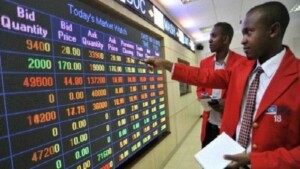
But the real signal wasn’t the drop.
It was the activity behind it.
Trading volume surged to over 1.2 billion shares worth about ₦75 billion — a level that points to deliberate repositioning, not fear-driven exits.
This is how institutional money behaves. It doesn’t panic. It rotates.
And that’s exactly what the NGX stock market today is showing.
Where the Money Is Moving
Follow the liquidity, and the story sharpens.
Banking and financial stocks dominated trading flows. Names like Guaranty Trust Holding Company, Access Holdings and Zenith Bank saw some of the heaviest transaction volumes on the day.
That’s not random.
Banks are the transmission channel of macro change. They react fastest to:
- interest rate shifts
- FX liquidity changes
- government borrowing cycles
So when capital clusters in financial stocks, it usually signals that investors are repositioning around macro expectations — not just reacting to price moves.
At the same time, selling pressure in consumer and industrial names suggests capital is being pulled away from sectors more exposed to cost pressures and demand weakness.
This is not a broad exit.
It’s selective.
FX Stability Is Quietly Changing Everything
The deeper driver of the NGX stock market today isn’t equities themselves.
It’s the foreign exchange environment.
For much of the past year, FX instability forced investors into defensive strategies. Equities became a hedge — a place to park capital against currency risk.
Now that dynamic is shifting.
Even modest stability in the naira is beginning to change investor behaviour. When currency risk starts to ease, investors don’t need to hide in equities anymore. They can diversify again.
That’s exactly what appears to be happening.
Foreign portfolio investors — often the biggest drivers of liquidity — are slowly re-entering the market. But they’re doing it cautiously, targeting specific opportunities rather than chasing broad exposure.
That creates uneven flows.
Money comes in — but it doesn’t spread evenly. It concentrates, tests, and rotates.
Bond Yields Are Pulling Capital Away
While equities adjust, another force is gaining strength in the background: fixed income.
Nigeria’s bond market is becoming increasingly attractive. Elevated yields are offering investors a compelling alternative — one that delivers returns with lower volatility.
That changes the risk equation.
Why hold equities through fluctuations when bonds are offering strong, relatively predictable yields?
This is where the pressure is building.
Not as a sudden shift, but as a steady reallocation of capital — away from equities and into fixed income.
The NGX stock market today is beginning to reflect that shift.
Oil Prices Still Shape the Mood
Oil remains the invisible hand behind Nigeria’s financial markets.
Global crude dynamics continue to influence:
- FX inflows
- government revenues
- investor sentiment
Higher oil prices should, in theory, support the system. But investors are no longer looking at price alone. They’re watching transmission — how effectively oil revenues translate into FX stability and economic strength.
That uncertainty keeps sentiment cautious.
It supports the market — but doesn’t stabilise it fully.
The Real Meaning of the ₦1.3tn Drop
The headline figure is dramatic.
But the interpretation matters more.
This isn’t a breakdown. It’s a repricing.
After months of gains, investors are reassessing:
- where returns will come from next
- how risk should be priced
- which assets deserve capital
That process naturally creates volatility.
And that’s what we’re seeing now.
Smart Money Is Moving First
Retail investors often react to headlines.
Institutional investors move before them.
The surge in activity suggests institutional investors are not exiting the market outright, but are instead aggressively reallocating capital across sectors in response to shifting macro expectations.
They’re not exiting Nigeria.
They’re recalibrating exposure.
And that’s a critical difference.
What Happens Next
The path forward depends on a few key variables:
- FX stability: If the naira holds, confidence strengthens
- Bond yields: If yields rise further, equities face more pressure
- Oil prices: If volatility increases, uncertainty returns
If these remain balanced, the market could stabilise after this adjustment phase.
If not, the rotation could deepen into a broader correction.
The Bigger Shift No One Is Saying Clearly
Here’s the real story behind the NGX stock market today:
Nigeria’s market is transitioning.
From:
momentum-driven gains
To:
macro-driven positioning
From:
broad rallies
To:
selective capital allocation
That shift is subtle — but powerful.
And it’s exactly what separates a temporary dip from a structural change.
Final Take
₦1.3 trillion didn’t just disappear.
It moved.
And where it’s moving to will define the next phase of Nigeria’s financial markets.
The shift could reshape investor positioning, liquidity flows, and equity valuations across Nigeria’s financial markets if the current rotation phase continues.
That’s the signal behind the noise.
And it’s only just beginning.
Read more @ireport247news
About The Author
