

North Korea– Kim jong-un has opened new homes for families of fallen North Korean soldiers in Pyongyang, offering state-backed support and recognition for relatives of troops killed in the Ukraine war.
The project was unveiled by Kim Jong-un, who toured the residences with his daughter, Kim Ju-ae, emphasising the government’s commitment to assisting bereaved military families.

The residential district, named Saeppyol Street, is located in Pyongyang’s Hawasong district and consists of newly built apartment blocks allocated specifically to families of soldiers killed overseas.
“These homes are a tribute to the young martyrs who sacrificed all for their motherland,” Kim Jong-un said during the ceremony. “It is the state’s duty to ensure their families are cared for and take pride in their sons and husbands.”
State media released images showing Kim walking along the streets, speaking with residents, and inspecting the interiors of the new apartments. Analysts note that such ceremonial visits are a hallmark of Pyongyang’s domestic messaging strategy, combining Kim Jong-un housing initiative with visible state support for families.
Housing in Pyongyang is one of the most coveted and tightly controlled resources in North Korea, and allocation is often tied to political loyalty. Providing families of fallen soldiers with modern apartments is seen by observers as a concrete way to demonstrate the state’s recognition and reward for military service.
A North Korean official quoted in state media said, “We worked to complete the project ahead of schedule so that families could feel some comfort and security, even in the wake of loss.” The official described Saeppyol Street as part of a broader Pyongyang housing project designed to symbolise national unity and commitment to the military.
North Korea’s involvement in the Ukraine conflict began in 2024, under a formal mutual defence agreement with Russia. Thousands of North Korean troops were deployed alongside Russian forces to support operations in the conflict.
According to South Korean, Ukrainian, and Western estimates, approximately 14,000 North Korean soldiers were sent to Ukraine, and more than 6,000 are believed to have been killed.
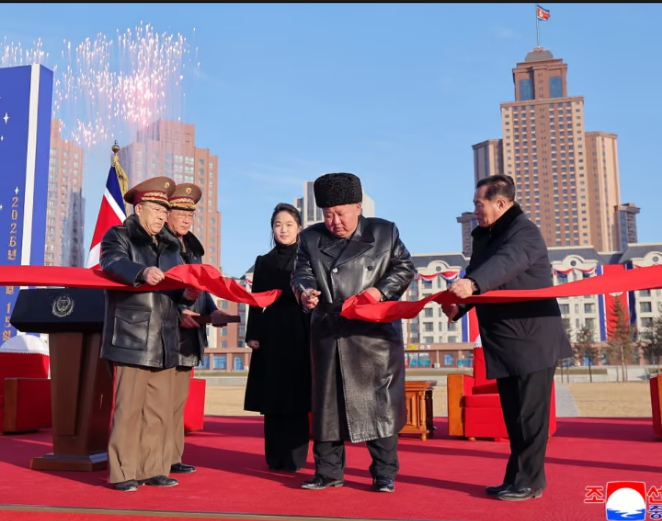
While Pyongyang does not release official casualty numbers, analysts say projects like Saeppyol Street serve as a public acknowledgment of losses while simultaneously reinforcing domestic propaganda.
Kim Jong-un’s speech highlighted the symbolic significance of the new homes. “These residences are not merely buildings,” he said. “They are a recognition of sacrifice, a concrete guarantee that the state stands by the families of those who gave their lives in service to the nation.”
South Korea’s National Intelligence Service has reported that North Korean forces benefit from overseas deployments by gaining modern combat experience and Russian technical assistance, which could improve the performance of their weapons systems.
“Despite the high human cost, North Korea is using this deployment to strengthen its military capabilities,” said a South Korean official briefed on recent intelligence.
Hong Min, an analyst at the Korea Institute for National Unification, described the Saeppyol Street housing project as “a highly calculated political signal. It visually demonstrates the state providing compensation for families of fallen soldiers while reinforcing loyalty and obedience to the regime.”
He added, “It is both a domestic tool for unity and an international signal of North Korea’s ongoing military alignment with Russia.”
The ceremony also coincides with preparations for a major ruling party congress scheduled later this month. Observers expect Kim Jong-un to outline his domestic and foreign policy priorities for the next five years, using projects such as Saeppyol Street to demonstrate leadership and reinforce control.
“Timing these announcements and projects before political events is a long-standing practice in Pyongyang,” Hong Min said.
In addition to housing, North Korea has unveiled other memorial projects commemorating soldiers killed abroad. State media has featured images of statues, museums, and monuments dedicated to military achievements, forming a broader narrative that portrays overseas deployment as honorable and necessary.
Analysts note that these initiatives, combined with tangible housing benefits, aim to reduce public discontent over casualties.
Residents moving into the new apartments expressed gratitude in state media reports. One mother said, “While I mourn my son, these homes give me hope and show that our sacrifices are recognized.” Another family commented on the modern facilities and the opportunity to live closer to the capital’s services.

The Pyongyang housing project also reinforces the ongoing Kim Jong-un housing initiative, linking his personal leadership to direct benefits for citizens. Such projects are central to the regime’s domestic strategy, blending social welfare, political loyalty, and public demonstration of state care.
As the war in Ukraine continues, North Korea’s actions remain closely watched by international observers. The combination of troop deployment, casualties, and high-profile domestic housing projects demonstrates how the regime manages military losses and public perception simultaneously.
Analysts suggest that these projects not only honor the dead but also prepare the domestic audience to accept further foreign deployments.
The inauguration of Saeppyol Street, along with other memorial and housing projects, underscores a consistent approach: providing tangible compensation while framing military service abroad as a point of national pride.
Through these measures, North Korea sends a clear message to its citizens that sacrifice is acknowledged, loyalty is rewarded, and the state remains in control of both narrative and resources.
Read also: Ukraine peace deal hinges on 20-year US security guarantee, Zelenskyy says


