Israeli Prime Minister Benjamin Netanyahu reiterated his determination to disarm Hamas and fully demilitarize Gaza, stressing the need for security while Palestinian officials travel to Cairo for urgent negotiations.
Netanyahu emphasized that the current Gaza ceasefire provides for the return of all Israeli hostages and ensures Israel maintains control over key territories within the Strip.
The address followed high-level consultations with US envoy Jared Kushner, who arrived to assess recent ceasefire violations and apply pressure on Hamas to comply with disarmament agreements.
US Vice President JD Vance was scheduled to arrive shortly, coordinating with Israeli officials to enforce ceasefire terms and ensure Hamas adheres to its demilitarization commitments.

Hamas allegedly attacked Israeli soldiers during the ceasefire, killing two, prompting Israeli airstrikes that killed at least 44 Palestinians. Hamas denied involvement, escalating tensions and ceasefire uncertainty.
Initially, Israel announced it would cut humanitarian aid to Gaza after the attack but restored limited supplies following consultations with US officials, though the Rafah crossing remains closed.
Vice President Vance described the ceasefire violations as “hills and valleys,” noting Hamas’s fragmented structure, with some cells potentially honoring the truce while others act independently.
A Palestinian delegation traveled to Cairo to discuss implementing the second phase of the ceasefire plan, focusing on establishing a technocratic governance body and enforcing Hamas disarmament.
Khalil al-Hayya, exiled Hamas leader, is expected to negotiate the formation of a neutral governing body to run Gaza, with demilitarization remaining the main sticking point.
Under the 20-point plan presented by Donald Trump, Gaza governance would be overseen by an international technocratic body led by world powers, including Trump and former UK Prime Minister Tony Blair.
Hamas has objected to the plan, insisting the Gaza administration should be Palestinian-led, rejecting enforced demilitarization and international oversight, making compliance a critical issue in peace talks.
Trump has publicly stated that Hamas pledged to disarm, although no definitive timeline exists. He warned Israel or international actors may enforce demilitarization if compliance is insufficient.
Despite the ceasefire, Israeli forces continued operations in Gaza, targeting Deir al-Balah and Gaza City. At least two Palestinians were reportedly killed on Monday amid ongoing violence.
Palestinian authorities allege Israel violated the ceasefire at least 80 times, killing more than 80 civilians since the agreement took effect, undermining both peace efforts and demilitarization goals.
Israel maintains these operations respond to attempts by Hamas to test ceasefire boundaries. Troops currently control over 50 percent of Gaza and mark red zones where entry is forbidden.
At least 11 Palestinians died crossing unclear red zone boundaries. Residents described navigating Gaza as nearly impossible, illustrating the urgent need for humanitarian aid and structured governance reform.

Humanitarian agencies report aid entry is far below the 600-truck daily requirement to meet food, medical, and reconstruction needs, worsening Gaza’s ongoing humanitarian crisis and civilian suffering.
UNRWA director Sam Rose emphasized that international NGOs, including British organizations, face severe restrictions delivering aid, preventing effective response to the humanitarian crisis while Hamas disarmament negotiations continue.
Israel continues to block the Rafah crossing because Hamas delayed returning Israeli hostages’ remains. Sixteen hostages remain, many buried under collapsed buildings from airstrikes, complicating relief operations.
Hamas insists specialized equipment is necessary for safe recovery but maintains its commitment to the ceasefire, highlighting the fragile balance between security enforcement and ongoing demilitarization negotiations.
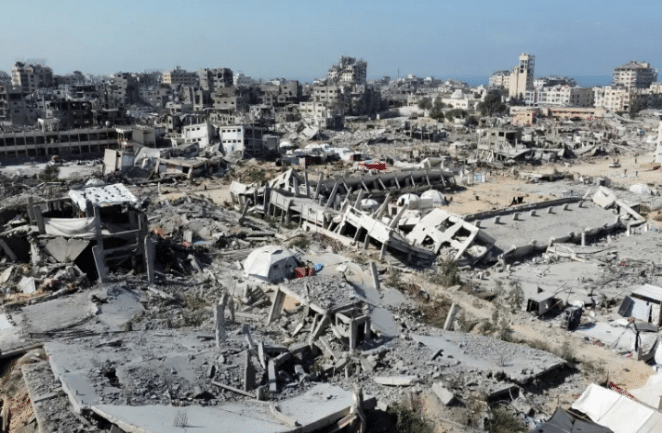
Gaza City’s infrastructure has been heavily damaged, with bombed-out streets and collapsed apartment blocks. Civilians report extreme difficulty navigating due to red zones and ongoing Israeli military activity.
US officials continue diplomatic efforts to stabilize Gaza, monitoring ceasefire compliance and pressing Hamas for disarmament, reflecting the crucial role of the international community in supporting peace efforts.
Observers warn that long-term peace is unlikely without enforceable Hamas disarmament, as recurring ceasefire violations, civilian casualties, and humanitarian shortages threaten regional security and undermine international oversight efforts.
The coming days are pivotal, as Hamas compliance with disarmament, negotiations in Cairo, and expanded humanitarian aid will determine Gaza’s security and long-term stability under the current ceasefire.
Hamas’s compliance remains uncertain, and delays in aid distribution exacerbate political and humanitarian tensions, highlighting that enforceable demilitarization is necessary for both civilian protection and regional peace.
International actors face mounting pressure to enforce ceasefire rules and governance reforms, as sporadic violence and civilian deaths continue, emphasizing the importance of disarmament to break the cycle of conflict.
Netanyahu’s strategy reflects Israel’s priority of neutralizing Hamas’s military capacity. Peace prospects, humanitarian relief, and governance reforms are all directly tied to enforceable demilitarization of the Strip.
Without compliance, the humanitarian crisis and conflict are likely to worsen. Aid shortages, damaged infrastructure, and ongoing Israeli operations threaten civilian survival and future governance prospects.
Enforcing disarmament remains central to achieving long-term peace, with international oversight, US involvement, and diplomatic mediation crucial to ensuring Hamas does not regain military strength.
Netanyahu’s approach highlights the connection between security and humanitarian aid, with demilitarization serving as a prerequisite for international assistance and Gaza’s eventual reconstruction and stability.
Hamas disarmament is the decisive factor shaping Gaza’s trajectory, with failure likely resulting in additional civilian casualties, worsening humanitarian conditions, and continued military escalation across the Strip.
Netanyahu’s vow to disarm Hamas underscores the intersection of military, diplomatic, and humanitarian priorities. Gaza’s future depends on compliance, international oversight, and continued diplomatic support for peace.