

US President Donald Trump’s special envoy Steve Witkoff and senior adviser Jared Kushner have returned to the Middle East as Witkoff and Kushner arrive in Israel to reinforce diplomatic efforts supporting the fragile Gaza ceasefire agreement, a US embassy spokesperson confirmed on Monday.
The two envoys, who played central roles in brokering the truce between Israel and Palestinian factions, are expected to meet with Prime Minister Benjamin Netanyahu’s cabinet members to review progress and discuss next steps in stabilizing the situation. Their arrival highlights renewed American engagement in the region after weeks of intensive negotiations and intermittent violence.
Officials in Washington say Witkoff and Kushner arrive in Israel at a critical moment when both sides are testing the limits of the ceasefire. “They’re here to reaffirm the US commitment to regional peace and to ensure that all parties are holding to the terms of the agreement,” a US embassy spokesperson said, noting that the visit is part of a coordinated diplomatic follow-up effort.
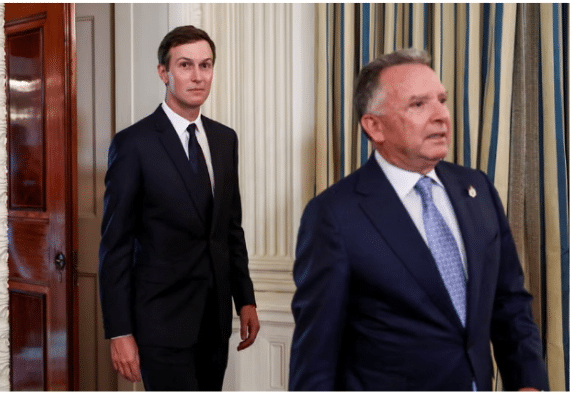
The Gaza ceasefire agreement, which came into effect after relentless fighting that left hundreds dead and thousands displaced, remains fragile. Israeli military sources reported isolated incidents along the border, though overall calm has largely prevailed. For Washington, the truce is a key test of its revived Middle East strategy under Trump’s leadership.
Israeli government officials have welcomed the high-level visit, saying it demonstrates sustained American interest in maintaining regional stability. One senior aide to Netanyahu said that “continued US engagement gives the ceasefire greater credibility and pressure on both parties to keep their word.”
The White House emphasized that Witkoff and Kushner arrive in Israel not just to observe the situation but to shape the next phase of post-conflict reconstruction. They are expected to discuss humanitarian corridors, prisoner exchanges, and financial mechanisms to rebuild infrastructure in Gaza while ensuring Israeli security remains uncompromised.
Meanwhile, US Vice-President JD Vance hinted that he may travel to Israel later this week. “We’re trying to figure it out,” Vance told reporters.
“The administration wants to go and check on how things are going.” He added that managing the truce would be “a process with fits and starts,” suggesting Washington expects setbacks but remains determined to stay involved.
Analysts believe the American delegation’s return signifies a deeper diplomatic shift. “When Witkoff and Kushner arrive in Israel, it’s more than a courtesy visit,” said political analyst Yael Shahar. “It’s a signal that the US intends to remain the main broker in the region’s peace framework and to prevent another escalation in Gaza.”
The Gaza ceasefire agreement, which emerged from weeks of Egyptian-led and US-backed talks, has been described by diplomats as one of the most complex yet promising deals in years. However, doubts persist about whether militant groups and Israeli hardliners will fully comply, given deep political and ideological divisions on both sides.
Within Israel, Netanyahu faces growing domestic pressure from both his coalition partners and the opposition. Critics accuse him of giving too many concessions while others argue the truce fails to address long-term security concerns. The prime minister has defended the deal as a “strategic necessity” and praised the American role in achieving it.
Steve Witkoff, a close Trump ally and seasoned negotiator, said before departing Washington that diplomacy “requires patience and practical steps on the ground.”
His mission, alongside Kushner’s, aims to sustain the truce while encouraging confidence-building measures among local leaders.
For Kushner, who was instrumental in negotiating the Abraham Accords, this visit marks his re-engagement with Middle East diplomacy after a period away from official duties. His relationships with Israeli and Gulf officials remain a cornerstone of US outreach efforts.
Israeli sources say discussions will focus on maintaining border calm, monitoring smuggling routes, and expediting aid deliveries into Gaza. Humanitarian groups have warned that without immediate relief, the enclave’s already dire conditions could spark further unrest.
A senior US official traveling with the delegation said the administration remains “deeply invested” in making the ceasefire sustainable. He confirmed that American diplomats are working closely with the United Nations and Egypt to ensure humanitarian aid flows unimpeded.
“The purpose of this mission is simple,” the official said. “When Witkoff and Kushner arrive in Israel, it sends a clear message that the United States won’t abandon the peace process once the cameras leave. This is a long-term commitment.”
Observers say the ceasefire framework includes a new mechanism allowing international monitors to verify compliance in real time — a key innovation aimed at preventing rapid escalation. If successful, the model could form the basis of future regional stabilization efforts.
Yet, despite cautious optimism, residents in southern Israel and Gaza remain wary. Occasional alarms have reignited fear of renewed hostilities. In Gaza City, residents said they hope the calm holds long enough to rebuild homes, reopen schools, and restore basic services.
Security experts warn that spoilers on both sides could undermine the truce for political gain. “Each day of quiet is an achievement,” said Israeli defense analyst Reuven Ben-Ari. “But without continued diplomatic pressure, the ceasefire could unravel as quickly as it began.”

The Gaza ceasefire agreement remains the central pillar of ongoing discussions. Both American and Israeli officials are said to be exploring economic incentives for long-term stability, including regional infrastructure projects and trade facilitation measures between Israel and neighboring Arab states.
As Witkoff and Kushner arrive in Israel for extended talks, expectations are high that they will push for tangible progress before the next round of diplomatic consultations in Washington.
The duo is expected to meet not only with Netanyahu’s team but also with humanitarian coordinators and business leaders involved in reconstruction planning.
By the end of their visit, Witkoff and Kushner arrive in Israel will likely be seen as a turning point in US mediation efforts — a visible demonstration that Washington intends to balance its political alliances with a pragmatic push for stability. Their presence underscores the belief that diplomacy, not deterrence alone, offers the best path forward in a region weary of endless conflict.


