

Manchester City Carabao Cup semi-final dominance was once again on display as Pep Guardiola’s side claimed a decisive away victory, shutting out Newcastle at St James’ Park and taking firm control of the tie ahead of the return leg.
A disciplined defensive display combined with clinical late finishing ensured City left Tyneside with a commanding advantage, reinforcing their reputation as the competition’s modern specialists and placing one foot firmly on the road to Wembley.
The visitors sealed the result late on with a second goal that summed up their control and composure. Two substitutes combined to telling effect as Rayan Ait-Nouri delivered a precise pass into the path of Rayan Cherki, who swept the ball confidently past Nick Pope.
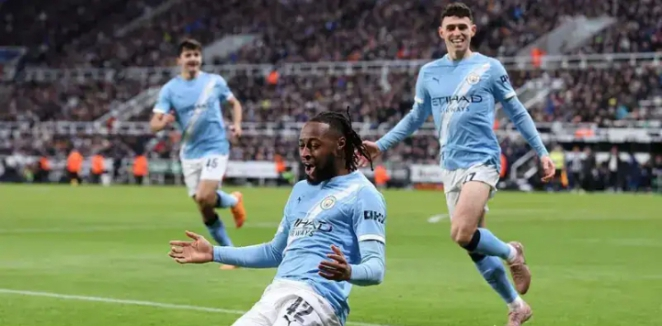
The goal not only killed off any lingering Newcastle hope but also highlighted the depth at Guardiola’s disposal, with City able to change the game decisively from the bench in the closing stages.
Newcastle will rue a series of missed opportunities that could have altered the tone of the contest. Yoane Wissa came agonisingly close on two occasions, first seeing a powerful effort clawed away by goalkeeper James Trafford before reflecting on a glaring miss earlier in the first half.
Bruno Guimarães also went close, his thunderous strike crashing back off the woodwork when the home crowd was already rising in anticipation.
In total, all four of the clearest chances created by the hosts were squandered, leaving frustration to grow as City’s resistance held firm.
The clean sheet carried added significance. Manchester City became the only team to prevent Newcastle from scoring at home all season, an achievement that underlined the visitors’ organisation and discipline.
Every Newcastle surge was met with calm defending, intelligent positioning, and timely interventions, as City absorbed pressure without ever appearing rattled.
For Newcastle, the inability to convert promising situations into goals turned belief into anxiety as the match wore on.
While the scoreline reflected City’s efficiency, the contest was not without controversy.
Post-match discussion was dominated by debate around officiating decisions, with the phrase “game has gone” circulating widely in reaction to what many viewed as a poor night for VAR.
In a semi-final of such importance, the lack of clarity around key moments drew criticism and shifted focus away from the football itself. Although those decisions did not change the outcome, they added an edge to the atmosphere and left Newcastle feeling aggrieved.
City, however, will care little for external noise. Their focus remains on results, and this performance fitted a familiar pattern in knockout football.
They managed the tempo expertly, slowed the game when required, and accelerated at key moments.
Even without dominating possession for long stretches, they dictated where the match was played and limited Newcastle to hopeful bursts rather than sustained pressure.
The individual performances reflected the broader flow of the game. A. Semenyo emerged as Player of the Match with an average rating of 7.79, standing out for his composure and influence when others struggled to impose themselves. L.
Hall and L. Miley delivered solid contributions, while the defensive unit worked tirelessly to maintain shape and concentration.
At the other end of the scale, Newcastle’s lower ratings told the story of a side that worked hard but lacked cutting edge, with frustration creeping into decision-making as chances went begging.
This result further strengthens City’s remarkable record in the competition. They have now progressed from each of their last six Carabao Cup semi-finals and gone on to lift the trophy every time, a statistic that looms large ahead of the return leg at the Etihad Stadium on 4 February.
History suggests that once City establish an advantage at this stage, they rarely relinquish it, and Newcastle are acutely aware of the scale of the challenge they face.
For Newcastle, the defeat is a test of mentality as much as tactics. Eddie Howe’s side have shown resilience in recent seasons, but overturning a deficit away at the Etihad requires near perfection.
Missed chances that might be survivable in league matches are ruthlessly punished in two-legged ties against elite opposition, and this encounter served as a stark reminder of that reality.
Attention now briefly turns to upcoming fixtures as both teams juggle domestic and European commitments. Newcastle travel to Molineux to face Wolves on Sunday before welcoming PSV Eindhoven to St James’ Park in the Champions League.

Those matches offer an opportunity to restore confidence and sharpen attacking efficiency, elements that will be essential if they are to keep the semi-final alive.
Manchester City, meanwhile, face a demanding run that includes a trip to Old Trafford to take on Manchester United, followed by a Champions League away game against Bodo/Glimt.
Such schedules are familiar territory for Guardiola’s squad, whose depth and experience allow them to rotate without losing cohesion.
Managing minutes while maintaining momentum will be key as they aim to keep multiple trophy pursuits on track.
As the second leg approaches, the narrative is clear. City hold the advantage, bolstered by history, form, and squad depth, while Newcastle must find a way to transform promise into productivity.
The controversy surrounding VAR may fade, but the missed chances will linger in the minds of the home players.
Read also: Michael Carrick assume duty as Man Utd Manager: A new chapter at Old Trafford
At Wembley, a place awaits one of these sides, and based on the evidence of this first leg, Manchester City remain firmly in control of their destiny.
About The Author


