Madagascar is facing an unprecedented political crisis as President Andry Rajoelina warned of an illegal power grab, claiming the elite Capsat unit is attempting to seize control by force.
The Madagascar power grab follows weeks of youth-led protests demanding solutions to water and electricity shortages, an end to government corruption, and a radical overhaul of the political system.
President Andry Rajoelina issued a statement assuring citizens he remained in the country, managing national affairs, while the Capsat unit moved to assert control over the army.
Ruphin Fortunat Zafisambo, the newly appointed prime minister, called for calm, stating the government is “fully ready to listen and engage with youth, unions, and the military,” amid escalating unrest.
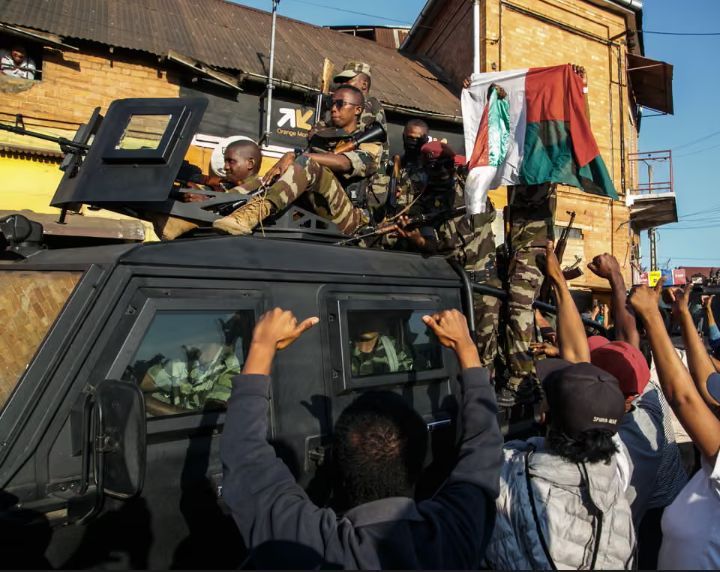
Soldiers from the Capsat unit, which originally brought Rajoelina to power during a 2009 coup, announced their intervention on Sunday morning, heightening fears of a full-scale Madagascar power grab.
The political crisis in Madagascar intensified after Gen Z Madagascar, a leaderless youth movement, organized mass demonstrations starting 25 September, inspired by anti-establishment protests in Indonesia and Nepal.
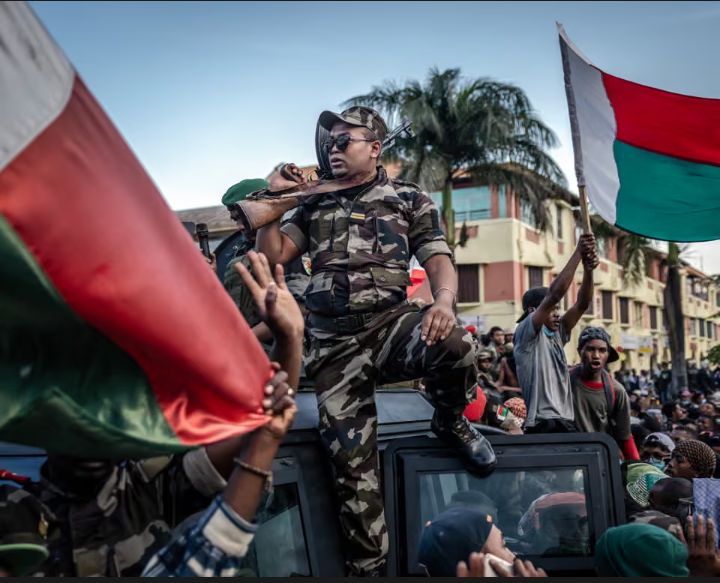
Capsat members left their base in Soanierana district, driving armored vehicles toward the symbolic May 13 Square, joining thousands of cheering protesters in a public display of force.
A Capsat general stated that one soldier had been killed by gendarmerie forces, while a journalist was shot in the buttocks, underscoring the escalating tension surrounding the Madagascar power grab.
The UN reported at least 22 deaths at the start of the protests, though Rajoelina disputed the figure, claiming 12 “looters and vandals” had died, rejecting the UN’s higher estimates.
Protesters demanded the resignation of President Andry Rajoelina, the parliamentary leader, and constitutional court judges, challenging long-entrenched power structures in Madagascar’s fragile democracy.
Youth-led protests have increasingly incorporated social media campaigns, with activists sharing real-time footage from the streets, galvanizing public support against perceived corruption and government inaction.
Madagascar power grab concerns extend beyond the capital, with rural regions reporting sporadic demonstrations, reflecting widespread frustration over poor governance, limited access to services, and chronic poverty.
Some opposition politicians joined the Capsat unit in May 13 Square, but activists voiced fears that the Madagascar power grab could lead to unchecked military authority, undermining democratic principles.
The youth-led protests were initially coordinated by Gen Z Madagascar, emphasizing decentralization, participatory decision-making, and a rejection of traditional political elites seen as self-serving.
Economic analysts warn that the ongoing Madagascar power grab could deter foreign investment, disrupt trade, and worsen the economic plight of citizens, many of whom live below the poverty line.
Madagascar’s GDP per capita stands at $545, and Transparency International ranked the country 140 out of 180 nations on its 2024 corruption perceptions index, highlighting chronic governance challenges.
Rajoelina’s decision to dissolve the government on 29 September was rejected as insufficient by protest leaders, who continued calls for full systemic reform and resignations across top state institutions.
The Capsat unit emphasized it would not fire on demonstrators, instead urging unity among military factions, signaling a strategic approach to consolidating power during the Madagascar power grab.
Analysts note that the presence of armored vehicles and high-ranking military officers in central Antananarivo reflects the high stakes, as the Capsat unit solidifies its influence over national security structures.
Human rights groups have called for caution, highlighting that escalation could result in unnecessary civilian casualties, a concern amplified by earlier shootings and reports of violence during youth-led protests.
International observers, including regional African organizations, have urged restraint, recommending that the government and military engage in dialogue to prevent further destabilization amid the Madagascar power grab.
Some young activists voiced unease over the Capsat unit, labeling soldiers who joined the protests “dangerous,” fearing a shift from citizen-led action to military-dominated political maneuvers.
President Andry Rajoelina reiterated in a national address that any attempt to seize power illegally violates constitutional and democratic norms, condemning the Capsat unit’s intervention as unconstitutional.
Protesters in May 13 Square continue to chant “Miala Rajoelina!” (“Leave Rajoelina!”), signaling sustained popular resistance despite military presence and escalating political tension during the Madagascar power grab.
The youth-led protests underscore generational frustration with corruption, lack of services, and exclusion from decision-making, reflecting deeper societal demands for accountability and political participation.
Political analysts warn that Madagascar’s fragile institutions could struggle to contain the fallout from the power grab, raising concerns about prolonged instability, civil unrest, and potential humanitarian impacts.
Social media reports suggest a growing digital mobilization, with activists sharing images and videos of Capsat patrols, illustrating how the Madagascar power grab is evolving in both physical and online spaces.
The Capsat unit’s historical legacy, including its role in the 2009 coup, adds complexity to public perception, creating ambiguity over whether their intervention is stabilizing or exacerbating the Madagascar power grab.
Economic observers caution that political uncertainty could severely impact foreign aid and investment, crucial for a country already struggling with poverty, unemployment, and infrastructure deficits.
As the situation develops, Madagascar power grab dynamics are being closely monitored by international media, governments, and NGOs, all tracking potential shifts in governance and public order.
Experts stress that dialogue, compromise, and adherence to constitutional norms are essential to prevent escalation, protect civilians, and navigate the political crisis in Madagascar effectively.
The youth-led protests continue to demand broad systemic reform, transparent governance, and the removal of officials perceived as complicit in corruption, ensuring accountability during the Madagascar power grab.
Local residents describe a tense atmosphere in Antananarivo, with checkpoints, armored vehicles, and military presence contributing to heightened anxiety amid ongoing demonstrations and calls for political change.
As political analysts and citizens debate the legitimacy of the Capsat unit’s actions, the Madagascar power grab remains a defining moment in the nation’s modern history, testing democratic resilience.
The international community continues to advocate for peaceful negotiation, urging President Andry Rajoelina and military leaders to avoid escalation and prioritize dialogue to resolve Madagascar’s political crisis.
Despite military intervention, youth-led protests persist, reflecting the determination of Gen Z activists to maintain pressure for reform and signal that government accountability remains non-negotiable.
Madagascar power grab tensions reveal the interplay between institutional weakness, public frustration, and youth activism, offering lessons on the risks of militarized interventions in fragile democracies.
Observers warn that prolonged unrest could exacerbate humanitarian needs, including food, water, and medical care, already scarce in regions affected by the political crisis in Madagascar.
In the midst of uncertainty, the Madagascar power grab continues to dominate headlines, illustrating the country’s fragile political environment and the growing influence of youth-led activism on national affairs.
About The Author