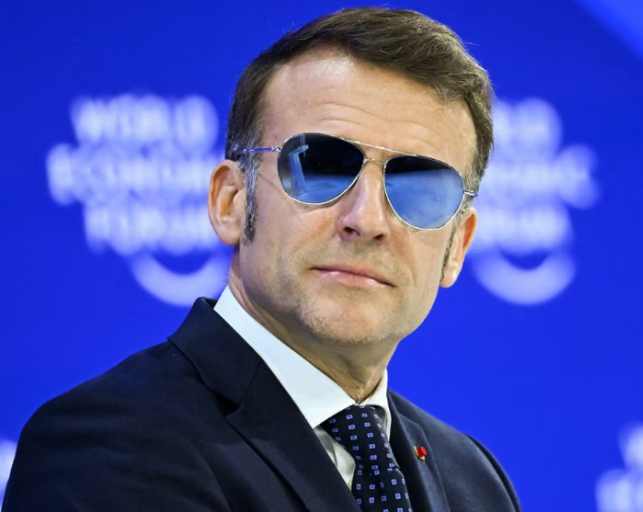
French President Emmanuel Macron delivered a forceful set of remarks at the World Economic Forum in Davos on Tuesday, rejecting what he called “new imperialism or new colonialism” and urging global leaders to focus on cooperation rather than geopolitical rivalry.
Macron’s comments came amid escalating tensions between major powers, especially after U.S. President Donald Trump asserted there was “no going back” on interest in acquiring Greenland, a move that drew criticism from European capitals.
Addressing a packed audience, Macron warned against wasting time on “crazy ideas” that would open “Pandora’s box” of conflict and confrontation, instead advocating for political dialogue to solve shared problems.
“Let’s not open Pandora’s box or new topics,” Macron said, adding that the current moment requires cooperation to fix three major global challenges affecting citizens worldwide.

Although Macron did not name Trump in that statement, commentators at Davos widely interpreted parts of his speech as a direct response to provocative U.S. remarks and policy threats.
Earlier in the session, Macron highlighted that the global order cannot be defined by the “law of the strongest,” a phrase he used to critique an approach based on coercion and power alone.
According to reports from the forum coverage, he framed the choice ahead for world leaders as one between a new colonial approach and effective multilateralism that respects sovereignty and international law.
Macron argued that embracing multilateral cooperation — working together through established institutions and partnerships — is essential to confronting challenges like climate change, peacebuilding, and economic stability.
He stressed that national independence and sovereignty remain key components of global order, and nations must not allow themselves to be subjugated or treated as vassals to more powerful states.
In the context of Greenland, Macron reminded the audience that France’s deployment of forces was intended to support Denmark and a European ally, not to threaten anyone.
France also plans to use its G7 presidency to revive frank dialogue among world powers, with the objective of preventing trade wars and escalation of protectionist policies.
These remarks were delivered against a broader backdrop of geopolitical tension, including Trump’s tariff threats against European nations if Denmark refused to cede Greenland’s territory.
European Commission President Ursula von der Leyen echoed Macron’s push for unity, warning that tariffs risked a downward spiral in global markets and economic cooperation.
Von der Leyen stressed that Europe’s response would be “unflinching, united, and proportional,” and reiterated full solidarity with Greenland and the non‑negotiable sovereignty of Danish territory.
Her comments underscored Europe’s determination to defend its strategic interests while maintaining diplomatic engagement with the United States and other partners.
Market reactions to the geopolitical tensions were immediate: global stocks dipped while safe‑haven investments like gold rose as investors weighed the risk of escalating trade disputes.
Behind Macron’s speech lay a deeper argument about the need for strategic autonomy, especially for Europe, to reduce excessive reliance on external powers like the U.S. or China.
That theme has appeared in Macron’s diplomacy before, including calls for stronger cooperation between Europe and Asia to counter “revisionist countries” and pressures to control territories or resources.
Macron has consistently framed global challenges — such as trade imbalances, climate change, and security risks — as requiring collective action and reinforced multilateral institutions.
He has argued that the world cannot respond effectively to rising geopolitical competition through isolationism or unilateral power plays but through shared commitments to rules-based order.
His stance resonates with his long‑standing vision for a “new international order” that strengthens cooperation among countries and refocuses global governance to address modern crises.
Macron’s remarks at Davos reflect years of rhetoric pushing for deeper European strategic initiatives, including economic integration, defense autonomy, and partnership networks stretching beyond the West.
In the past, Macron has emphasized that Europe must defend itself and prepare for threats proactively, rather than delegate security to external allies without a coherent strategy.
His call for multilateralism also comes as parts of Africa and other regions reassess traditional ties with former colonial powers and seek more balanced partnerships.
For example, in West Africa, several countries have expelled French troops and challenged the legacy of military cooperation, reflecting growing demand for sovereignty free from former imperial influence.
These developments complicate France’s diplomatic efforts to present itself as both a partner and advocate for international cooperation without perceptions of dominance.
Critics, including some African leaders, have pushed back against Macron’s framing of international support, suggesting that comments about historical gratitude can inflame tensions.
Overall, Macron’s Davos speech sought to recalibrate discussions about global leadership, emphasizing that progress depends on shared solutions rather than competitive imperial posturing.
He urged world leaders not to be divided by narrow national interests but to focus on common challenges that require cooperation and mutual respect.
Macron also criticized the idea of resorting to aggressive trade tools among allies, calling such approaches unpredictable and counterproductive for global stability.
In calling certain strategies “crazy,” Macron was underscoring the risks of returning to outdated geopolitical mindsets that could unravel decades of diplomatic progress.
Macron’s broader message at Davos was clear: the world needs more dialogue, cooperation, and effective international institutions, not tension rooted in historic rivalries.
His appeal for cooperation rang against a backdrop of rising geopolitical competition that spans climate policy, economic governance, security alliances, and territorial questions.
As the international community watches, Macron’s emphasis on cooperation over confrontation reflects both France’s global diplomatic priorities and broader European perspectives.
While his comments may sharpen debates between global powers, they also underscore the ongoing complexities of maintaining peace and stability in an era of geopolitical flux.
At its core, Macron’s speech was a reminder that collective action and respect for sovereignty remain central to his vision of global order for the decades ahead.