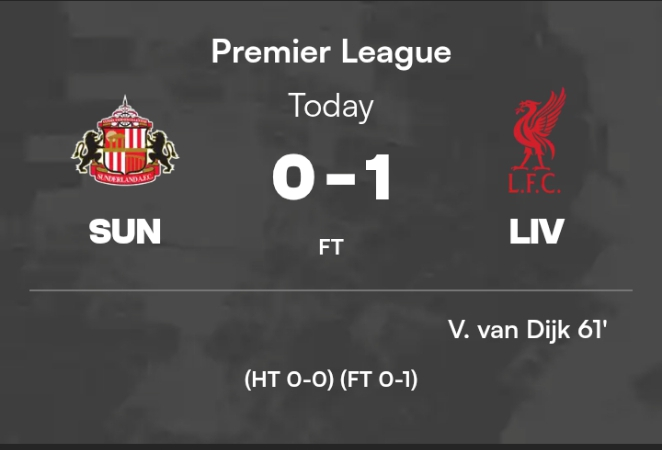
Liverpool edge Sunderland – Liverpool demonstrated patience and resilience as they edged Sunderland 1-0 at the Stadium of Light on Wednesday. Virgil van Dijk’s decisive strike in the 61st minute proved the difference in a tightly contested match. The win maintains Liverpool’s challenge for a top-four finish and keeps Sunderland searching for their first home victory of the season.
The first half was largely balanced, with Sunderland showing defensive discipline and Liverpool controlling possession without creating clear-cut chances. Liverpool’s 57% ball possession highlighted their dominance, yet Sunderland’s organized backline frustrated the visitors’ attacking efforts. The opening 45 minutes ended scoreless, reflecting the tactical caution from both sides.
Sunderland’s defensive setup relied on compact lines and frequent pressing. Reinildo earned a yellow card in the 24th minute for a tactical foul on Mohamed Salah, preventing a potential Liverpool break. This early warning illustrated Sunderland’s commitment to disrupting Liverpool’s rhythm.
Liverpool’s attack struggled to convert possession into meaningful opportunities in the first half. The team registered only three shots on target from 23 attempts, showing a clear need for clinical finishing in the final third. Despite the dominance, chances were limited due to Sunderland’s disciplined defensive structure.
The second half began with Liverpool pressing more aggressively. Jurgen Klopp’s tactical tweaks, including slightly higher positioning from midfielders, increased pressure on Sunderland’s defensive line.
Van Dijk’s goal in the 61st minute came from a precise header following Salah’s cross, reflecting Liverpool’s reliance on aerial strength in key moments.
Sunderland attempted to respond immediately after conceding. They pushed fullbacks higher and sought wider attacks, but Liverpool’s central defenders remained alert, successfully intercepting crosses and preventing clear opportunities. The home side’s strategy showed determination but lacked final quality in the final third.
Liverpool’s defensive discipline was evident throughout the match. Alisson Becker made two important saves to maintain the clean sheet, while Van Dijk and teammates managed 22 interceptions and 12 clearances. The defense’s organization proved essential in preserving the narrow lead.
Sunderland’s attacking numbers were notable but ultimately ineffective. They recorded 11 total shots, including five off-target and four blocked attempts. The statistics highlight the difficulty Sunderland faced in breaking through Liverpool’s well-structured defensive line.
Liverpool’s expected goals (xG) of 1.91 indicates that their attacking efforts were more likely to succeed than Sunderland’s 0.745. This statistical advantage mirrors the result, emphasizing Liverpool’s clinical edge when opportunities arose. Salah’s involvement was central to creating Liverpool’s attacking openings, though his finishing was limited.
Set pieces played a decisive role in this match. Van Dijk’s winning goal came from a well-executed corner, underlining Liverpool’s threat from aerial situations.
Sunderland, conversely, struggled to capitalize on their own set-piece chances, reflecting a gap in attacking execution.
Discipline was crucial in determining match flow.
Sunderland received one yellow card, while Liverpool avoided any cautions. Minimal fouls and controlled aggression allowed Liverpool to maintain rhythm and focus, reducing the risk of dangerous free-kick situations.
Sunderland goalkeeper was tested, making two saves to keep the scoreline respectable. Despite these efforts, the team lacked sustained attacking momentum, often losing possession too quickly when attempting transitions from defense to attack.
Liverpool’s midfield control was another key factor. Completing 491 passes compared to Sunderland’s 372, Liverpool dominated ball circulation and retained possession in critical areas, forcing Sunderland to chase the game and risk defensive exposure.
The match also revealed the strategic contrast between teams. Sunderland relied heavily on counter-attacks, attempting only one successful transition, while Liverpool’s patient build-up allowed them to dictate tempo and force defensive errors.
Van Dijk’s performance was particularly influential. Not only scoring the winning goal, he also contributed significantly in defense, winning eight aerial challenges and organizing the backline. His presence added stability to Liverpool’s overall game structure.
Sunderland’s resilience cannot be overlooked. Despite losing, the team remained organized and avoided further concessions, demonstrating commitment and tactical awareness against one of the league’s top sides. Their discipline in limiting clear-cut chances kept the final score respectable.
Liverpool’s victory moves them closer to solidifying their place in the Premier League’s top four. With this win, they remain in contention for Champions League qualification, a critical target for Jurgen Klopp’s squad this season.
Sunderland, meanwhile, remain in the relegation battle. Their inability to convert possession into goals and failure to capitalize on home advantage leaves them struggling to secure vital points in upcoming fixtures. Improvements in attack will be key to their survival hopes.

Looking at individual performances, Mohamed Salah’s creativity and movement were central to Liverpool’s offensive output. While he did not score, his assist for Van Dijk’s goal demonstrates his continuing influence and ability to create opportunities against compact defenses.
Defensive coordination also defined the match’s outcome. Liverpool’s ability to manage Sunderland’s sporadic attacks, coupled with disciplined positioning, ensured that the visiting side remained in control despite periods of pressure. The match underlined the importance of defensive solidity in tight contests.
From a tactical standpoint, Klopp’s adjustments during the second half made a decisive impact. By pressing higher and optimizing player positioning, Liverpool created a scoring chance that ultimately led to the match-winning goal, highlighting the manager’s strategic acumen.
Sunderland must now reassess their attacking strategy. The limited threat from counter-attacks and lack of efficiency in final passes demonstrates the need for improvement if they hope to escape relegation pressure. Focus on sharper finishing and better positioning is essential.
Liverpool can take confidence from the win as they continue their pursuit of European qualification. Maintaining focus in upcoming matches against mid-table opponents will be vital to accumulating points and securing a top-four finish.
Read also: Crystal Palace vs Burnley: Clarets’ seven-minute blitz overturns Strand-Larsen double
In summary, Liverpool’s narrow 1-0 victory over Sunderland highlighted defensive resilience, tactical discipline, and timely execution in attack. Van Dijk’s header proved decisive, and the win preserves Liverpool’s ambitions for the season.
Sunderland showed commendable organization but lacked the cutting edge to threaten Liverpool consistently. For both sides, lessons from this match will inform strategy in the coming weeks, particularly regarding attacking precision and defensive coordination.
As the Premier League season progresses, every point counts. Liverpool’s ability to capitalize on key moments separates them from struggling sides, while Sunderland must improve efficiency and creativity to remain competitive in their battle for survival.
About The Author