North Korean leader Kim Jong-un has openly acknowledged that his country deployed soldiers to carry out landmine-clearing operations for Russia, marking one of Pyongyang’s rare public admissions of direct military involvement linked to Moscow’s war efforts.
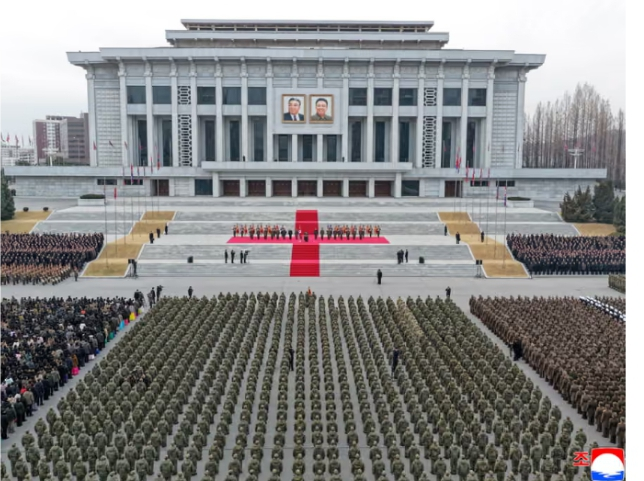
Kim made the disclosure during a high-profile ceremony in Pyongyang to welcome home members of an engineering regiment that had been deployed to Russia’s Kursk region earlier this year. According to North Korean state media, the soldiers were tasked with clearing landmines in areas affected by fighting connected to the ongoing war in Ukraine.
Praising the regiment’s work, Kim said the troops had transformed what he described as a “vast danger zone” into a safe and secure area in a matter of months. He framed the mission as a heroic contribution not only to Russia but also to what he portrayed as a shared struggle against hostile forces.
The deployment reportedly lasted 120 days and began in August. Kim confirmed that nine members of the engineering unit were killed during the operation, underscoring the deadly risks involved in mine-clearing duties. The fallen soldiers were posthumously awarded state honours, which Kim said would “add eternal lustre” to their bravery and sacrifice.
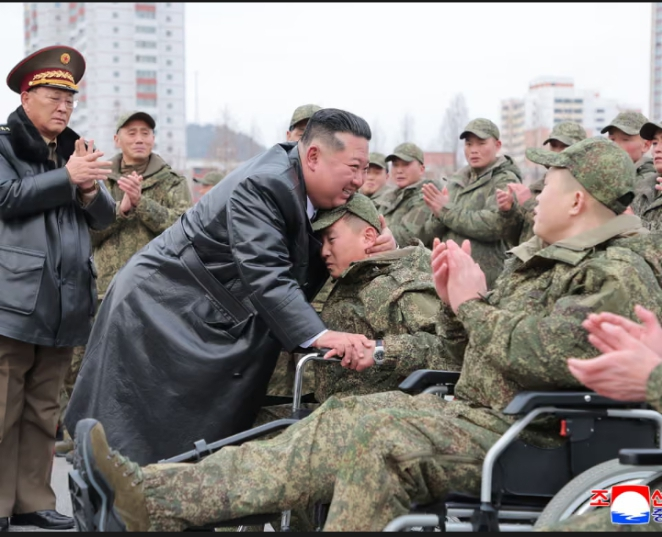
Images released by the Korean Central News Agency showed Kim warmly embracing returning soldiers, some of whom appeared visibly injured and seated in wheelchairs.
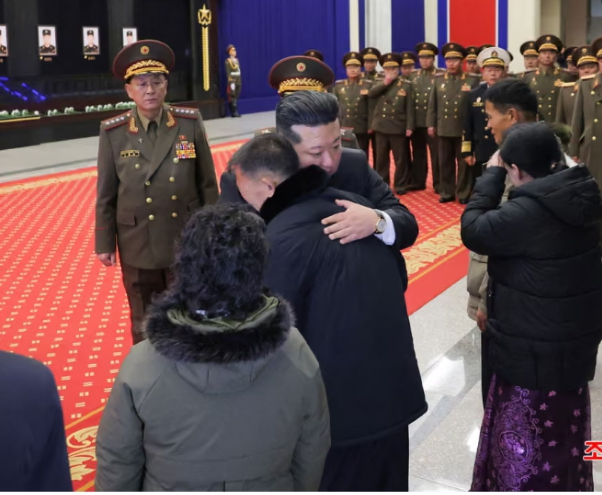
Other photographs depicted emotional scenes of the leader consoling families of the deceased and kneeling before portraits of fallen troops at the April 25 House of Culture in Pyongyang.
One particularly striking image showed Kim holding the head and hand of a wounded soldier in a wheelchair, while others showed him placing medals and flowers beside portraits of those who died.
The highly choreographed displays appeared designed to emphasise Kim’s personal involvement and compassion, while reinforcing loyalty and sacrifice as core national values.
In his speech, Kim noted that the soldiers wrote letters to their hometowns and villages during breaks from mine-clearing work, presenting them as devoted sons of the nation who endured extreme physical and mental strain. He praised both officers and rank-and-file soldiers for what he described as “mass heroism” under unimaginable daily pressures.
The acknowledgement adds weight to longstanding claims by South Korean and Western intelligence agencies that North Korea has sent thousands of troops to support Russia since Moscow’s full-scale invasion of Ukraine. Until earlier this year, Pyongyang had neither confirmed nor denied such deployments, maintaining strict silence on the issue.
Analysts say the mine-clearing mission highlights the practical military assistance North Korea is providing to Russia, extending beyond symbolic gestures or diplomatic backing. Clearing landmines is widely regarded as one of the most dangerous tasks on the battlefield, often resulting in high casualty rates even after active fighting subsides.
In return for its support, Russia is believed to be supplying North Korea with food, fuel, financial assistance and military technology. Experts argue that this cooperation allows Pyongyang to ease the impact of international sanctions imposed over its nuclear and ballistic missile programmes, while also gaining access to advanced military expertise.
North Korea officially confirmed in April that it had deployed troops to assist Russia and that some had been killed, but it provided few details at the time. Kim’s latest remarks represent the clearest public account yet of the nature of those missions and the human cost involved.
The ceremony in Pyongyang follows a series of similar appearances by Kim in recent months. In July, state media broadcast images of him honouring flag-draped coffins believed to contain the remains of soldiers killed abroad. At an earlier event in August, he was shown emotionally embracing a returning soldier who appeared overwhelmed.
International reaction to the growing military cooperation between Pyongyang and Moscow has been sharply critical. Western governments and regional powers warn that North Korea’s involvement risks prolonging the war in Ukraine and destabilising security dynamics in both Europe and East Asia.
Concerns have also been raised that Russia may be transferring sensitive weapons technology to North Korea in exchange for manpower and logistical support. Such transfers could accelerate Pyongyang’s missile and nuclear programmes, further complicating diplomatic efforts to rein in its military ambitions.
Despite renewed diplomatic signals from Washington, including an offer by former US president Donald Trump to meet Kim during an Asia trip in October, the North Korean leader has shown little interest in re-engagement. Instead, Kim appears focused on strengthening ties with Russia and China as part of a broader strategy to counter Western pressure.
By publicly praising the mine-clearing mission, Kim is also sending a strong domestic message. The carefully staged ceremony reinforces narratives of sacrifice, loyalty and national pride, while framing overseas deployments as noble contributions to the country’s strategic interests.
As the war in Ukraine continues, Kim’s admission underscores the expanding scope of North Korea’s role and signals that Pyongyang is increasingly willing to acknowledge, and even celebrate, its involvement alongside Russia on the international stage.
Read also:China holds low-key Nanjing massacre memorial without Xi amid Japan row
About The Author