

Iran’s supreme leader has signalled an intensified crackdown as nationwide protests deepen, warning that authorities will not retreat while accusing foreign powers of orchestrating unrest across the country.
Ayatollah Ali Khamenei delivered the warning in his first public address since protests erupted nearly two weeks ago, following a sharp economic shock that rapidly evolved into political dissent.
The demonstrations, which began after a sudden collapse in Iran’s currency value, have since spread to all provinces, posing the most significant challenge to the Islamic Republic in years.
Speaking on state television, Khamenei described protesters as “saboteurs” and “vandals,” claiming they were acting in service of foreign interests rather than domestic grievances.
He accused the United States of exploiting economic hardship to destabilise Iran, arguing that street protests were designed to satisfy Western leaders hostile to Tehran.
Khamenei made indirect reference to US president Donald Trump, suggesting demonstrators were damaging their own cities to please a foreign leader promising support from abroad.

The remarks came amid rising international scrutiny after Trump publicly suggested that Iran’s supreme leader was preparing to flee the country as unrest intensified.
In a Fox News interview, Trump claimed Iran’s leadership was losing control, stating that conditions inside the country were “getting very bad” for those in power.
Iranian officials swiftly rejected those claims, accusing Washington of psychological warfare and external interference aimed at weakening the Islamic Republic.
Alongside Khamenei’s speech, Iran’s judiciary chief, Gholamhossein Mohseni Ejei, issued a stark warning to demonstrators, pledging “maximum” punishment without legal leniency.
Ejei said authorities would respond decisively to anyone participating in protests, framing the unrest as a security threat rather than a civil movement.
Despite these warnings, thousands of protesters poured into streets overnight, defying a sweeping nationwide internet shutdown imposed by authorities on Thursday evening.
Videos obtained from inside Iran showed crowds filling major intersections in Tehran, Mashhad, Ahvaz, and Rasht, with chants echoing long after nightfall.
In Tehran, protesters reportedly set fire to a building associated with the state broadcaster, a rare symbolic attack against a core pillar of government messaging.
Demonstrators were also seen raising the pre-1979 Iranian flag featuring the lion and sun emblem, signalling rejection of the Islamic Republic’s foundations.
The revival of monarchist imagery reflected a growing openness among protesters to alternative political futures previously considered taboo within Iran.
Reza Pahlavi, the exiled son of Iran’s last shah, issued calls for coordinated demonstrations, urging citizens to reclaim public spaces despite the blackout.
Footage circulating before internet access collapsed showed crowds chanting in support of Pahlavi, including in Mashhad, the hometown of Khamenei himself.
Pahlavi praised protesters for mobilising under extreme conditions, urging them to maintain momentum despite communication disruptions and security threats.
Authorities responded with force, according to multiple eyewitnesses who described violent confrontations between protesters and security forces across several cities.
Protesters reported being pursued by riot police, paramilitary Basij units, and plainclothes officers using motorbikes to disperse crowds at speed.
A 25-year-old artist in Tehran said security forces were deliberately targeting protesters’ eyes, a tactic previously documented during earlier unrest.
She described fear of mass casualties as thousands remained in the streets despite the communications blackout limiting access to emergency support.
Human rights groups estimate that at least 42 people have been killed since the protests began, with more than 2,270 detained nationwide.
Iranian authorities have not released official casualty figures, though state media has acknowledged unrest for the first time since demonstrations began.
State broadcasters characterised the protests as violent riots, alleging infiltration by foreign-backed “terrorist agents” seeking to destabilise the country.
Iranian television aired footage of pro-government rallies, attempting to project an image of national unity and daily life continuing as normal.
Officials claimed that Israeli intelligence operatives had infiltrated protest networks, alleging plans for staged attacks designed to blame the state.
Press TV reported that an Israeli-linked spy cell had been disrupted, though no independent verification of those claims was available.
The internet shutdown, implemented shortly after Pahlavi’s call for protests, severely restricted information flow both inside and outside Iran.
Analysts said the blackout complicated efforts to assess protest, though available evidence suggested participation continued to expand.
Read also:Russia fires hypersonic Oreshnik missile at Ukraine in massive strike
Anti-government chants reportedly erupted simultaneously across multiple cities at 8pm local time, indicating coordinated action despite limited communication.
Some protesters called openly for the return of the exiled crown prince, while others appeared to embrace the symbolism of pre-revolutionary Iran.
Observers noted the movement remained largely leaderless, though Pahlavi’s emergence has provided a focal point for sections of the opposition.
Pahlavi later called for renewed demonstrations, framing the coming days as a critical test of the movement’s endurance under pressure.
His organisation also claimed that thousands of security personnel had privately expressed willingness to defect, though such assertions remain unverified.
Scenes of defiance continued across the country, with protesters throwing stones and forcing security forces to retreat in several confrontations.
A 21-year-old student in Tehran described officers abandoning vehicles under pressure from crowds determined to reclaim public spaces.
Elsewhere, anger spilled into religious institutions, with reports of attacks on a Shia seminary in Gonabad earlier in the week.
Local officials confirmed damage to the facility, describing violent clashes between demonstrators and staff during the incident.
Protesters in northern cities expressed frustration at being labelled traitors, rejecting claims of collaboration with foreign governments.
A shop owner in Rasht said protesters felt betrayed by clerical elites who, he argued, had lost touch with ordinary Iranians’ struggles.
Economic hardship remains the catalyst for the unrest, with inflation, unemployment, and currency collapse fuelling widespread anger.
However, calls for political reform and an end to clerical rule have increasingly dominated protest slogans and street demonstrations.
Security analysts warn that harsher crackdowns may further radicalise the movement, particularly if casualties continue to mount.
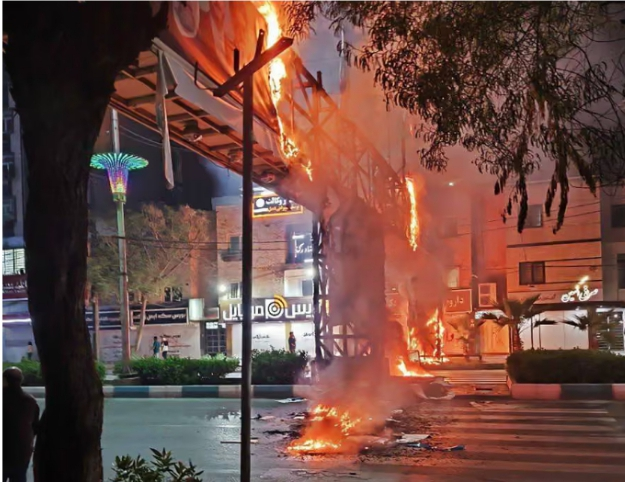
For now, Iran’s leadership appears determined to suppress the protests through force, information control, and legal intimidation.
Yet despite arrests, violence, and internet blackouts, demonstrators continue to return to the streets, signalling a deepening crisis for the Islamic Republic.


