The Kenya war recruitment scam has emerged as one of the most disturbing security and humanitarian revelations in the country’s recent history, following the arrest of a suspected recruiter accused of trafficking Kenyan men into fighting for Russia in the Ukraine conflict.
Kenyan authorities confirmed that Festus Arasa Omwamba, 33, was arrested in Moyale, near the border with Ethiopia, after intelligence agencies linked him to a broader network responsible for what officials now describe as organised human trafficking in Kenya tied directly to a foreign war.
According to police investigators, the suspect is believed to have played a central role in recruiting vulnerable young men with promises of well-paying overseas employment, a pattern now commonly referred to as false job offers abroad.
Instead of legitimate work, many of those who travelled reportedly found themselves coerced into joining Russian military units fighting in the Russia-Ukraine war.
A statement from the Directorate of Criminal Investigations (DCI) said Omwamba was being held in custody and would be presented in court as investigations widened to identify accomplices and financial backers.
“This is not an isolated crime,” the DCI said in its statement. “It is a well-coordinated operation that exploits desperation and unemployment, stripping victims of choice and dignity.”
Investigators added that the Kenya war recruitment scam relied heavily on informal recruitment channels, social networks, and word-of-mouth endorsements that made the offers appear credible to unsuspecting victims.
The arrest followed the release of a classified assessment by Kenya’s National Intelligence Service (NIS), which laid bare the scale of the crisis.
The intelligence report stated that more than 1,000 Kenyan citizens have been recruited or trafficked into the conflict, with 89 currently believed to be on active front lines, 39 hospitalised, and 28 listed as missing in action.
Officials cautioned that the figures may underestimate the true scale, as some families remain too fearful or uncertain to report disappearances.
A senior intelligence officer, speaking on condition of anonymity, said the findings shocked even seasoned analysts. “We are looking at a pipeline that feeds directly into the Russia-Ukraine war,” the officer said.
“This is not about adventure or ideology. It is about deception, coercion, and profit.” The officer added that Kenyan authorities are now treating the Kenya war recruitment scam as both a national security threat and a grave human rights violation.
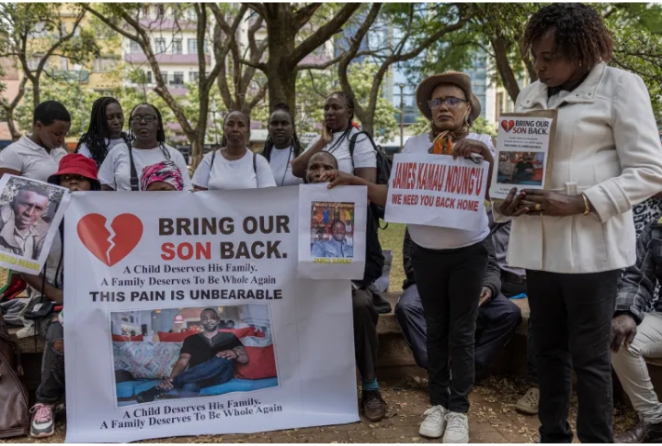
The revelations have triggered anguish and anger among families, particularly in Nairobi, where relatives of the missing staged prayer vigils and peaceful protests.
Holding photographs of sons and brothers, families demanded urgent government action to dismantle recruitment rings and secure the return of those still alive.
One protester said her son believed he was travelling to Europe for warehouse work. “He told me, ‘Mum, this job will change our lives,’” she said through tears. “Now they say he is fighting in Ukraine. We don’t even know if he eats or sleeps.”
Police sources confirmed that Omwamba was arrested shortly after returning from Russia, a detail that has intensified suspicions that he may have maintained direct contact with intermediaries linked to foreign fighters recruitment for the Russian military.
Local media quoted a police spokesperson saying the suspect is believed to have helped arrange travel documents and initial accommodation, acting as a bridge between Kenyan recruits and handlers abroad. “He knew exactly what these men were being sent into,” the spokesperson said. “This was not ignorance. This was intent.”
The Russian Embassy in Nairobi has strongly denied allegations that Moscow is complicit in deceptive recruitment. In a statement last week, the embassy described the claims as “misleading propaganda” and insisted it does not issue visas to Kenyan citizens for the purpose of fighting in Ukraine.
At the same time, it acknowledged that Russia does not bar foreign nationals from voluntarily enlisting in its armed forces. Kenyan human rights groups have rejected that argument, saying consent obtained through deception cannot be considered voluntary. “If someone is promised a job and ends up with a gun, that is trafficking,” one advocate said.
Kenya’s Foreign Affairs Minister Musalia Mudavadi said the government was under no illusions about the public’s anger and fear. He confirmed plans to travel to Moscow in March to engage Russian authorities directly.
“Our citizens were misled, exploited, and placed in harm’s way,” Mudavadi said. “The government will pursue every diplomatic and legal avenue to ensure accountability and to secure the safe return of Kenyans stranded in Russia.”
He added that the Kenya war recruitment scam exposed weaknesses in labour migration oversight that must now be urgently addressed.
The Kenyan case reflects a wider African pattern. Similar allegations have surfaced in South Africa, Zimbabwe, and other countries, where young men have reported being lured abroad before finding themselves trapped in war zones.
Ukrainian officials have accused Russia of deceiving more than 1,700 Africans into joining its war effort, as the conflict stretches into a fifth year.
South Africa recently confirmed the repatriation of several nationals who were lured into fighting, reinforcing claims that human trafficking in Kenya is part of a larger continental problem rather than an isolated anomaly.
For families still waiting for news, the arrest of one suspect offers only limited relief. Many say their primary concern is information: whether their loved ones are alive, where they are being held, and when they might return home. “We don’t want politics,” said one father at a Nairobi vigil.
Read also: Ancient stepwells revived to combat India’s day zero water crisis
“We want our children back.” As investigations continue and diplomatic pressure mounts, the Kenya war recruitment scam, driven by false job offers abroad, foreign fighters recruitment, and entrenched human trafficking in Kenya, has laid bare the human cost of a distant war that has reached deep into Kenyan homes.
About The Author