

The Keir Starmer resignation calls rocking British politics intensified on Monday night after dozens of Labour MPs publicly demanded the prime minister step aside following disastrous election setbacks and a failed attempt to calm growing unrest inside his party.
What began as isolated criticism quickly escalated into a full-scale Labour leadership crisis as ministerial aides resigned, senior MPs rebelled openly and influential party figures questioned whether Starmer could still lead Labour into the next general election.

According to the Guardian, as many as 69 Labour MPs had either called publicly for Starmer’s resignation or urged him to set a clear timetable for departure by Monday evening.
The rebellion deepened despite Starmer delivering a major speech earlier in the day in which he insisted he would “fight any challenge” to his leadership and argued that Britain could not afford “the chaos of constantly changing leaders.”
Labour Leadership Crisis Deepens After Starmer Speech
The crisis represents the gravest threat yet to Starmer’s authority since Labour returned to government. Instead of calming tensions, his speech appeared to trigger even more frustration among MPs who believe the party has lost touch with working-class voters and failed to respond effectively to mounting public anger over living costs, immigration, Brexit-related divisions and controversial policy decisions.
Several Labour MPs openly declared that Starmer could no longer reconnect with voters. Others accused the government of drifting politically while losing support to populist and nationalist movements led by Nigel Farage.
Mary Kelly Foy, the Labour MP for Durham, delivered one of the strongest attacks on the prime minister. She said: “My heart breaks at the current state of the party I’ve called my political home for my entire life.”
Foy also criticised what she described as Labour’s “misguided tactic” of trying to “beat Reform at their game,” warning that the strategy was alienating core supporters across the country.
The revolt spread rapidly across Labour ranks as more MPs publicly abandoned the prime minister throughout the evening. Ben Goldsborough, the MP for South Norfolk, said he no longer believed Starmer could deliver the change voters expected from Labour.
“I no longer believe the prime minister can lead that change,” Goldsborough said while demanding a “swift timetable” for Starmer’s resignation.
Ministerial Resignations Increase Pressure on Starmer
The crisis was worsened by the resignation of several parliamentary private secretaries and ministerial aides who traditionally serve as loyal government allies. Their departures highlighted the scale of frustration now building inside Labour.
Tom Rutland resigned from his role as parliamentary private secretary to environment secretary Emma Reynolds, arguing that public “animosity” towards Starmer had become politically toxic.
Rutland said voter anger meant Starmer could no longer remain in office if Labour hoped to recover before the next election.
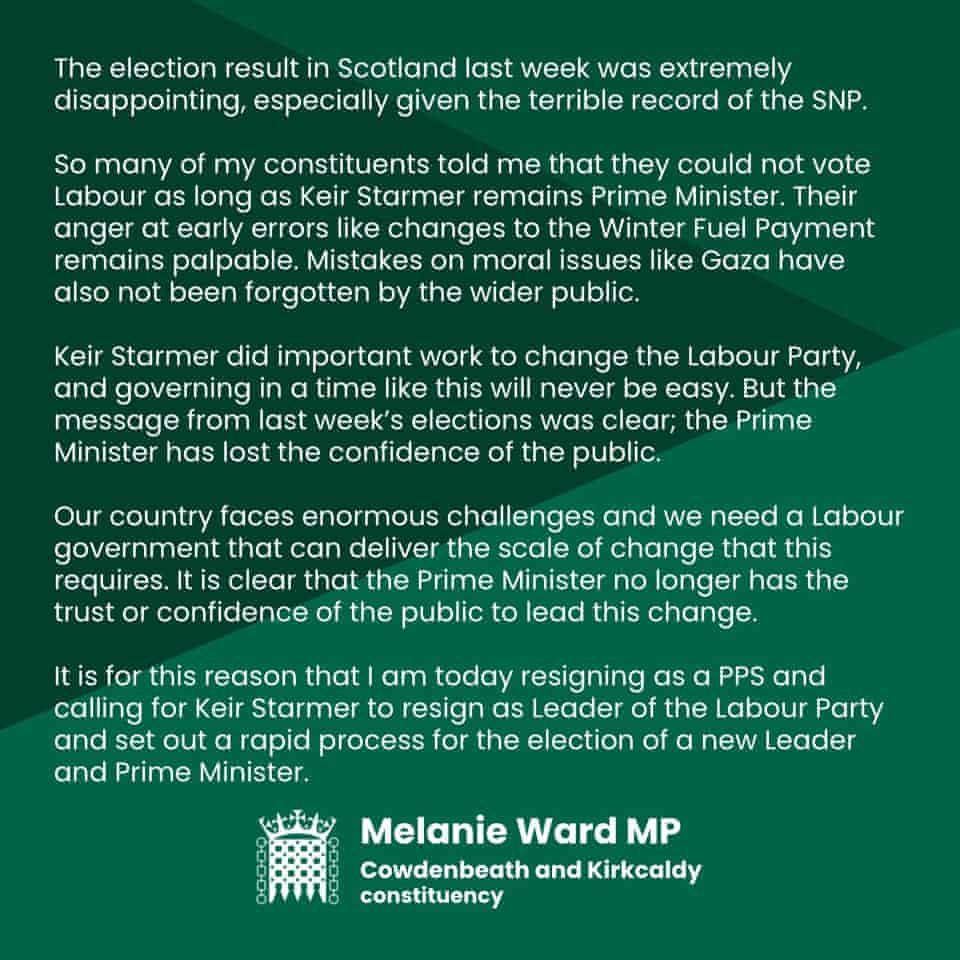
Melanie Ward, the Labour MP for Cowdenbeath and Kirkcaldy, also resigned from her role as a justice PPS while demanding a “rapid process” to replace the prime minister.
Ward revealed the extent of dissatisfaction among ordinary voters, saying many constituents had told her directly that they could not support Labour while Starmer remained leader.
“Their anger at early errors like changes to the Winter Fuel Payment remains palpable,” she said.
Ward added that Labour’s handling of moral issues such as Gaza had also damaged trust among sections of the electorate.
Another major blow came when Debbie Abrahams, the influential chair of the Work and Pensions Committee, publicly backed calls for Starmer to step down in the autumn. She also declared support for Greater Manchester mayor Andy Burnham should a future leadership contest take place.
Abrahams said she would “very much like” Burnham to return to parliament and positioned him as a possible unity candidate capable of reconnecting Labour with traditional supporters.
Angela Rayner and Andy Burnham Enter Leadership Debate
The growing support for Burnham reflects mounting concern within Labour about Starmer’s electoral appeal following heavy local election losses that triggered the current crisis.
Some Labour figures believe Burnham’s more populist communication style and strong regional support could help rebuild trust among disillusioned northern voters who have increasingly drifted towards Reform UK and other opposition movements.
Angela Rayner also entered the debate during an appearance at the Communication Workers Union conference where she admitted Labour’s current approach “isn’t working.”
Rayner warned that people were turning “to populists and nationalists” because Labour had failed to solve cost-of-living problems affecting ordinary households.
Although Rayner stopped short of directly demanding Starmer’s resignation, her remarks were widely interpreted as a sign of serious internal concern about Labour’s direction.
Starmer attempted to fight back during his speech earlier in the day by presenting himself as the only figure capable of maintaining political stability.
He argued that Britain had already suffered enough from leadership turmoil under Conservative governments and insisted Labour must avoid repeating the same mistakes.
Read more here: Keir Starmer leadership speech: PM says Labour must “face up to the big challenges” amid party revolt
“The chaos of constantly changing leaders inflicted huge damage on this country,” Starmer said.
He also promised to deliver a “new direction for Britain” through stronger European cooperation while maintaining Labour’s broader economic agenda.
Starmer attacked Nigel Farage during the speech, describing him as “not just a grifter, he’s a chancer.”
Labour MPs Demand Starmer Resign After Election Losses
Critics inside Labour argued the speech failed to address the deeper political concerns driving rebellion within the party.
Rachel Taylor, the MP for North Warwickshire and Bedworth, said she watched the speech “with an open mind” but concluded the prime minister “didn’t speak clearly enough about the change my constituents need to feel.”
Taylor subsequently joined demands for Starmer to announce a departure timetable.
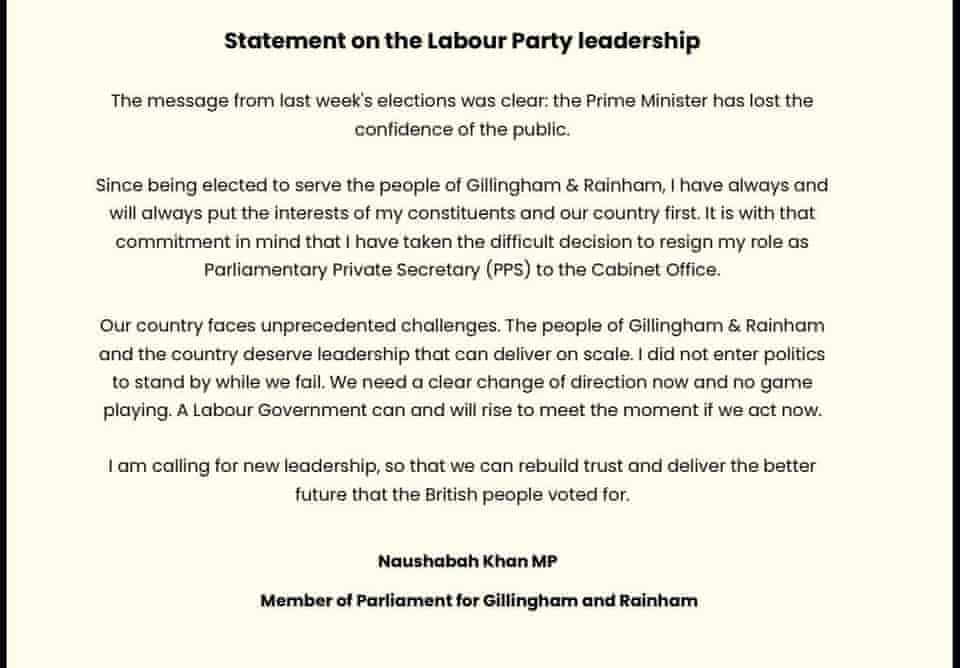
Naushabah Khan also resigned from her government role while declaring that the prime minister had “lost the confidence of the public.”
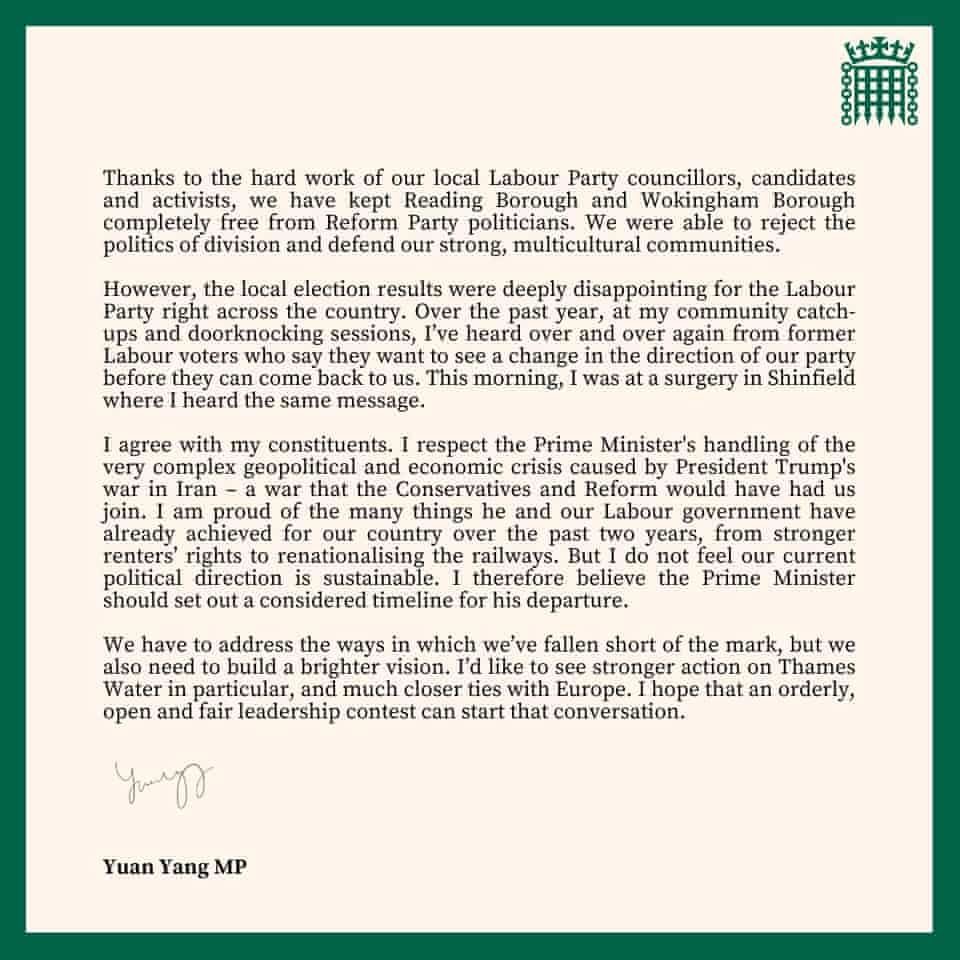
Yuan Yang, another newly elected Labour MP, similarly called for a “considered timeline” for Starmer’s departure.
The scale of coordinated criticism has shocked many political observers because much of it is coming from MPs elected only recently under Starmer’s leadership.
Instead of protecting him, many newer MPs now fear they could lose their seats if Labour enters the next election under a deeply unpopular leader.
Despite the growing rebellion, Starmer still retains support from important figures within Labour.
Culture Secretary Lisa Nandy defended the prime minister and insisted he was showing leadership by confronting criticism directly.
Nandy said Starmer would continue fighting “any system that stands in the way of making people’s lives better.”
Labour chair Anna Turley also backed the prime minister, insisting this was a moment for the party to “step up” rather than “give up.”
Meanwhile, Labour peer Lord Foulkes warned that forcing Starmer out could plunge both the party and country into further instability.
“He won a majority in the last general election and had a mandate to continue,” Foulkes said.
Can Keir Starmer Survive the Growing Revolt?
The political pressure surrounding Downing Street continues to intensify by the hour.
Many MPs now believe Starmer’s authority has been fatally weakened after the local election disaster and the unprecedented scale of rebellion that followed.

With senior figures openly discussing possible successors including Andy Burnham and Angela Rayner, Labour now faces a dangerous internal struggle that could dominate British politics for weeks.
Whether Starmer can survive the revolt may depend on whether he can quickly reconnect with voters and restore confidence among MPs increasingly convinced that his leadership has become an electoral liability.
For now, the Keir Starmer resignation calls continue to grow louder, placing the prime minister under extraordinary pressure at one of the most turbulent moments of his political career.

