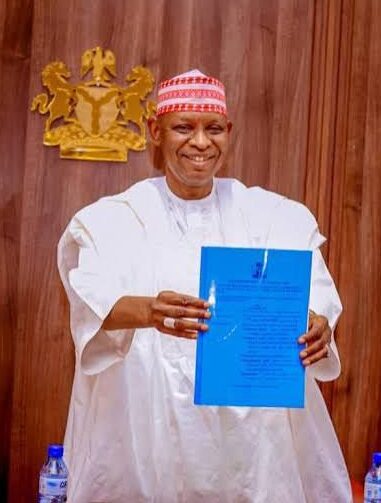
Kano State Governor, Abba Kabir Yusuf, on Wednesday unveiled the 2026 Appropriation Bill, proposing an expenditure plan of N1.37tn aimed at accelerating human development, strengthening public infrastructure, and consolidating ongoing reforms across key sectors of the state’s economy.
Presenting the document to the Kano State House of Assembly, Yusuf described the fiscal proposal as a forward-looking plan designed to consolidate legacy projects while responding directly to citizens’ priorities.
Tagged “Budget of Enabling Growth and Shared Prosperity,” the bill seeks to reinforce the administration’s long-term vision for an inclusive, innovation-driven Kano.
According to a statement issued by his spokesperson, Sunusi Tofa, the proposed budget is structured around 68 per cent capital expenditure and 32 per cent recurrent spending, a ratio that signals the administration’s determination to expand physical and human capital assets across the state.
With N934.6bn earmarked for capital projects and N433.4bn for recurrent obligations, the 2026 fiscal plan represents one of the highest capital allocations in Kano’s recent budgeting history.
New Tax Reforms and Fiscal Outlook Anchored on Growth Targets
As Governor Yusuf presented the fiscal framework, analysts noted that the new tax reforms initiated at the federal and state levels are expected to shape Kano’s revenue outlook in 2026.
The focus keyword—new tax reforms—captures the federal harmonisation of taxes, elimination of multiple levies, and the strengthened internally generated revenue (IGR) system that states like Kano are aligning with.
These new tax reforms are projected to improve transparency, reduce the burden on small businesses, and streamline collections through digital platforms.
For Kano, a state with a robust commercial base and Nigeria’s largest informal market cluster, the reforms hold significant implications for revenue expansion and compliance efficiency.
Government sources indicated that Kano’s 2026 budget assumptions are tied to improved IGR performance, enhanced by the new tax reforms that prioritize broadening the tax net rather than imposing higher rates on existing taxpayers.
This aligns with the governor’s public commitment to ensure that revenue mobilisation does not translate into hardship for low-income earners and small traders.
Education Receives Highest Allocation at N405bn
Education remains the central pillar of the administration’s development strategy.
With N405.3bn, representing 30 per cent of the total budget, the sector receives the highest allocation for the second consecutive year.
Yusuf stressed that the heavy investment is aimed at rebuilding public schools, expanding access to tertiary education, and improving teacher training.
“We are determined to invest in human capital because an educated population is the engine of a progressive society,” he said.
The allocation covers the construction of new classrooms, rehabilitation of dilapidated structures, scholarships for indigent students, digital learning initiatives, and the upgrade of science laboratories.
The budget also expands the state’s school feeding programme and provides more funding for the Girl-Child Education Initiative.
Infrastructure Gets N346bn to Strengthen Urban and Rural Connectivity
Infrastructure development follows with N346.2bn, about 25 per cent of the entire budget.
The governor explained that the funds would be deployed to complete the administration’s legacy road projects, modernise transportation systems, rehabilitate rural access roads, and expand the state’s water supply infrastructure.
In Kano metropolis, several strategic road dualisations, flyovers, and drainage projects will continue into 2026 to ease traffic congestion and enhance urban mobility.
The state will also intensify investments in renewable energy and street lighting to improve safety and boost nighttime commercial activities.
Yusuf stated that infrastructure investments will not only create jobs but will also attract private capital, particularly in the manufacturing and logistics sectors.
Health Sector Receives N212bn for Expanded Services
Health takes the third-largest allocation with N212.2bn, representing 16 per cent of the budget.
This includes funding for renovating primary health centres across all 44 local government areas, improving maternal and child health services, procuring medical equipment, and expanding ambulance services.
The governor reaffirmed his plan to complete ongoing hospital construction projects, expand health insurance coverage, and strengthen disease surveillance systems.
He added that investments in health are essential for promoting productivity and reducing preventable deaths
Agriculture, Security, Water, Commerce, Tourism and Social Inclusion
Beyond the top three sectors, the 2026 budget makes substantial provisions for agriculture, security, youth empowerment, women development, environmental management, tourism promotion, and persons with special needs.
The agriculture component prioritises modern irrigation systems, fertilizer support, and mechanisation schemes.
The security allocation will enhance intelligence gathering, support community policing structures, and bolster emergency response capabilities.
In the social development segment, the budget outlines new programmes for vulnerable groups, job creation initiatives for youths, and expanded empowerment schemes for women entrepreneurs.
A Budget Driven by Citizens’ Priorities
Governor Yusuf emphasised that the 2026 fiscal plan was shaped through extensive consultations, aligning with the administration’s commitment to participatory governance.
He described the Appropriation Bill as “a bold but realistic roadmap” anchored on the needs of citizens and the long-term ambition of building a prosperous Kano.
He urged the House of Assembly to give the proposal timely consideration and passage, stressing that accountability and legislative oversight will be crucial for translating the budget into visible development outcomes.
“We remain committed to transparency and collaboration. Our shared goal is to transform this budget from figures on paper into real, impactful projects for the people of Kano,” he said.
With improving revenue projections driven partly by Nigeria’s new tax reforms, analysts expect Kano’s 2026 budget to be one of the most closely watched in the country, particularly as states increasingly rely on internal financial discipline and innovation to meet development targets.
About The Author