

The Iran-US war has entered a more volatile phase as Donald Trump escalated rhetoric against American allies, warning that the United States could step back from securing the Strait of Hormuz and leave responsibility to nations that rely most on it.
His comments come amid rising fears of wider regional conflict, fresh threats to energy infrastructure, and ongoing military exchanges involving Iran, Israel, and US-linked forces.
Trump’s remarks, posted on social media, questioned why the US should continue to bear the burden of protecting a critical global shipping route when other nations benefit more directly.
The Strait of Hormuz, through which roughly one-fifth of the world’s oil supply passes, has become a central flashpoint after Iran declared it effectively closed, warning that vessels in the area could be targeted.
The US president’s suggestion that Washington might “let them be responsible” for the strait marks a sharp escalation in tensions with allies, particularly members of NATO, whom he accused of failing to support American efforts.
NATO leaders, however, have pushed back, arguing that reopening the strait does not fall under the alliance’s responsibilities.
At the same time, the conflict has widened beyond naval threats. Iran has issued urgent warnings for evacuations at major oil and gas facilities across the Gulf, including sites in Saudi Arabia, the United Arab Emirates, and Qatar.
Iranian state media described these facilities as “legitimate targets,” raising alarm about imminent strikes that could disrupt global energy markets even further.
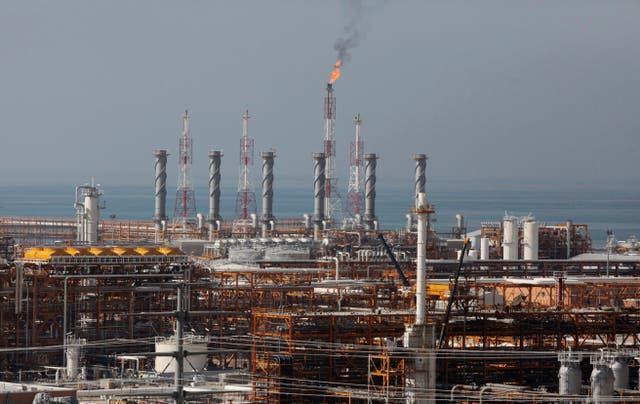
These warnings followed reported Israeli strikes on Iranian-linked energy infrastructure, including the massive South Pars gas field, one of the largest natural gas reserves in the world.
The attack drew condemnation from Qatar, which shares the field through its North Field extension. Officials warned that targeting such infrastructure risks severe consequences not only for regional stability but also for global energy security.
Meanwhile, intelligence assessments from US officials suggest that although Iran’s military capabilities have been degraded by recent operations, the country remains capable of launching significant retaliatory attacks.
Tulsi Gabbard told lawmakers that Iran’s regime is still intact and retains the ability to strike US and allied interests through both direct and proxy forces.
She added that even if weakened, Iran could spend years rebuilding its missile and drone capabilities, indicating that the conflict may have long-term implications beyond the immediate crisis.
According to her assessment, Iran’s nuclear programme had previously suffered major setbacks, but its conventional and asymmetric warfare capabilities remain a concern.
Diplomatic efforts appear limited at this stage. Russia has called for negotiations as the only viable path to restoring safe shipping through the Strait of Hormuz.
Russian officials stressed that military escalation would only deepen the crisis and prolong disruptions to global trade routes.
In Europe, frustration is growing over what some leaders describe as a lack of a coordinated strategy. Rachel Reeves criticised both the US and Israel for failing to anticipate the consequences of Iran’s actions, particularly the closure of the strait. She described the situation as “predictable” and warned that the absence of a clear plan risks worsening economic fallout.
The humanitarian and geopolitical dimensions of the crisis are also expanding. Reports indicate casualties and destruction in parts of Lebanon following Israeli strikes, while tensions continue to spill across borders.
In addition, Iran’s internal actions—including the reported execution of a foreign national—have drawn condemnation from European governments, further isolating Tehran diplomatically.
The conflict has also affected civilian sectors in unexpected ways. Members of Iran’s women’s national football team recently returned home after competing abroad, amid fears they could face repercussions for political expressions.
Their safe return was highlighted by Iranian media as a sign of stability, even as broader tensions continue to mount.
Elsewhere, global leaders are attempting to balance multiple crises. Pedro Sánchez emphasised that the Middle East situation would not divert attention from ongoing support for Ukraine in its conflict with Russia, underscoring how interconnected global security challenges have become.
Trump’s criticism of NATO adds another layer of complexity to the situation. His assertion that the alliance “abandoned” the US has been firmly rejected by European leaders, but it reflects ongoing divisions over burden-sharing and strategic priorities.
Analysts warn that such disagreements could weaken coordinated responses at a time when unity is crucial.
The economic stakes are particularly high. With oil prices already rising sharply due to disruptions in the Strait of Hormuz, any further escalation could trigger global inflationary pressures. Countries heavily dependent on energy imports are especially vulnerable, and markets remain highly sensitive to developments in the region.
The Strait itself is one of the world’s most critical chokepoints, linking the Persian Gulf to the open ocean. Its closure—or even partial disruption—has immediate consequences for global shipping, insurance costs, and supply chains.
Iran’s strategy appears aimed at leveraging this vulnerability to exert pressure on both regional rivals and Western powers.
Despite the heightened rhetoric, questions remain about how far each side is willing to go. While the US has demonstrated its military reach, Trump’s latest comments suggest a potential shift toward reducing direct involvement unless allies contribute more significantly.
This could signal a recalibration of US strategy, though it also risks creating uncertainty among partners.
For Iran, the stakes are equally high. The country faces economic strain, international isolation, and ongoing military pressure.
Yet its willingness to threaten key infrastructure indicates a readiness to escalate in order to defend its strategic interests and deter further attacks.
As the situation develops, the risk of miscalculation remains a major concern.
With multiple actors involved—including regional powers, global superpowers, and non-state groups—the potential for rapid escalation is significant. Diplomatic channels remain open but appear fragile, and any breakthrough will likely require concessions from multiple sides.
Read also: US judge orders VOA reopening, declares shutdown illegal
For now, the Iran-US war continues to evolve with no clear resolution in sight. Trump’s warning over the Strait of Hormuz highlights the growing strain between the US and its allies, while Iran’s threats against energy infrastructure underscore the global implications of the conflict.
As tensions rise, the world watches closely, aware that developments in this కీల region could reshape geopolitical and economic landscapes for years to come.