

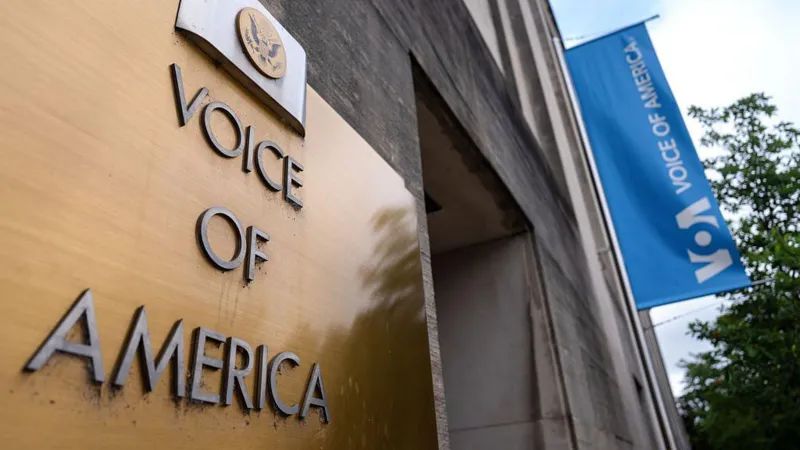
VOA Reopening – A US federal judge has ordered the reopening of the Voice of America (VOA), ruling that the Trump administration’s decision to shut down the global news outlet was unlawful and must be reversed within a week.
The landmark judgment not only restores the broadcaster’s operations but also mandates the reinstatement of hundreds of journalists who were dismissed or placed on leave during the sweeping shutdown.
The ruling represents a significant legal and political blow to Donald Trump, whose administration had argued that restructuring the US-funded media network was necessary to address alleged bias. However, the court found that the actions taken went far beyond reform and instead violated statutory obligations governing the organisation.
District Court Judge Royce Lamberth, who presided over the case, described the shutdown as “arbitrary and capricious,” a legal standard indicating that the government failed to provide a rational basis for its decision.
In his ruling, Lamberth emphasised that federal authorities had ignored key laws that define the mission and structure of VOA, including requirements to broadcast in specific languages and serve audiences in strategically important regions around the world.
The Voice of America was established during World War II as a tool to counter Nazi propaganda and has since evolved into one of the United States’ primary instruments of international broadcasting.
Over the decades, it has built a reputation for delivering news in nearly 50 languages across radio, television, and digital platforms, reaching millions of people globally, particularly in countries with restricted press freedom.
The controversy surrounding its closure began shortly after Trump returned to office. Through an executive order, his administration targeted VOA and other outlets overseen by the US Agency for Global Media (USAGM), including Radio Free Europe/Radio Liberty and Radio Free Asia.
The directive called for these organisations to be reduced or eliminated to the fullest extent permitted by law, citing concerns about political bias and inefficiency.
To implement these changes, Trump appointed Kari Lake to lead USAGM. Her tenure quickly became controversial as she initiated mass layoffs affecting more than 85% of the agency’s workforce.
At VOA alone, more than 1,000 employees were impacted, leaving only a skeleton staff in place. Many journalists were placed on paid administrative leave, effectively silencing the broadcaster while avoiding immediate legal challenges related to termination.
The shutdown had far-reaching consequences beyond the United States. In regions such as Eastern Europe, Asia, and the Middle East, VOA’s absence created a vacuum in independent reporting.
This was particularly evident during periods of heightened geopolitical tension, including conflicts involving Iran and its regional adversaries, where access to reliable information became increasingly critical.
Legal challenges to the shutdown emerged swiftly. Three VOA journalists filed a lawsuit arguing that the administration’s actions violated federal law and undermined the broadcaster’s independence.
Among them was Patsy Widakuswara, who became a prominent voice in defending the organisation’s mission. She and her colleagues contended that VOA’s role is not to serve as a mouthpiece for any administration but to provide accurate, balanced, and comprehensive news to global audiences.
In an earlier stage of the case, Judge Lamberth had already ruled that Kari Lake lacked the authority to suspend USAGM employees because she had not been confirmed by the Senate.
This procedural issue formed a key part of the broader legal argument, highlighting concerns about executive overreach and the circumvention of established checks and balances.
The latest ruling builds on that foundation, going further to declare the entire shutdown unlawful.
Lamberth noted that the administration failed to consider the statutory framework that governs VOA, including provisions designed to protect its editorial independence and ensure continuity of service.
He criticised the lack of a “principled basis” for the decision, suggesting that it was driven more by political considerations than by legitimate policy objectives.
The judge’s order gives the government one week to restore VOA’s operations and reinstate affected staff. While the timeline is tight, it reflects the urgency the court places on re-establishing the broadcaster’s role in global information dissemination. However, it remains uncertain whether the administration will comply immediately or seek to delay the process through an appeal.
The potential for an appeal introduces further complexity. Sarah Rogers, who has been nominated as a successor to Lake and awaits Senate confirmation, could play a role in determining the agency’s next steps. If the ruling is challenged, the case could move to a higher court, prolonging uncertainty for VOA employees and audiences alike.
Beyond the immediate legal implications, the case has reignited a broader debate about press freedom in the United States. Critics of the shutdown argue that dismantling a long-standing international broadcaster undermines America’s credibility as a champion of free speech and independent journalism.
They point to VOA’s historical role in providing uncensored news to audiences living under authoritarian regimes, where state-controlled media often dominates.
Supporters of the administration’s actions, on the other hand, maintain that reforms were necessary to address perceived ideological bias within publicly funded media. They argue that taxpayers should not fund outlets that they believe do not reflect a balanced range of perspectives.
However, the court’s ruling suggests that even if such concerns exist, they must be addressed within the bounds of the law.
The impact of the decision is likely to extend beyond VOA itself. Other US-funded broadcasters under USAGM, including Radio Free Europe/Radio Liberty and Radio Free Asia, may also see their operations stabilised or restored as a result of the judgment.
This could help re-establish a network of international media outlets that have historically played a key role in US foreign policy and public diplomacy.
For VOA journalists, the ruling represents both a legal victory and an opportunity to resume their work. Many have spent months in limbo, uncertain about their professional futures and the fate of the organisation they serve. The court’s decision offers a path forward, though challenges remain in rebuilding operations and regaining audience trust.
The case also underscores the importance of legal safeguards in protecting institutions from abrupt political interference. By enforcing existing laws, the judiciary has reaffirmed the principle that even the executive branch must operate within defined limits, particularly when it comes to organisations with statutory mandates.
As the deadline for compliance approaches, attention will turn to how quickly and effectively VOA can resume its broadcasts. Restarting a global media operation is a complex task, requiring the coordination of personnel, infrastructure, and content across multiple platforms and regions.
In the longer term, the controversy may prompt renewed discussions about the governance of US-funded media and the balance between editorial independence and government oversight. Lawmakers could seek to clarify or strengthen existing statutes to prevent similar disputes in the future.
Read also: USS Gerald R Ford fire: aircraft carrier hit by damage, morale concerns during Iran deployment
Ultimately, the ruling marks a pivotal moment for the Voice of America and its role in the global media landscape. Whether it leads to lasting stability or further legal battles will depend on the actions taken in the coming days by the administration and the courts.
About The Author
