
Sri Lankan authorities confirmed Wednesday that an Iran ship docking request was formally submitted after a US torpedo strike sank the Iranian frigate Iris Dena off the island’s southern coastline, leaving dozens dead and survivors stranded at sea awaiting urgent rescue assistance from naval teams.
Officials said the frigate issued a distress transmission moments after what survivors described as “a sudden impact below deck,” reporting severe flooding, electrical failure, and uncontrollable structural damage before communications abruptly ceased entirely.
The strike occurred in international waters south of Sri Lanka during heightened regional tensions linked to the broader US-Israel war on Iran, significantly escalating maritime security concerns across key commercial shipping corridors overnight.

According to the Sri Lanka Navy, patrol units and coastguard vessels were dispatched immediately after receiving the emergency coordinates transmitted shortly before the vessel disappeared beneath the surface.
By the time first responders reached the location, commanders reported “only a widening oil slick and scattered debris,” with sailors clinging to inflatable life rafts amid strong currents.
Rescue divers and naval crews conducted coordinated search sweeps through darkness and choppy waters, expanding the operation radius to locate additional survivors possibly drifting beyond initial impact zones.
Authorities confirmed that at least six more bodies were recovered Thursday, increasing the verified death toll while identification procedures continued under strict documentation protocols.
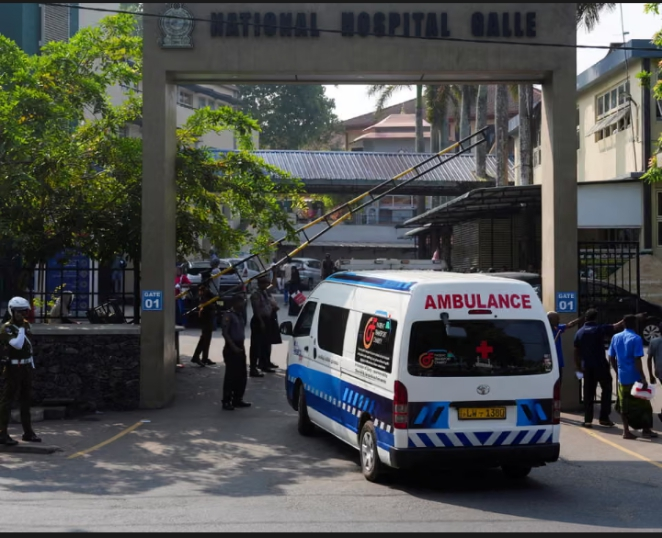
Medical officials in Galle stated that 32 rescued Iranian sailors remained hospitalized, receiving treatment for blast trauma, dehydration, fractures, and prolonged saltwater exposure injuries sustained during evacuation.
Hospital administrators described security around the facility as “heightened but precautionary,” with uniformed police and military personnel restricting unauthorized access to protect survivors and preserve order.
Sri Lanka’s foreign ministry acknowledged receipt of the Iran ship docking request from Iranian diplomatic representatives seeking immediate humanitarian coordination, medical transfers, and logistical access for consular officials.
Tehran’s embassy characterized the docking request as “strictly humanitarian,” emphasizing the need to facilitate repatriation of remains and provide assistance to surviving crew members.
Preparations were underway to transfer the bodies of 87 Iranian sailors to diplomatic custody following forensic verification and completion of required maritime casualty documentation procedures.
Iran’s foreign ministry issued a statement calling the sinking “an unprovoked attack,” demanding clarification and accountability from the United States regarding operational justification.
US defense officials, speaking on background, described the action as “a lawful defensive maritime engagement,” declining to release targeting details or intelligence assessments underpinning the strike.
Security analysts noted that naval confrontations in heavily trafficked waters carry inherent risks of miscalculation, particularly amid rapidly escalating military hostilities across the Middle East.
Shipping monitors confirmed that multiple commercial vessels altered routes temporarily after distress alerts signaled instability near established transit lanes south of Sri Lanka.
Environmental response teams began assessing potential ecological consequences as fuel slicks expanded outward from the sinking site, prompting containment evaluations and coastal monitoring initiatives.
Fishermen operating nearby recounted seeing “a column of dark smoke rising quickly,” followed by visible fragments drifting toward regional fishing grounds hours later.
Maritime law specialists stressed that investigations must determine whether proper identification, communication warnings, and proportional engagement standards were followed before weapons were deployed.
The Iran ship docking request places Colombo in a diplomatically sensitive position, balancing neutrality commitments with humanitarian obligations under international maritime conventions.
Government spokespeople stated Sri Lanka would “extend cooperation consistent with international law,” while ensuring its territorial integrity and port security protocols remain fully enforced.
Defense observers argue that the sinking underscores the expanding naval dimension of regional conflict, where sea lanes increasingly serve as contested strategic spaces.
Survivors interviewed from hospital beds described chaotic final moments onboard, recalling alarms blaring, compartments flooding, and commanders ordering immediate evacuation procedures.
One sailor said the crew received “no prior warning,” while another recounted assisting injured colleagues onto life rafts before the frigate submerged stern-first.
The Iran ship docking request may also affect insurance risk assessments for vessels transiting the Indian Ocean amid rising geopolitical volatility.
Regional diplomats privately expressed concern that further maritime engagements could destabilize trade flows connecting Asia, Europe, and the Middle East.
Sri Lankan officials reiterated that their immediate priority remains search completion, environmental mitigation, and coordination with Iranian authorities for dignified repatriation.

International observers called for a transparent inquiry to establish the precise sequence of events, including targeting authorization and adherence to engagement rules.
The Iran ship docking request continues shaping urgent diplomatic exchanges as both Washington and Tehran maintain sharply contrasting narratives regarding the incident’s legality.
Analysts caution that without de-escalation mechanisms, maritime confrontations could intensify, drawing additional regional actors into increasingly complex naval standoffs.
Read also: Iran Revolutionary Guard strikes US tanker in Gulf as Strait tensions surge
As investigations proceed and families await confirmation, the Iran ship docking request stands at the center of a rapidly evolving maritime crisis with far-reaching geopolitical consequences.
Iran ship docking request,
US torpedo strike, Sri Lanka Navy rescue operation, Iranian sailors repatriation, maritime security investigation